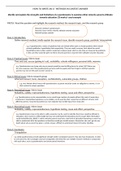
HOW TO WRITE AN A* METHODS IN CONTEXT ANSWER
Identify and explain the strengths and limitations of a questionnaire to examine ethnic minority parents attitudes
towards education (20 marks)- used example
FIRSTLY: Read the question and highlight the research method, the research topic, and the research group
Research method= questionnaire
Research issue= ethnic minority attitude towards education
Research group= parents
Para 1: Introduction
Define research method, briefly explain the research issue, identify research group, positivist/ interpretivist
e.g. A questionnaire a series of questions that can include either open or closed questions which would
provide qualitative/ quantitative data respectively. They are used to uncover facts about the world.
Quantitative data is often coded to make later analysis easier which is why they are favoured by positivists.
In this case they would be given to ethnic minority parents to examine their attitudes towards education.
Para 2: Practical issues- link to issue
Time and cost, access (getting in/ out), availability, schools willingness, personal skills, memory,
e.g. Questionnaires are cheap and easy as parents would be used to filling forms for school. BUT there may
be a low response rate if the questionnaires go home with the pupils who then forget to tell their parents/
parents may not see the point so don’t answer it.
Para 3: Ethical issues- link to research group
Informed consent, harm, deception, confidentiality, vulnerable groups, children
e.g. Very limited ethical issues with questionnaires as parent would be under no obligation to answer, it is in
their control to answer questions
Para 4: Theoretical issues- link to issue
Reliability, validity, representativeness, hypothesis testing, cause and effect, perspective
e.g. Questionnaires can be representative as can reach large numbers of people without the need of researchers
involvement. Standardised questions so are reliable, can be used by other researchers in different schools/ with
different parents. Favoured by positivist as more objective due to little input from researcher
Para 5: Theoretical issues- link to issue
Reliability, validity, representativeness, hypothesis testing, cause and effect, perspective
e.g. Questionnaires may not be able to valid as parents may lie, want to look like they have a positive attitude to
education, don’t want it to reflect badly but may not understand the education process so give false information-
social desirability bias. BAND 5- ethnic minority parents may have a low level of education themselves so won't be
able to understand all of the questions so therefore would give invalid answers. Researcher also can't go into any
depth about why a parent has given a certain answer, difficult to understand impact of teacher labelling.
Para 6: Conclusion
Triangulation
e.g. while questionnaires provide significant strength within sociological research, they also have drawbacks. In order
to overcome this, the sociologist could use triangulation whereby they use multiple research methods in conjunction
with each other, such as questionnaires and unstructured interviews.
Identify and explain the strengths and limitations of a questionnaire to examine ethnic minority parents attitudes
towards education (20 marks)- used example
FIRSTLY: Read the question and highlight the research method, the research topic, and the research group
Research method= questionnaire
Research issue= ethnic minority attitude towards education
Research group= parents
Para 1: Introduction
Define research method, briefly explain the research issue, identify research group, positivist/ interpretivist
e.g. A questionnaire a series of questions that can include either open or closed questions which would
provide qualitative/ quantitative data respectively. They are used to uncover facts about the world.
Quantitative data is often coded to make later analysis easier which is why they are favoured by positivists.
In this case they would be given to ethnic minority parents to examine their attitudes towards education.
Para 2: Practical issues- link to issue
Time and cost, access (getting in/ out), availability, schools willingness, personal skills, memory,
e.g. Questionnaires are cheap and easy as parents would be used to filling forms for school. BUT there may
be a low response rate if the questionnaires go home with the pupils who then forget to tell their parents/
parents may not see the point so don’t answer it.
Para 3: Ethical issues- link to research group
Informed consent, harm, deception, confidentiality, vulnerable groups, children
e.g. Very limited ethical issues with questionnaires as parent would be under no obligation to answer, it is in
their control to answer questions
Para 4: Theoretical issues- link to issue
Reliability, validity, representativeness, hypothesis testing, cause and effect, perspective
e.g. Questionnaires can be representative as can reach large numbers of people without the need of researchers
involvement. Standardised questions so are reliable, can be used by other researchers in different schools/ with
different parents. Favoured by positivist as more objective due to little input from researcher
Para 5: Theoretical issues- link to issue
Reliability, validity, representativeness, hypothesis testing, cause and effect, perspective
e.g. Questionnaires may not be able to valid as parents may lie, want to look like they have a positive attitude to
education, don’t want it to reflect badly but may not understand the education process so give false information-
social desirability bias. BAND 5- ethnic minority parents may have a low level of education themselves so won't be
able to understand all of the questions so therefore would give invalid answers. Researcher also can't go into any
depth about why a parent has given a certain answer, difficult to understand impact of teacher labelling.
Para 6: Conclusion
Triangulation
e.g. while questionnaires provide significant strength within sociological research, they also have drawbacks. In order
to overcome this, the sociologist could use triangulation whereby they use multiple research methods in conjunction
with each other, such as questionnaires and unstructured interviews.