DOWNLOAD RKG INSTITUTE APP & RKG CA CLASSES APP FOR CLASS XI, XII & CA CLASSES ONLINE 1
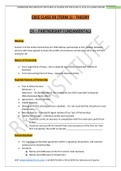
CBSE CLASS XII (TERM 1) - THEORY
CH – PARTNERSHIP FUNDAMENTALS
Meaning
Section 4 of the Indian Partnership Act 1932 defines partnership as the ‘relation between
persons who have agreed to share the profits of a business carried on by all or any of them
acting for all’.
Nature of Partnership
• From Legal Point of View – Not a separate legal entity (Unlimited Liability of
Partners)
• From Accounting Point of View – Separate Business Entity
Essential Features of Partnership
• Two or More Persons:
Minimum – 2
Maximum – 50 [Section 464 of the Companies Act 2013 read with Companies
(Miscellaneous) Rules, 2014]
• Agreement – Oral or Written
• Lawful Business
• Sharing of Profits (sharing of loss is implied) – It is not essential that all partners must
share losses.
• Mutual Agency – Principal & Agent relation (True Test of Partnership)
• Liability of Partners – Unlimited, jointly and severally
1. If partner carries on business in competition with firm and earns profit from
it, then _______________________________________________________
2. If partner earns profit for himself from any transaction of the firm (or from
firm’s property), the profit so earned ______________________________
Partnership Deed
• It is a written partnership agreement which is signed by all partners, and contains
various terms of partnership.
• Contents:
Names and Addresses of the firm and its main business;
Names and Addresses of all partners;
VISIT WWW.RKGINSTITUTE.COM | Call 9650719104 or 9351230704 for Admissions & Queries
, DOWNLOAD RKG INSTITUTE APP & RKG CA CLASSES APP FOR CLASS XI, XII & CA CLASSES ONLINE 2
Amount of capital to be contributed by each partner;
The accounting period of the firm;
The date of commencement of partnership;
Rules regarding operation of Bank Accounts;
Profit and loss sharing ratio;
Rate of interest on capital, loan, drawings, etc;
Mode of auditor’s appointment, if any;
Salaries, commission, etc, if payable to any partner;
The rights, duties and liabilities of each partner;
Treatment of loss arising out of insolvency of one or more partners;
Settlement of accounts on dissolution of the firm;
Method of settlement of disputes among the partners;
Rules to be followed in case of admission, retirement, death of a partner; and
Any other matter relating to the conduct of business.
• Partnership Deed is useful because:
1. It governs the rights, duties and liabilities of each Partner
2. In case of disputes, settlement can be easily made.
• Important provisions of Indian Partnership Act, 1932, if Partnership Deed is silent /
non-existing:
Profit-sharing ratio – Equal
Interest on Capital – not to be allowed
Interest on Drawings – not to be charged
Interest on Loan Advanced by Partner to Firm – allowed @ 6% p.a.
Remuneration to Partner – not to be allowed
Interest on Loan Advanced by Firm to Partner – Not to be charged
• Can Minor become Partner?
_____________________________________________________________________
__________________________.
Interest on Capital
• It is allowed to partners to compensate them for their capital investment
• Two situations in which Interest on Capital is generally allowed:
When profit-sharing ratio is equal but capital contribution is unequal.
When profit-sharing ratio is unequal, but capital contributed by partners are
equal.
VISIT WWW.RKGINSTITUTE.COM | Call 9650719104 or 9351230704 for Admissions & Queries
, DOWNLOAD RKG INSTITUTE APP & RKG CA CLASSES APP FOR CLASS XI, XII & CA CLASSES ONLINE 3
CH – GOODWILL
Meaning
Goodwill is the value of the reputation of a firm in respect of the profits expected in future
over and above the normal profits. It is an intangible asset, which reflects value of
reputation of a business.
Features of Goodwill
1. It is an intangible asset
2. It is not Fictitious asset
3. It helps in earning higher profits.
4. Its value is subjective matter.
Factors Affecting Value of Goodwill
Nature of business
Location of business
Efficiency of management
Market situation (eg: monopoly condition, limited competition)
Quality of goods/services.
Customer relations & loyalty
Special advantages (Import licenses, long term contracts, assured supply of
electricity etc)
Need for Valuation of Goodwill (for a Partnership Firm)
Change in the profit-sharing ratio amongst the existing partners;
Admission of new partner;
Retirement of a partner;
Death of a partner; and
Dissolution of a firm involving sale of business as a going concern.
Amalgamation of partnership firms.
Types of Goodwill
(A) Purchased Goodwill
Goodwill for which an agreed consideration (price) is paid in cash or kind. For eg: at
the time of purchase/acquisition of another business.
VISIT WWW.RKGINSTITUTE.COM | Call 9650719104 or 9351230704 for Admissions & Queries
, DOWNLOAD RKG INSTITUTE APP & RKG CA CLASSES APP FOR CLASS XI, XII & CA CLASSES ONLINE 4
(B) Self-generated Goodwill
It is an internally generated goodwill, for which no separate consideration has been
paid.
Note: As per recognition criteria laid down in AS-26, self-generated goodwill is not
recorded in the Books of Accounts.
VISIT WWW.RKGINSTITUTE.COM | Call 9650719104 or 9351230704 for Admissions & Queries
CBSE CLASS XII (TERM 1) - THEORY
CH – PARTNERSHIP FUNDAMENTALS
Meaning
Section 4 of the Indian Partnership Act 1932 defines partnership as the ‘relation between
persons who have agreed to share the profits of a business carried on by all or any of them
acting for all’.
Nature of Partnership
• From Legal Point of View – Not a separate legal entity (Unlimited Liability of
Partners)
• From Accounting Point of View – Separate Business Entity
Essential Features of Partnership
• Two or More Persons:
Minimum – 2
Maximum – 50 [Section 464 of the Companies Act 2013 read with Companies
(Miscellaneous) Rules, 2014]
• Agreement – Oral or Written
• Lawful Business
• Sharing of Profits (sharing of loss is implied) – It is not essential that all partners must
share losses.
• Mutual Agency – Principal & Agent relation (True Test of Partnership)
• Liability of Partners – Unlimited, jointly and severally
1. If partner carries on business in competition with firm and earns profit from
it, then _______________________________________________________
2. If partner earns profit for himself from any transaction of the firm (or from
firm’s property), the profit so earned ______________________________
Partnership Deed
• It is a written partnership agreement which is signed by all partners, and contains
various terms of partnership.
• Contents:
Names and Addresses of the firm and its main business;
Names and Addresses of all partners;
VISIT WWW.RKGINSTITUTE.COM | Call 9650719104 or 9351230704 for Admissions & Queries
, DOWNLOAD RKG INSTITUTE APP & RKG CA CLASSES APP FOR CLASS XI, XII & CA CLASSES ONLINE 2
Amount of capital to be contributed by each partner;
The accounting period of the firm;
The date of commencement of partnership;
Rules regarding operation of Bank Accounts;
Profit and loss sharing ratio;
Rate of interest on capital, loan, drawings, etc;
Mode of auditor’s appointment, if any;
Salaries, commission, etc, if payable to any partner;
The rights, duties and liabilities of each partner;
Treatment of loss arising out of insolvency of one or more partners;
Settlement of accounts on dissolution of the firm;
Method of settlement of disputes among the partners;
Rules to be followed in case of admission, retirement, death of a partner; and
Any other matter relating to the conduct of business.
• Partnership Deed is useful because:
1. It governs the rights, duties and liabilities of each Partner
2. In case of disputes, settlement can be easily made.
• Important provisions of Indian Partnership Act, 1932, if Partnership Deed is silent /
non-existing:
Profit-sharing ratio – Equal
Interest on Capital – not to be allowed
Interest on Drawings – not to be charged
Interest on Loan Advanced by Partner to Firm – allowed @ 6% p.a.
Remuneration to Partner – not to be allowed
Interest on Loan Advanced by Firm to Partner – Not to be charged
• Can Minor become Partner?
_____________________________________________________________________
__________________________.
Interest on Capital
• It is allowed to partners to compensate them for their capital investment
• Two situations in which Interest on Capital is generally allowed:
When profit-sharing ratio is equal but capital contribution is unequal.
When profit-sharing ratio is unequal, but capital contributed by partners are
equal.
VISIT WWW.RKGINSTITUTE.COM | Call 9650719104 or 9351230704 for Admissions & Queries
, DOWNLOAD RKG INSTITUTE APP & RKG CA CLASSES APP FOR CLASS XI, XII & CA CLASSES ONLINE 3
CH – GOODWILL
Meaning
Goodwill is the value of the reputation of a firm in respect of the profits expected in future
over and above the normal profits. It is an intangible asset, which reflects value of
reputation of a business.
Features of Goodwill
1. It is an intangible asset
2. It is not Fictitious asset
3. It helps in earning higher profits.
4. Its value is subjective matter.
Factors Affecting Value of Goodwill
Nature of business
Location of business
Efficiency of management
Market situation (eg: monopoly condition, limited competition)
Quality of goods/services.
Customer relations & loyalty
Special advantages (Import licenses, long term contracts, assured supply of
electricity etc)
Need for Valuation of Goodwill (for a Partnership Firm)
Change in the profit-sharing ratio amongst the existing partners;
Admission of new partner;
Retirement of a partner;
Death of a partner; and
Dissolution of a firm involving sale of business as a going concern.
Amalgamation of partnership firms.
Types of Goodwill
(A) Purchased Goodwill
Goodwill for which an agreed consideration (price) is paid in cash or kind. For eg: at
the time of purchase/acquisition of another business.
VISIT WWW.RKGINSTITUTE.COM | Call 9650719104 or 9351230704 for Admissions & Queries
, DOWNLOAD RKG INSTITUTE APP & RKG CA CLASSES APP FOR CLASS XI, XII & CA CLASSES ONLINE 4
(B) Self-generated Goodwill
It is an internally generated goodwill, for which no separate consideration has been
paid.
Note: As per recognition criteria laid down in AS-26, self-generated goodwill is not
recorded in the Books of Accounts.
VISIT WWW.RKGINSTITUTE.COM | Call 9650719104 or 9351230704 for Admissions & Queries