Paper 1 - Social Influence
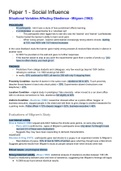
Situational Variables Affecting Obedience - Milgram (1963)
PROCEDURE
- 40 participants - told it was a study of how punishment affects learning
- 2 confederates: an experimenter & a ‘volunteer ppt’
- The participants drew rigged lots to see who was the ‘teacher’ and ‘learner’ (confederate)
- Teacher tested the learner’s ability to learn word pairs
- When wrong answer - teacher administered increasingly strong electric shocks: starting
at 15V, max 450V with 15V interval increases
In the voice feedback study the learner gave mainly wrong answers & received fake shocks in silence in
another room
- At 300V he pounded on the wall and gave no further responses
- If the teacher asked to stop at any point the experimenter gave them a series of prods e.g. “you
have no other choice, you must go on”.
FINDINGS
- Predictions from college students and colleagues: very few would go beyond 150V before
refusing to continue, 1 in 1000 would go full 450V
- In reality, 65% continued to 450V, all went to 300 with only 5 stopping there.
Proximity Condition- teacher & learner in the same room, obedience fell to 40%. Touch proximity
(teacher forced learner’s hand onto shock plate) = 30%. Experimenter absent (instructions over
telephone) = 21%
Location Condition - original study in prestigious Yale university - when moved to a run down office
with no obvious connections to Yale, obedience fell slightly to 48%
Uniform Condition - Bushman (1988): researcher dressed either as a police officer, beggar, or
business executive, stopped people in the street and told them to give change to another researcher for
a parking metre. Police officer = 72% obeyed, beggar = 52%, business executive = 48%
Evaluations of Milgram’s Study
Low internal validity
Orne & Holland (1968) argued ppts didn’t believe the shocks were genine, so were play-acting
- Perry (2013) confirms this - tapes of Milgram’s participants show only about 1/2 thought it was
real and 2/3 of these were disobedient.
- Suggests they may have been responding to demand characteristics.
HOWEVER
Sheridan & King (1972) - participants gave real shocks to a puppy in an experiment similar to Milgram’s
- Real distress of puppy: 54% of men & 100% of women gave what they thought was a fatal shock
Suggests genuine results from Milgram’s study as people obeyed even when shocks were real.
Ethical issues - psychological distress
Strong historical validity - Blass (1999): statistical analysis of obedience studies between 1961-85.
Found no relationship between year and level of obedience, suggesting that Milgram’s findings still apply
● A 2009 study found almost identical results.
, Agentic State & Legitimacy of Authority
AGENTIC STATE = person sees themselves as an agent carrying out another person’s wishes
(particularly authority figure)
Process of agentic shift - moving from an autonomous state (where a person sees themselves as
responsible for their own actions) to the agentic state.
- Milgram interviews asked why ppts continued to give shocks - typical response = “i wouldn't have
done it by myself, i was just doing what i was told” (experimenter).
- Figure has a higher place in the social hierarchy
Explanation for agentic state
= to maintain a positive self-image. Once in the agentic state the action is no longer their responsibility,
and will affect their self-image.
Binding factors - allow the person to minimise the damaging effect of their behaviour e.g. shifting
responsibility to the victim. Also social etiquette - doesn't want to appear rude.
LEGITIMACY OF AUTHORITY = a person who is perceived to be in a position of social control within a
situation. This is the first condition needed for a shift to the agentic state.
Requires an institution if commands are particularly harmful - e.g. the military.
● Milgram: Yale University, although when moved to a run down office there were still relatively
high levels of obedience - so could be the category of institution that causes obedience rather
than its status within that category.
Evaluations of Agentic States & Legitimacy of Authority
Cruelty May Influence Findings
Milgram acknowledged other explanations for the findings. Signs of cruelty were detected among
participants who may have used the situation to express their sadistic impulses.
+ Supported by the SPE: guards inflicted increasing cruelty on prisoners despite no obvious
authority figure instructing them.
+ Adds to ethical issues? Ppts should have been screened better.
So, in some participants, cruelty may have played a role.
Legitimacy of Authority Can Explain Cultural Differences
Studies show countries differ in the degree of obedience to authority
- Kilham & Mann (1974): 16% of Australians went to 450V
- Mantell (1971): 85% of Germans went to 450V
- This reflects the different societal structures & how children are raised to perceive authority
However - cant explain all general differences: some of Milgram’s ppts recognised the authority of the
experimenter and still disobeyed. Suggests innate tendencies to obey / disobey may be more influential.
Research Support For Agentic State
Blass & Schmidt (2001) asked students to watch the original footage and suggest who was responsible
for the ‘harm’ caused to the learner
● They named the experimenter, as they perceived him to be at the top of the hierarchy and,
therefore, had legitimate authority over the situation.
Beta Bias - Milgram only used male participants
Situational Variables Affecting Obedience - Milgram (1963)
PROCEDURE
- 40 participants - told it was a study of how punishment affects learning
- 2 confederates: an experimenter & a ‘volunteer ppt’
- The participants drew rigged lots to see who was the ‘teacher’ and ‘learner’ (confederate)
- Teacher tested the learner’s ability to learn word pairs
- When wrong answer - teacher administered increasingly strong electric shocks: starting
at 15V, max 450V with 15V interval increases
In the voice feedback study the learner gave mainly wrong answers & received fake shocks in silence in
another room
- At 300V he pounded on the wall and gave no further responses
- If the teacher asked to stop at any point the experimenter gave them a series of prods e.g. “you
have no other choice, you must go on”.
FINDINGS
- Predictions from college students and colleagues: very few would go beyond 150V before
refusing to continue, 1 in 1000 would go full 450V
- In reality, 65% continued to 450V, all went to 300 with only 5 stopping there.
Proximity Condition- teacher & learner in the same room, obedience fell to 40%. Touch proximity
(teacher forced learner’s hand onto shock plate) = 30%. Experimenter absent (instructions over
telephone) = 21%
Location Condition - original study in prestigious Yale university - when moved to a run down office
with no obvious connections to Yale, obedience fell slightly to 48%
Uniform Condition - Bushman (1988): researcher dressed either as a police officer, beggar, or
business executive, stopped people in the street and told them to give change to another researcher for
a parking metre. Police officer = 72% obeyed, beggar = 52%, business executive = 48%
Evaluations of Milgram’s Study
Low internal validity
Orne & Holland (1968) argued ppts didn’t believe the shocks were genine, so were play-acting
- Perry (2013) confirms this - tapes of Milgram’s participants show only about 1/2 thought it was
real and 2/3 of these were disobedient.
- Suggests they may have been responding to demand characteristics.
HOWEVER
Sheridan & King (1972) - participants gave real shocks to a puppy in an experiment similar to Milgram’s
- Real distress of puppy: 54% of men & 100% of women gave what they thought was a fatal shock
Suggests genuine results from Milgram’s study as people obeyed even when shocks were real.
Ethical issues - psychological distress
Strong historical validity - Blass (1999): statistical analysis of obedience studies between 1961-85.
Found no relationship between year and level of obedience, suggesting that Milgram’s findings still apply
● A 2009 study found almost identical results.
, Agentic State & Legitimacy of Authority
AGENTIC STATE = person sees themselves as an agent carrying out another person’s wishes
(particularly authority figure)
Process of agentic shift - moving from an autonomous state (where a person sees themselves as
responsible for their own actions) to the agentic state.
- Milgram interviews asked why ppts continued to give shocks - typical response = “i wouldn't have
done it by myself, i was just doing what i was told” (experimenter).
- Figure has a higher place in the social hierarchy
Explanation for agentic state
= to maintain a positive self-image. Once in the agentic state the action is no longer their responsibility,
and will affect their self-image.
Binding factors - allow the person to minimise the damaging effect of their behaviour e.g. shifting
responsibility to the victim. Also social etiquette - doesn't want to appear rude.
LEGITIMACY OF AUTHORITY = a person who is perceived to be in a position of social control within a
situation. This is the first condition needed for a shift to the agentic state.
Requires an institution if commands are particularly harmful - e.g. the military.
● Milgram: Yale University, although when moved to a run down office there were still relatively
high levels of obedience - so could be the category of institution that causes obedience rather
than its status within that category.
Evaluations of Agentic States & Legitimacy of Authority
Cruelty May Influence Findings
Milgram acknowledged other explanations for the findings. Signs of cruelty were detected among
participants who may have used the situation to express their sadistic impulses.
+ Supported by the SPE: guards inflicted increasing cruelty on prisoners despite no obvious
authority figure instructing them.
+ Adds to ethical issues? Ppts should have been screened better.
So, in some participants, cruelty may have played a role.
Legitimacy of Authority Can Explain Cultural Differences
Studies show countries differ in the degree of obedience to authority
- Kilham & Mann (1974): 16% of Australians went to 450V
- Mantell (1971): 85% of Germans went to 450V
- This reflects the different societal structures & how children are raised to perceive authority
However - cant explain all general differences: some of Milgram’s ppts recognised the authority of the
experimenter and still disobeyed. Suggests innate tendencies to obey / disobey may be more influential.
Research Support For Agentic State
Blass & Schmidt (2001) asked students to watch the original footage and suggest who was responsible
for the ‘harm’ caused to the learner
● They named the experimenter, as they perceived him to be at the top of the hierarchy and,
therefore, had legitimate authority over the situation.
Beta Bias - Milgram only used male participants