Research Methods Notes
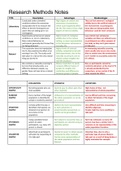
TYPE Description Advantages Disadvantages
Conducted under controlled High degree of control over They can lack external / ecological
conditions where the researcher extraneous circumstances validity due to the artificial nature of
Laboratory manipulates the IV to measure the which could negatively affect the environment. As participants
effect on the DV. Participants are the DV. This means it has a high know they are being studied, their
aware they are taking part in an degree of internal validity. behaviour could be more unnatural.
investigation.
Experiments carried out in natural Higher levels of ecological Less control over extraneous
conditions, ie. not in a laboratory. validity due to the natural variables and there are ethical issues
Field More natural behaviour as setting, so more representative as participants are often unaware of
participants generally don't know they of the behaviour witnessed in the study so they can't give consent
are being observed. everyday life. to take part.
The researcher does not manipulate Higher levels of external An interesting naturally occurring
the IV, they examine the effect of an validity, compared to lab and event usually only occurs very rarely.
Natural existing IV on a DV. The study could field experiments, due to the Also no control over the environment
take place in a lab as the only natural naturally occuring IV, and so so it’s harder to accurately assess the
thing can be the IV. obtains unique insights into IV's effects.
real-life situations.
Also contains a naturally occuring IV, Allows researchers to easily Bias, as participants cannot be
but one that already exists, as a compare different types of randomly allocated, so the level of IV
Quasi difference between people, e.g. people for insights into is already predecided by the
gender Does not have to be a natural similarities and differences researchers, so less certain if the IV
setting. between groups of people. alone caused the effect.
EXPLANATION STRENGTHS LIMITATIONS
OPPORTUNITY Recruiting people who are Quick & easy to obtain ppts than High chance of bias - not
SAMPLE most available other methods representative of whole population
RANDOM Every member of the target Unbiased as it is representative of Can be difficult and time consuming
SAMPLE population is identified & the whole population so can be to obtain full details of the target
sample is randomly selected generalised population.
A strata within the pop. is Likely to be more representative Very difficult and time consuming to
STRATIFIED identified. Participants are as each subsection is identify subgroups.
SAMPLE obtained in proportion to proportionally represented, so People might be more unwilling to
occurrence in the results can be generalised. take part.
population.
Using a predetermined Not subject to researcher bias, as Not truly unbiased, as every nth
SYSTEMATIC system to select participants are selected using an person may have a similar trait in
SAMPLE participants, e.g. every nth objective system. common so not representative of the
person is chosen wider population therefore.
Advertised so participants Quicker & easier to obtain people Volunteer bias, due to only a
VOLUNTEER self-select by responding to compared to other methods. particular type of person likely to
SAMPLE it to take part. Can be more representative of take part as a result of being broke or
the whole population and less highly motivated for example.
biassed.
, Self-Report Techniques
Open Question Questionnaires
● Allow participants to answer however they wish, generating qualitative data
● Less chance of researcher bias, especially if anonymous
● But participants may answer in a socially desirable way, so these questionnaires can lack
validity
Closed Question Questionnaires
● Restrict the participant to a predetermined set of responses, generating quantitative data e.g.
checklists
● Data is easier to analyse and find trends, due to its quantitative format
● However, could produce a response bias if the participant doesn’t take the time to read all
the answers properly so can lack internal validity.
Structured Interviews
● Questions decided in advance, asked in exactly the same order for each participant, using an
interview schedule
● The questions are standardised, so can easily be repeated & answers are easier to
compare.
● Comparability may be a problem if the same interviewer behaves differently in different
interviews or different interviewers behave differently (low reliability)
WRITING GOOD QUESTIONS
Clarity - clear questions that the reader can understand, with no ambiguity i.e. no double negatives
Bias - leading questions may result in participants giving a particular answer + social desirability bias
Analysis - open questions are harder to analyse due to qualitative data
Filler Questions - can reduce demand characteristics
Sequence - start with easy ones in case participants are anxious
Pilot Questionnaire - test on a small group of people to see if questions need to be refined
Content Analysis & Thematic Analysis
= quantifying qualitative data, a systematic research technique for analysing items
Instead of observing actual people, a researcher makes observations through books, films,
advertisements, and photographs. The researcher has to decide the following:
Sampling method
● Does the researcher look at every page of a book, or (e.g.) every 5th page?
● If comparing the content in various books, does the researcher select books randomly?
● If analysing ads on TV, does the researcher sample behaviours, say, every 30 seconds, and note
every time the behaviour occurs.
Coding the data
The researcher uses behavioural categories, possibly selected using thematic analysis.
Methods of representing data
Data can be recorded in each behavioural category in two different ways:
- You can count instances = a quantitative analysis
- You can describe examples in each category = a qualitative analysis
TYPE Description Advantages Disadvantages
Conducted under controlled High degree of control over They can lack external / ecological
conditions where the researcher extraneous circumstances validity due to the artificial nature of
Laboratory manipulates the IV to measure the which could negatively affect the environment. As participants
effect on the DV. Participants are the DV. This means it has a high know they are being studied, their
aware they are taking part in an degree of internal validity. behaviour could be more unnatural.
investigation.
Experiments carried out in natural Higher levels of ecological Less control over extraneous
conditions, ie. not in a laboratory. validity due to the natural variables and there are ethical issues
Field More natural behaviour as setting, so more representative as participants are often unaware of
participants generally don't know they of the behaviour witnessed in the study so they can't give consent
are being observed. everyday life. to take part.
The researcher does not manipulate Higher levels of external An interesting naturally occurring
the IV, they examine the effect of an validity, compared to lab and event usually only occurs very rarely.
Natural existing IV on a DV. The study could field experiments, due to the Also no control over the environment
take place in a lab as the only natural naturally occuring IV, and so so it’s harder to accurately assess the
thing can be the IV. obtains unique insights into IV's effects.
real-life situations.
Also contains a naturally occuring IV, Allows researchers to easily Bias, as participants cannot be
but one that already exists, as a compare different types of randomly allocated, so the level of IV
Quasi difference between people, e.g. people for insights into is already predecided by the
gender Does not have to be a natural similarities and differences researchers, so less certain if the IV
setting. between groups of people. alone caused the effect.
EXPLANATION STRENGTHS LIMITATIONS
OPPORTUNITY Recruiting people who are Quick & easy to obtain ppts than High chance of bias - not
SAMPLE most available other methods representative of whole population
RANDOM Every member of the target Unbiased as it is representative of Can be difficult and time consuming
SAMPLE population is identified & the whole population so can be to obtain full details of the target
sample is randomly selected generalised population.
A strata within the pop. is Likely to be more representative Very difficult and time consuming to
STRATIFIED identified. Participants are as each subsection is identify subgroups.
SAMPLE obtained in proportion to proportionally represented, so People might be more unwilling to
occurrence in the results can be generalised. take part.
population.
Using a predetermined Not subject to researcher bias, as Not truly unbiased, as every nth
SYSTEMATIC system to select participants are selected using an person may have a similar trait in
SAMPLE participants, e.g. every nth objective system. common so not representative of the
person is chosen wider population therefore.
Advertised so participants Quicker & easier to obtain people Volunteer bias, due to only a
VOLUNTEER self-select by responding to compared to other methods. particular type of person likely to
SAMPLE it to take part. Can be more representative of take part as a result of being broke or
the whole population and less highly motivated for example.
biassed.
, Self-Report Techniques
Open Question Questionnaires
● Allow participants to answer however they wish, generating qualitative data
● Less chance of researcher bias, especially if anonymous
● But participants may answer in a socially desirable way, so these questionnaires can lack
validity
Closed Question Questionnaires
● Restrict the participant to a predetermined set of responses, generating quantitative data e.g.
checklists
● Data is easier to analyse and find trends, due to its quantitative format
● However, could produce a response bias if the participant doesn’t take the time to read all
the answers properly so can lack internal validity.
Structured Interviews
● Questions decided in advance, asked in exactly the same order for each participant, using an
interview schedule
● The questions are standardised, so can easily be repeated & answers are easier to
compare.
● Comparability may be a problem if the same interviewer behaves differently in different
interviews or different interviewers behave differently (low reliability)
WRITING GOOD QUESTIONS
Clarity - clear questions that the reader can understand, with no ambiguity i.e. no double negatives
Bias - leading questions may result in participants giving a particular answer + social desirability bias
Analysis - open questions are harder to analyse due to qualitative data
Filler Questions - can reduce demand characteristics
Sequence - start with easy ones in case participants are anxious
Pilot Questionnaire - test on a small group of people to see if questions need to be refined
Content Analysis & Thematic Analysis
= quantifying qualitative data, a systematic research technique for analysing items
Instead of observing actual people, a researcher makes observations through books, films,
advertisements, and photographs. The researcher has to decide the following:
Sampling method
● Does the researcher look at every page of a book, or (e.g.) every 5th page?
● If comparing the content in various books, does the researcher select books randomly?
● If analysing ads on TV, does the researcher sample behaviours, say, every 30 seconds, and note
every time the behaviour occurs.
Coding the data
The researcher uses behavioural categories, possibly selected using thematic analysis.
Methods of representing data
Data can be recorded in each behavioural category in two different ways:
- You can count instances = a quantitative analysis
- You can describe examples in each category = a qualitative analysis