Types of Conformity
A01 - KNOWLEDGE A03 - EVALUATION
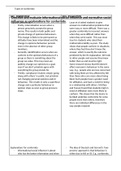
Describe and evaluate informational social influence and normative social
influence
Types as explanations for conformity - Lucas et al asked students to give
of conformity;
- Firstly, internalisation occurs when a answers to mathematical problems that
person genuinely accepts the group were easy or more difficult. There was a
norms. This results in both public and greater conformity to incorrect answers
private change of opinions/behaviours. when they were difficult rather than
This change is likely to be permanent as when they were easier. This was most
attitudes have been internalised and the true for students who rated their
change in opinions/behaviour persists mathematical ability as poor. The study
even in the absence of other group shows that people conform in situations
members. where they feel they don't know the
- Secondly, identification occurs when we answer, which is exactly the outcome
conform to the opinions/behaviours of a predicted by the ISI explanation. We look
group as there is something about the to other people and assume they know
group we value. This may mean we better than us and must be right.
publicly change our opinions to a goal, - Some research shows that NSI doesn't
even if we don't privately agree with affect everyone's behaviour in the same
everything the group stands for. way. E.g., people who are less concerned
- Thirdly, compliance involves simply 'going with being liked are less affected by NSI
along with others' in public, but privately than those who care more about being
not changing personal opinions and/or liked. Such people have a greater need
behaviour. This results in only a superficial for affiliation, and have a need for being
change and a particular behaviour or in a relationship with others. McGhee
opinion stops as soon as group pressure and Teevan found that students high in
stops. need of affiliation were more likely to
conform. This shows that the desire to
be liked underlies conformity for some
people more than others, therefore
there are individual differences in the
way people respond.
Explanations for conformity - The idea of Deutsch and Gerrard's 'two-
- Informational social influence is about process' approach is that behaviour is
who has the better information and when either due to NSI or ISI. E.g., conformity
A01 - KNOWLEDGE A03 - EVALUATION
Describe and evaluate informational social influence and normative social
influence
Types as explanations for conformity - Lucas et al asked students to give
of conformity;
- Firstly, internalisation occurs when a answers to mathematical problems that
person genuinely accepts the group were easy or more difficult. There was a
norms. This results in both public and greater conformity to incorrect answers
private change of opinions/behaviours. when they were difficult rather than
This change is likely to be permanent as when they were easier. This was most
attitudes have been internalised and the true for students who rated their
change in opinions/behaviour persists mathematical ability as poor. The study
even in the absence of other group shows that people conform in situations
members. where they feel they don't know the
- Secondly, identification occurs when we answer, which is exactly the outcome
conform to the opinions/behaviours of a predicted by the ISI explanation. We look
group as there is something about the to other people and assume they know
group we value. This may mean we better than us and must be right.
publicly change our opinions to a goal, - Some research shows that NSI doesn't
even if we don't privately agree with affect everyone's behaviour in the same
everything the group stands for. way. E.g., people who are less concerned
- Thirdly, compliance involves simply 'going with being liked are less affected by NSI
along with others' in public, but privately than those who care more about being
not changing personal opinions and/or liked. Such people have a greater need
behaviour. This results in only a superficial for affiliation, and have a need for being
change and a particular behaviour or in a relationship with others. McGhee
opinion stops as soon as group pressure and Teevan found that students high in
stops. need of affiliation were more likely to
conform. This shows that the desire to
be liked underlies conformity for some
people more than others, therefore
there are individual differences in the
way people respond.
Explanations for conformity - The idea of Deutsch and Gerrard's 'two-
- Informational social influence is about process' approach is that behaviour is
who has the better information and when either due to NSI or ISI. E.g., conformity