BIOCHEMISTRY – LECTURE 8 PART 2
electron transport chain
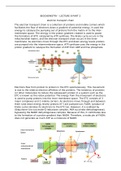
The electron transport chain is a collection of proteins and mobile carriers which
facilitates the flow of electrons down a gradient of potential energy. It used the
energy to catalyse the pumping out of protons from the matrix in to the inter-
membrane space. The energy in the proton gradient created is used to power
the formation of ATP, catalysed by ATP synthase. The Krebs cycle occurs in the
mitochondrial matrix, and the electron transport chain occurs in the inner
membrane. As electrons move through the ETC and down energy levels protons
are pumped into the intermembrane space. ATP synthase uses the energy in the
proton gradient to catalyse the formation of ATP from ADP and free phosphate.
Electrons flow from protein to protein in the ETC spontaneously. This movement
is due to the relative electron affinities of the proteins. The tendency of proteins
(or other molecules) to reduce the subsequent protein in a system such as the
ETC is known as the redox potential. The energy from the movement of electrons
is used to pump protons into the inner membrane space. The ETC consists of 3
major complexes and 2 mobile carriers. As electrons move through and between
them (and down energy levels) protons (H +) are pumped out. FADH2 (product of
Krebs cycle) donates its electrons to the ETC too. However, it is oxidised by
Ubiquinone (via succinate-Q reductase complex, AKA succinate dehydrogenase),
bypassing the NADH dehydrogenase complex. Because of this, it contributes less
to the formation of a proton gradient than NADH. Therefore, a molecule of FADH 2
does not generate as much ATP as a molecule of NADH.
electron transport chain
The electron transport chain is a collection of proteins and mobile carriers which
facilitates the flow of electrons down a gradient of potential energy. It used the
energy to catalyse the pumping out of protons from the matrix in to the inter-
membrane space. The energy in the proton gradient created is used to power
the formation of ATP, catalysed by ATP synthase. The Krebs cycle occurs in the
mitochondrial matrix, and the electron transport chain occurs in the inner
membrane. As electrons move through the ETC and down energy levels protons
are pumped into the intermembrane space. ATP synthase uses the energy in the
proton gradient to catalyse the formation of ATP from ADP and free phosphate.
Electrons flow from protein to protein in the ETC spontaneously. This movement
is due to the relative electron affinities of the proteins. The tendency of proteins
(or other molecules) to reduce the subsequent protein in a system such as the
ETC is known as the redox potential. The energy from the movement of electrons
is used to pump protons into the inner membrane space. The ETC consists of 3
major complexes and 2 mobile carriers. As electrons move through and between
them (and down energy levels) protons (H +) are pumped out. FADH2 (product of
Krebs cycle) donates its electrons to the ETC too. However, it is oxidised by
Ubiquinone (via succinate-Q reductase complex, AKA succinate dehydrogenase),
bypassing the NADH dehydrogenase complex. Because of this, it contributes less
to the formation of a proton gradient than NADH. Therefore, a molecule of FADH 2
does not generate as much ATP as a molecule of NADH.