Plants – Vegetative Structural Diversity: Roots & Shoots
Plants and climate change:
Colonisation of land by plants could be responsible for both an ice
age and a mass extinction event, due to increased photosynthesis
(removal of CO2 and production of oxygen).
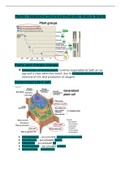
Generalised plant cell:
Chromoplasts – accumulate coloured compounds
Amyloplasts – accumulate starch
Elaioplasts – accumulate fat
Proteinoplasts – accumulate protein
Gerontoplast – senescence
, Cell wall: an extra-cellular structure that maintains the shape of the
cells but also provides structural strength that permits the plant as a
whole to withstand the force of gravity. Thicker than the plasma
membrane. Consists of cellulose microfibrils embedded in a matrix
of polysaccharides and proteins.
A developing plant cell secretes a thin flexible primary cell wall,
which thickens and strengthens with development.
Between the primary cell walls of adjacent cells is the middle
lamella, which is made of pectins – polysaccharides that act as a
‘glue’, holding cells together and strengthening them.
Some cells secrete a secondary cell wall between the plasma
membrane and primary cell wall for further strengthening. E.g. in
wood
Plasmodesmata perforate cell walls and provide channels for inter-
cellular communication.
Plant cell types:
Cellular differentiation
Major cell types:
- Parenchyma
- Collenchyma
- Sclerenchyma
- Water-conducting cells of xylem
- Sugar-conducting cells of phloem
Parenchyma cells:
- Have thin and flexible primary cell walls
- Lack secondary cell walls
- Are the least specialised
- Perform most metabolic functions: photosynthetic leaf cells,
storage cells
- Retain the ability to divide and differentiate
Collenchyma cells:
- Grouped in strands and help support young parts of the plant
shoot
- Have thicker and more uneven cell walls than parenchyma
- Lack secondary walls
- Provide flexible support witout restraining growth
- Alive at maturity
- e.g. bundles of collenchyma cells found near the surface of
celelary stalks: the ‘strings’ in celery stalks
Schlerenchyma cells:
- Are rigid because of thick secondary walls stengtheend by lignin
(hydrophobic – impermeable to water)
- Dead at functional maturity: cell walls are so thick that at maturity,
the cell is completely cut off from the extracellular environment and
Plants and climate change:
Colonisation of land by plants could be responsible for both an ice
age and a mass extinction event, due to increased photosynthesis
(removal of CO2 and production of oxygen).
Generalised plant cell:
Chromoplasts – accumulate coloured compounds
Amyloplasts – accumulate starch
Elaioplasts – accumulate fat
Proteinoplasts – accumulate protein
Gerontoplast – senescence
, Cell wall: an extra-cellular structure that maintains the shape of the
cells but also provides structural strength that permits the plant as a
whole to withstand the force of gravity. Thicker than the plasma
membrane. Consists of cellulose microfibrils embedded in a matrix
of polysaccharides and proteins.
A developing plant cell secretes a thin flexible primary cell wall,
which thickens and strengthens with development.
Between the primary cell walls of adjacent cells is the middle
lamella, which is made of pectins – polysaccharides that act as a
‘glue’, holding cells together and strengthening them.
Some cells secrete a secondary cell wall between the plasma
membrane and primary cell wall for further strengthening. E.g. in
wood
Plasmodesmata perforate cell walls and provide channels for inter-
cellular communication.
Plant cell types:
Cellular differentiation
Major cell types:
- Parenchyma
- Collenchyma
- Sclerenchyma
- Water-conducting cells of xylem
- Sugar-conducting cells of phloem
Parenchyma cells:
- Have thin and flexible primary cell walls
- Lack secondary cell walls
- Are the least specialised
- Perform most metabolic functions: photosynthetic leaf cells,
storage cells
- Retain the ability to divide and differentiate
Collenchyma cells:
- Grouped in strands and help support young parts of the plant
shoot
- Have thicker and more uneven cell walls than parenchyma
- Lack secondary walls
- Provide flexible support witout restraining growth
- Alive at maturity
- e.g. bundles of collenchyma cells found near the surface of
celelary stalks: the ‘strings’ in celery stalks
Schlerenchyma cells:
- Are rigid because of thick secondary walls stengtheend by lignin
(hydrophobic – impermeable to water)
- Dead at functional maturity: cell walls are so thick that at maturity,
the cell is completely cut off from the extracellular environment and