Vegetative Structural Diversity: Leaves & Photosynthetic
Pathways
Leaf Anatomy:
The leaf is the most diverse and specialised plant organ. Site of photosynthesis,
gas exchange and transpiration. Traps light energy, splits water, fixes CO 2 and
synthesises sugars.
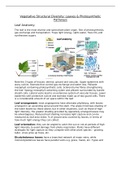
Note the 3 types of tissues: dermal, ground and vascular. Upper epidermis with
waxy cuticle, Stomata that control gas exchange and water loss. Palisade
mesophyll containing photosynthetic cells. Sclerenchyma fibres strengthening
the leaf. Spongy mesophyll containing xylem and phloem surrounded by bundle
sheath cells. Lateral veins lead to an extensive system of vascular tissues. Lower
epidermis with protective cuticle and stomata made up of two guard cells. There
is a considerable amount of air space within the leaf.
Leaf arrangement: most angiosperms have alternate phyllotaxy, with leaves
arranged in an ascending spiral around the stem. The angle minimises shading of
the lower leaves by those above, but in other situations, such as those of high
light intensity, the greater shading provided by oppositely arranged leaves may
be advantageous. Reduced leaf shading increases light capture and can be
measured as leaf area index: % of ground area covered by leaves, in terms of
how much light energy they can collect.
Leaf orientation: they can be angled to catch the sun or not at periods of high
light intensity to avoid damage from photo-respiration. Plants have different
strategies for light capture as they compete with other plant species – growing
taller, vines grow up trees, etc.
Dicotyledonous leaves have a branched network of major veins, while
monocotyledonous leaves have parallel veins e.g. grass, maize, etc. Types and
, shapes of dicotyledonous leaves:
Modified leaves: some species have leaves that are adapted to perform
additional functions. E.g. tendrils, spines (stem photosynthesises), storage
leaves, reproductive leaces (fall off & grow into a new plant) and bracts.
Photosynthesis:
Photosynthesis: the conversion of solar energy to chemical energy. Carried out
by photoautotrophs (autotrophs make their own energy, heterotrophs gain
energy from elsewhere). Occurs in plants, algae, some protists and prokaryotes –
these organisms feed not only themselves but also most of the living world.
Photosynthesis takes place in the chloroplasts in the leaf cells.
Leaf: note the mesophyll cells containing chloroplasts, the vein containing the
xylem that transports the water necessary for photosynthesis, the phloem that
transports sugars, and the stomata that permit CO 2 entry and O2 exit.
The chloroplast is a 3 membrane structure with stacked thylakoids within a
double membrane. The thylakoids contain the chlorophyll for trapping light, the
various membranes are required for electron transport, and organic synthesis
occurs in the stroma.
Redox process: there are 2 parts to photosynthesis – the trapping of light
energy and its conversion to chemical energy, and using that energy to split
water, and electrons being transferred with hydrogen ions from water to carbon
Pathways
Leaf Anatomy:
The leaf is the most diverse and specialised plant organ. Site of photosynthesis,
gas exchange and transpiration. Traps light energy, splits water, fixes CO 2 and
synthesises sugars.
Note the 3 types of tissues: dermal, ground and vascular. Upper epidermis with
waxy cuticle, Stomata that control gas exchange and water loss. Palisade
mesophyll containing photosynthetic cells. Sclerenchyma fibres strengthening
the leaf. Spongy mesophyll containing xylem and phloem surrounded by bundle
sheath cells. Lateral veins lead to an extensive system of vascular tissues. Lower
epidermis with protective cuticle and stomata made up of two guard cells. There
is a considerable amount of air space within the leaf.
Leaf arrangement: most angiosperms have alternate phyllotaxy, with leaves
arranged in an ascending spiral around the stem. The angle minimises shading of
the lower leaves by those above, but in other situations, such as those of high
light intensity, the greater shading provided by oppositely arranged leaves may
be advantageous. Reduced leaf shading increases light capture and can be
measured as leaf area index: % of ground area covered by leaves, in terms of
how much light energy they can collect.
Leaf orientation: they can be angled to catch the sun or not at periods of high
light intensity to avoid damage from photo-respiration. Plants have different
strategies for light capture as they compete with other plant species – growing
taller, vines grow up trees, etc.
Dicotyledonous leaves have a branched network of major veins, while
monocotyledonous leaves have parallel veins e.g. grass, maize, etc. Types and
, shapes of dicotyledonous leaves:
Modified leaves: some species have leaves that are adapted to perform
additional functions. E.g. tendrils, spines (stem photosynthesises), storage
leaves, reproductive leaces (fall off & grow into a new plant) and bracts.
Photosynthesis:
Photosynthesis: the conversion of solar energy to chemical energy. Carried out
by photoautotrophs (autotrophs make their own energy, heterotrophs gain
energy from elsewhere). Occurs in plants, algae, some protists and prokaryotes –
these organisms feed not only themselves but also most of the living world.
Photosynthesis takes place in the chloroplasts in the leaf cells.
Leaf: note the mesophyll cells containing chloroplasts, the vein containing the
xylem that transports the water necessary for photosynthesis, the phloem that
transports sugars, and the stomata that permit CO 2 entry and O2 exit.
The chloroplast is a 3 membrane structure with stacked thylakoids within a
double membrane. The thylakoids contain the chlorophyll for trapping light, the
various membranes are required for electron transport, and organic synthesis
occurs in the stroma.
Redox process: there are 2 parts to photosynthesis – the trapping of light
energy and its conversion to chemical energy, and using that energy to split
water, and electrons being transferred with hydrogen ions from water to carbon