Edexcel A level Geography Unit 3 Topic 5 : The Water Cycle and Water Insecurity
Enquiry Question 1: What are the processes operating within the hydrological cycle from global to
local scale?
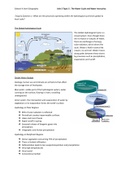
The Global Hydrological Cycle
The Global Hydrological Cycle is a
closed system. Even though there
are no inputs or outputs of water,
there are exchanges of energy-
solar radiation, which drives the
cycle. Water is held in stores like
oceans, ice and soil. Water moves
along paths between these stores
by processes such as precipitation,
evaporation and runoff.
Global Water Budget
Geology, human use and climate are all factors that affect
the storage time of freshwater.
Blue water- visible part of the hydrological system, water
running on the surface, flowing in rivers, travelling
underground.
Green water- the interception and evaporation of water by
vegetation or its evaporation forms the earth’s surface.
Hydrology in Polar Regions
➔ 85% of solar radiation is reflected
➔ Permafrost creates impermeable surfaces
➔ Lakes and rivers freeze
➔ Rapid runoff in spring
➔ Seasonal release of biogenic gases into
atmosphere
➔ Orographic and frontal precipitation
Hydrology in Rainforest Regions
➔ Dense vegetation consuming 75% of precipitation
➔ There is limited infiltration
➔ Deforestation leads to less evapotranspiration and precipitation
➔ Very high temperatures
➔ Very humid
➔ Convectional rainfall
, Edexcel A level Geography Unit 3 Topic 5 : The Water Cycle and Water Insecurity
Types of Rainfall
Convectional
➔ Typical of eastern and south-eastern
parts of the UK in the summer during
periods of high temperatures
➔ The rainfall created is often intense
and associated with electrical storms
and thunder
➔ The morning heat warms the ground,
which in turn heats low-level
moisture. This moisture evaporates
and rises. As the air rises, it cools and
the moisture within will condense, to
form rain and in turn rainfall
Frontal
➔ Brings most rain to the UK over the
course of a year
➔ Fronts are formed as part of a low
pressure area (depression), when warmer moist
air from the south-west meets colder polar air
from the north or north-west
➔ The warmer air from the south-west is
forced to rise over the denser colder air forming
rain along both warm and cold fronts
Orographic/ relief
➔ The western side of the UK receives
the highest rainfall totals, especially in
autumn and winter
➔ Warmer. Moist Atlantic air from the
south-west is forced to rise as it
reaches the western uplands
➔ As it rises, it cools over the high
ground producing heavy rain over the
western and northern parts of the UK
Enquiry Question 1: What are the processes operating within the hydrological cycle from global to
local scale?
The Global Hydrological Cycle
The Global Hydrological Cycle is a
closed system. Even though there
are no inputs or outputs of water,
there are exchanges of energy-
solar radiation, which drives the
cycle. Water is held in stores like
oceans, ice and soil. Water moves
along paths between these stores
by processes such as precipitation,
evaporation and runoff.
Global Water Budget
Geology, human use and climate are all factors that affect
the storage time of freshwater.
Blue water- visible part of the hydrological system, water
running on the surface, flowing in rivers, travelling
underground.
Green water- the interception and evaporation of water by
vegetation or its evaporation forms the earth’s surface.
Hydrology in Polar Regions
➔ 85% of solar radiation is reflected
➔ Permafrost creates impermeable surfaces
➔ Lakes and rivers freeze
➔ Rapid runoff in spring
➔ Seasonal release of biogenic gases into
atmosphere
➔ Orographic and frontal precipitation
Hydrology in Rainforest Regions
➔ Dense vegetation consuming 75% of precipitation
➔ There is limited infiltration
➔ Deforestation leads to less evapotranspiration and precipitation
➔ Very high temperatures
➔ Very humid
➔ Convectional rainfall
, Edexcel A level Geography Unit 3 Topic 5 : The Water Cycle and Water Insecurity
Types of Rainfall
Convectional
➔ Typical of eastern and south-eastern
parts of the UK in the summer during
periods of high temperatures
➔ The rainfall created is often intense
and associated with electrical storms
and thunder
➔ The morning heat warms the ground,
which in turn heats low-level
moisture. This moisture evaporates
and rises. As the air rises, it cools and
the moisture within will condense, to
form rain and in turn rainfall
Frontal
➔ Brings most rain to the UK over the
course of a year
➔ Fronts are formed as part of a low
pressure area (depression), when warmer moist
air from the south-west meets colder polar air
from the north or north-west
➔ The warmer air from the south-west is
forced to rise over the denser colder air forming
rain along both warm and cold fronts
Orographic/ relief
➔ The western side of the UK receives
the highest rainfall totals, especially in
autumn and winter
➔ Warmer. Moist Atlantic air from the
south-west is forced to rise as it
reaches the western uplands
➔ As it rises, it cools over the high
ground producing heavy rain over the
western and northern parts of the UK