CITI Certification Questions and
Answers latest Graded A+
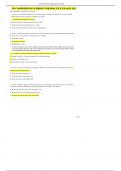
The Belmont Report's principle of respect for persons incorporates at least two ethical
convictions: first, that individuals should be treated as autonomous agents, and second,
that: - ANSWER persons with diminished autonomy are entitled to protection
Which of the following is an example of how the principle of beneficence can be applied
to a study employing human subjects? - ANSWER Determining that the study has a
maximization of benefits and a minimization of risks.
Which of the following are the three principles discussed in the Belmont Report? -
ANSWER Respect for Persons, Beneficence, Justice
Which of the following is an example of how the principle of beneficence is applied to a
study involving human subjects? - ANSWER Ensuring that risks are reasonable in
relationship to anticipated benefits.
The researcher's failure to protect research subjects from deductive disclosure is the
primary ethical violation in which of the following studies? - ANSWER Harvard "Tastes,
Ties, and Time (T3)" study (2006-2009)" study
According to the Belmont Report, the moral requirement that there be fair outcomes in
the selection of research subjects, expresses the principle of: - ANSWER justice
Humphreys collecting data for the Tearoom Trade study under the pretense that he was
a lookout is an example of a violation of the principle of: - ANSWER Respect for
persons.
The Belmont principle of beneficence requires that: - ANSWER Potential benefits justify
the risks of harm.
Which of the following studies is linked most directly to the establishment of the National
Research Act in 1974 and ultimately to the Belmont Report and Federal regulations for
human subject protection? - ANSWER The Public Health Service Tuskegee Study of
Untreated Syphilis in the Negro Male.
Continuing review of an approved and ongoing protocol - ANSWER Must occur within
12 months of the approval date.
According to the federal regulations, research is eligible for exemption, if - ANSWER
The research falls into one of six categories of research activity described in the
regulations.
Answers latest Graded A+
The Belmont Report's principle of respect for persons incorporates at least two ethical
convictions: first, that individuals should be treated as autonomous agents, and second,
that: - ANSWER persons with diminished autonomy are entitled to protection
Which of the following is an example of how the principle of beneficence can be applied
to a study employing human subjects? - ANSWER Determining that the study has a
maximization of benefits and a minimization of risks.
Which of the following are the three principles discussed in the Belmont Report? -
ANSWER Respect for Persons, Beneficence, Justice
Which of the following is an example of how the principle of beneficence is applied to a
study involving human subjects? - ANSWER Ensuring that risks are reasonable in
relationship to anticipated benefits.
The researcher's failure to protect research subjects from deductive disclosure is the
primary ethical violation in which of the following studies? - ANSWER Harvard "Tastes,
Ties, and Time (T3)" study (2006-2009)" study
According to the Belmont Report, the moral requirement that there be fair outcomes in
the selection of research subjects, expresses the principle of: - ANSWER justice
Humphreys collecting data for the Tearoom Trade study under the pretense that he was
a lookout is an example of a violation of the principle of: - ANSWER Respect for
persons.
The Belmont principle of beneficence requires that: - ANSWER Potential benefits justify
the risks of harm.
Which of the following studies is linked most directly to the establishment of the National
Research Act in 1974 and ultimately to the Belmont Report and Federal regulations for
human subject protection? - ANSWER The Public Health Service Tuskegee Study of
Untreated Syphilis in the Negro Male.
Continuing review of an approved and ongoing protocol - ANSWER Must occur within
12 months of the approval date.
According to the federal regulations, research is eligible for exemption, if - ANSWER
The research falls into one of six categories of research activity described in the
regulations.