Receptors and transduction 2
Metabotropic receptors
These receptors are not
directly coupled to their ion
channels and transduce the
signal via intermediate
proteins (G-proteins) that
activate intracellular second
messenger pathways
G proteins are complexes of
subunits, which bind GTP and
have GTPase activity (GTP is
activating molecule through
hydrolysis of phosphate to give
GDP)
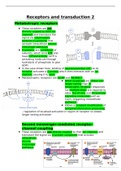
In the case shown here, binding of neurotransmitter (NT) to its
receptor activates a G protein which then interacts with an ion
channel, causing it to open
Metabotrophic receptors are SLOW and INDIRECT.
GPCR responses are slower and
longer lasting than iR
(ionotrophic receptor) responses
(as multiple steps are required to
allow flux of ions and intracellular
signalling molecules such as
Ca2+, triggering intracellular
pathways).
Allows a constant modification of
temporal information processing
– regulation of localised activation in region of receptor vs slower,
longer lasting activation
Second messenger-mediated receptor-
channel coupling
These receptors are not directly coupled to their ion channels and
transduce the signal via G-protein complexes that activate
intracellular
second
messenger
pathways
, G proteins - a, b and g protein trimer and GDP
An intracellular second messenger influences ion channel activity:
NT binds to GPPR, activating G protein (trimeric complex with alpha,
beta and gamma subunits) – alpha subunit can activate another
enzyme which activates second messenger pathways, or directly
activates intracellular part of ion channel to allow cation flux. Series
of steps which indirectly allow cations to pass through ion channel.
With GPCRs, get an amplification step – from one NT binding to
receptor, get amplification of intracellular signalling, resulting in
activation of several ion channels and large influx to keep
momentum going.
2012 Nobel Prize (Chemistry) – GPCRs
Brian Kolbilka and Robert Lefkowitz for work on GPCRs – beta
adrenergic receptor, activated by adrenaline
Rhodopsin first GPCR discovered – light enters lens, touches optic
nerves which transmit light signal converted by receptors in retina
into nerve impulse sent to brain.
Retina has special photoreceptors called rods and cones. Rods –
black and white vision, cones – colour vision. 3 types based on type
of pigment for 3 colours.
Generic GPCR structure
All GPCRs have an
extracellular N-terminal
segment, seven
transmembrane
domains (TMs), which
form the TM core, three
exoloops, three
cytoloops, and a C-
terminal segment. A
fourth cytoplasmic loop
is formed when the C-
terminal segment is
Metabotropic receptors
These receptors are not
directly coupled to their ion
channels and transduce the
signal via intermediate
proteins (G-proteins) that
activate intracellular second
messenger pathways
G proteins are complexes of
subunits, which bind GTP and
have GTPase activity (GTP is
activating molecule through
hydrolysis of phosphate to give
GDP)
In the case shown here, binding of neurotransmitter (NT) to its
receptor activates a G protein which then interacts with an ion
channel, causing it to open
Metabotrophic receptors are SLOW and INDIRECT.
GPCR responses are slower and
longer lasting than iR
(ionotrophic receptor) responses
(as multiple steps are required to
allow flux of ions and intracellular
signalling molecules such as
Ca2+, triggering intracellular
pathways).
Allows a constant modification of
temporal information processing
– regulation of localised activation in region of receptor vs slower,
longer lasting activation
Second messenger-mediated receptor-
channel coupling
These receptors are not directly coupled to their ion channels and
transduce the signal via G-protein complexes that activate
intracellular
second
messenger
pathways
, G proteins - a, b and g protein trimer and GDP
An intracellular second messenger influences ion channel activity:
NT binds to GPPR, activating G protein (trimeric complex with alpha,
beta and gamma subunits) – alpha subunit can activate another
enzyme which activates second messenger pathways, or directly
activates intracellular part of ion channel to allow cation flux. Series
of steps which indirectly allow cations to pass through ion channel.
With GPCRs, get an amplification step – from one NT binding to
receptor, get amplification of intracellular signalling, resulting in
activation of several ion channels and large influx to keep
momentum going.
2012 Nobel Prize (Chemistry) – GPCRs
Brian Kolbilka and Robert Lefkowitz for work on GPCRs – beta
adrenergic receptor, activated by adrenaline
Rhodopsin first GPCR discovered – light enters lens, touches optic
nerves which transmit light signal converted by receptors in retina
into nerve impulse sent to brain.
Retina has special photoreceptors called rods and cones. Rods –
black and white vision, cones – colour vision. 3 types based on type
of pigment for 3 colours.
Generic GPCR structure
All GPCRs have an
extracellular N-terminal
segment, seven
transmembrane
domains (TMs), which
form the TM core, three
exoloops, three
cytoloops, and a C-
terminal segment. A
fourth cytoplasmic loop
is formed when the C-
terminal segment is