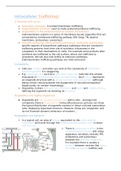
Intracellular Trafficking!
5 lectures will cover:
Essential concepts: in protein/membrane trafficking
Experimental systems: used to study protein/membrane trafficking
Organelles in the endomembrane system (functions):
endomembrane system is a series of membrane bound organelles that are
connected by membrane trafficking pathway (ER, Golgi, TN, plasma
membrane, endosomes, lysosomes).
Specific pathways (biosynthetic pathways, endocytic pathways):
specific aspects of biosynthetic pathways (pathways that are involved in
trafficking proteins from their site of synthesis {ribosomes in the
cytoplasm) to their destinations in cells). For example some proteins after
synthesis are trafficked to the cell surface, others are trafficked to
lysosomes. We will also look briefly at endocytic pathways.
Endomembrane trafficking pathways are interconnected.
Complexity
Cells are complex and when you look at the complexity of membrane
bound organelles it is staggering.
E.g. eukaryotic cell such as a pancreatic beta cell. Cells like this contain
thousands of membrane-enclosed compartments. Each colour represents
an organelle structure with a unique function and composition (although
being critical I would question the assignment of function/composition
based purely on cellular morphology).
Organelles contain different sets of proteins and lipids and carbohydrates,
defining the organelle via dictating its function.
Organelles are highly organised
Organelles are not randomly distributed within cells – amongst the
complexity there is organisation. Immunofluorescence pictures can show
the typical distribution of organelle markers in tissue cultured mammalian
cells, displaying organised structure. However, these are ‘snapshots’ and
do not illustrate dynamic behaviour of markers…
Organelles are dynamic
In a typical cell, an area of bilayer equivalent to the entire plasma
membrane will travel through the endocytosis/exocytosis cycle in about
half an hour.
There is continuous traffick in the
endomembrane system (ER, Golgi
apparatus, secretory vesicles, PM,
endosomes and lysosomes)
between the different organelles.
For example there is usually a
balance between vesicles that leave
the ER (anterograde traffick) and
, vesicles that return to the ER from later compartments (retrograde
traffick).
These trafficking pathways are occurring continuously in cells, and hence
organelles are very dynamic in nature.
Similarly at the plasma membrane there is continuous addition
(exocytosis) and removal (endocytosis) of membrane. In cells that look to
stay the same size (ie the surface area of the plasma membrane does not
change) it does not mean that nothing is happening. It just means that
addition of membrane balances removal of membrane.
Some cell types will be more dynamic than others in changing their
plasma membrane composition.
Overview of trafficking pathways
1. Assembly into ER. Lumenal (soluble) proteins are completely translocated
across the ER membrane. Integral membrane proteins are assemble into the ER
membrane. This is the entry point of all proteins (as far as I know) but you could
argue about endocytosed proteins do not enter here) into the endomembrane
system.
2. Budding from the ER. Proteins are selectively packaged into ER derived
vesicles (covered in more detail later on).
3, 5. Proteins and membrane are continuously recycled back to ‘earlier’
compartments in the secretory pathway.
4. In the Golgi this leads to cisternal maturation. In the trans-Golgi network
proteins are further sorted.
Some 6. get constitutively secreted,
some 7. get packaged into vesicles that fuse with
the plasma membrane in a regulated manner (ie after
a stimulus to the cell), or
8, get diverted to lysosomes via endosomes. It is
endosomes/ lysosomes that
9. endocytosed material often gets delivered to.
E.g. proteins like lysosomal hydrolases are used to
break down other macromolecules within lysosomes.
Note: there are some retrograde/recycling routes not
shown on this diagram.
These different organelles contain different enzymes
which are often involved in post-translational
modification of proteins as they pass through
secretory pathway.
Importance?
5 lectures will cover:
Essential concepts: in protein/membrane trafficking
Experimental systems: used to study protein/membrane trafficking
Organelles in the endomembrane system (functions):
endomembrane system is a series of membrane bound organelles that are
connected by membrane trafficking pathway (ER, Golgi, TN, plasma
membrane, endosomes, lysosomes).
Specific pathways (biosynthetic pathways, endocytic pathways):
specific aspects of biosynthetic pathways (pathways that are involved in
trafficking proteins from their site of synthesis {ribosomes in the
cytoplasm) to their destinations in cells). For example some proteins after
synthesis are trafficked to the cell surface, others are trafficked to
lysosomes. We will also look briefly at endocytic pathways.
Endomembrane trafficking pathways are interconnected.
Complexity
Cells are complex and when you look at the complexity of membrane
bound organelles it is staggering.
E.g. eukaryotic cell such as a pancreatic beta cell. Cells like this contain
thousands of membrane-enclosed compartments. Each colour represents
an organelle structure with a unique function and composition (although
being critical I would question the assignment of function/composition
based purely on cellular morphology).
Organelles contain different sets of proteins and lipids and carbohydrates,
defining the organelle via dictating its function.
Organelles are highly organised
Organelles are not randomly distributed within cells – amongst the
complexity there is organisation. Immunofluorescence pictures can show
the typical distribution of organelle markers in tissue cultured mammalian
cells, displaying organised structure. However, these are ‘snapshots’ and
do not illustrate dynamic behaviour of markers…
Organelles are dynamic
In a typical cell, an area of bilayer equivalent to the entire plasma
membrane will travel through the endocytosis/exocytosis cycle in about
half an hour.
There is continuous traffick in the
endomembrane system (ER, Golgi
apparatus, secretory vesicles, PM,
endosomes and lysosomes)
between the different organelles.
For example there is usually a
balance between vesicles that leave
the ER (anterograde traffick) and
, vesicles that return to the ER from later compartments (retrograde
traffick).
These trafficking pathways are occurring continuously in cells, and hence
organelles are very dynamic in nature.
Similarly at the plasma membrane there is continuous addition
(exocytosis) and removal (endocytosis) of membrane. In cells that look to
stay the same size (ie the surface area of the plasma membrane does not
change) it does not mean that nothing is happening. It just means that
addition of membrane balances removal of membrane.
Some cell types will be more dynamic than others in changing their
plasma membrane composition.
Overview of trafficking pathways
1. Assembly into ER. Lumenal (soluble) proteins are completely translocated
across the ER membrane. Integral membrane proteins are assemble into the ER
membrane. This is the entry point of all proteins (as far as I know) but you could
argue about endocytosed proteins do not enter here) into the endomembrane
system.
2. Budding from the ER. Proteins are selectively packaged into ER derived
vesicles (covered in more detail later on).
3, 5. Proteins and membrane are continuously recycled back to ‘earlier’
compartments in the secretory pathway.
4. In the Golgi this leads to cisternal maturation. In the trans-Golgi network
proteins are further sorted.
Some 6. get constitutively secreted,
some 7. get packaged into vesicles that fuse with
the plasma membrane in a regulated manner (ie after
a stimulus to the cell), or
8, get diverted to lysosomes via endosomes. It is
endosomes/ lysosomes that
9. endocytosed material often gets delivered to.
E.g. proteins like lysosomal hydrolases are used to
break down other macromolecules within lysosomes.
Note: there are some retrograde/recycling routes not
shown on this diagram.
These different organelles contain different enzymes
which are often involved in post-translational
modification of proteins as they pass through
secretory pathway.
Importance?