

Taylor’s Notes Alkanes
General Alkanes
Alkanes are hydrocarbon which are compounds which contain only carbon and hydrogen
They are called saturated because they contain no carbon-to-carbon double bonds, and so cannot undergo
addition reactions
They have the general formula CnH2n+2
Physical Properties of Alkanes
Boiling point of alkanes increases with the number of carbon atoms in a row in the chain because there is
greater surface area overlap with an increased carbon chain, therefore dispersion forces are stronger
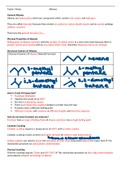
Structural Isomers of Alkanes
Structural Isomers of Hexane (Skeletal Formula)
How is Crude Oil Separated?
Fractional Distillation
Vaporise the crude oil at 400°C
Put into fractionating column
There is a temperature gradient (bottom is hotter than the top)
Fractions have a different boiling point
Different fractions will condense at different heights and therefore separate
How do we know fractions are mixtures?
Fractions have a range of Boiling Points A pure substance has a single boiling point
Catalytic Cracking
Catalytic cracking requires a temperature of 500°C with a zeolite catalyst
Catalytic cracking is done as there is a higher demand for shorter chain hydrocarbons
Zeolite catalysts are used to favour the formation of short chain (branched) alkanes for motor fuels The
mechanism proceeds via carbocationic intermediates
Thermal Cracking
Thermal cracking requires 70atm and 450-750°C This mechanism proceeds via free radical intermediates
and produces a higher percentage of alkenes
General Alkanes
Alkanes are hydrocarbon which are compounds which contain only carbon and hydrogen
They are called saturated because they contain no carbon-to-carbon double bonds, and so cannot undergo
addition reactions
They have the general formula CnH2n+2
Physical Properties of Alkanes
Boiling point of alkanes increases with the number of carbon atoms in a row in the chain because there is
greater surface area overlap with an increased carbon chain, therefore dispersion forces are stronger
Structural Isomers of Alkanes
Structural Isomers of Hexane (Skeletal Formula)
How is Crude Oil Separated?
Fractional Distillation
Vaporise the crude oil at 400°C
Put into fractionating column
There is a temperature gradient (bottom is hotter than the top)
Fractions have a different boiling point
Different fractions will condense at different heights and therefore separate
How do we know fractions are mixtures?
Fractions have a range of Boiling Points A pure substance has a single boiling point
Catalytic Cracking
Catalytic cracking requires a temperature of 500°C with a zeolite catalyst
Catalytic cracking is done as there is a higher demand for shorter chain hydrocarbons
Zeolite catalysts are used to favour the formation of short chain (branched) alkanes for motor fuels The
mechanism proceeds via carbocationic intermediates
Thermal Cracking
Thermal cracking requires 70atm and 450-750°C This mechanism proceeds via free radical intermediates
and produces a higher percentage of alkenes


