
Taylor’s Notes Group 7 Notes
Physical Properties
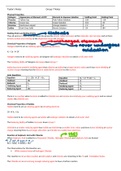
Halogen Appearance of Element at RTP Element in Aqueous Solution Melting Point Boiling Point
Fluorine Yellow Gas Pale Yellow Solution -220 -118
Chlorine Green Gas Green Solution -101 -35
Bromine Red-brown Liquid Orange Solution -7.2 59
Iodine Dark Grey Solid Brown Solution 114 184
Melting Point and Boiling Points
They all exist as X2 and as you go down the group the atomic radius increases as the molecular size increases and so there
is more surface area overlap so the dispersion forces are stronger
Chemical Properties of Halogens
Halogens tend to act as oxidising agents by gaining electrons
X2 + 2e- 2X-
Halogens tend to be oxidising agents as halogens will undergo reduction to obtain a full outer shell
The Oxidising Ability of halogens decreases down Group 7
Iodine is a more powerful oxidising agent than chlorine as iodine has a larger atomic radius and it has more shielding of
nuclear charge meaning that the electron added is less attracted to the nucleus
Ionic Equations
Equation F2 + 2Br- 2F- + Br2 Equation Cl2 + 2I- 2Cl- + I2
Oxidised 2Br- Oxidised 2I-
Reduced F2 Reduced Cl2
Oxidising Agent F2 Oxidising Agent Cl2
Reducing Agent 2Br- Reducing Agent 2I-
There is no reaction when bromine is added to chloride ions as bromine is a relatively poor oxidising agent and so cannot
oxidise the chloride ions
Chemical Properties of Halides
Halides tend to act as reducing agents by donating electrons
2X- X2 + 2e-
Halides tend to be reducing agents as halides will undergo oxidation to obtain a full outer shell
The Reducing Ability of halides increases down Group 7
Chloride is a weaker reducing agent than iodide as chloride has a smaller ionic radius and there is less shielding of nuclear
charge meaning there is a stronger attraction, so chloride less readily loses electrons
Reaction of Sulphuric Acid with Chloride
When Sulphuric Acid is added to a Potassium Chloride, Hydrogen Chloride and Sulphuric Acid are formed
KCl + H2SO4 KHSO4 + HCl
The Observations for this Reaction are:
White steamy fumes of Hydrogen Chloride
This reaction is not a redox reaction as both sulphur and chlorine are remaining in the +6 and -1 Oxidation States
The Chloride ion is not a strong enough reducing agent to have a further reaction
, Taylor’s Notes Group 7 Notes
Reaction of Sulphuric Acid with Bromide
When Sulphuric Acid is added to Potassium Bromide, Hydrogen Bromide and Sulphur Dioxide are formed
KBr + H2SO4 KHSO4 + HBr
Bromide ions are strong enough reducing agents to reduce the Sulphuric Acid to Sulphur Dioxide
The Half Equation for Bromide to Bromine = 2Br- Br2 + 2e-
The Half Equation for Sulphuric Acid to Sulphur Dioxide = 2H+ + H2SO4 + 2e- SO2 + 2H20
The Overall Equation for the Reaction of Bromide Ions with Sulphuric Acid = 2Br- + 2H+ + H2SO4 Br2 + SO2 + 2H2O
The Observation for this Reaction are:
Red Brown Liquid
Orange Fumes
Reaction of Sulphuric Acid with Iodide
When Sulphuric Acid is added to Potassium Iodide which forms Hydrogen Iodide and Sulphuric Acid
KI + H2SO4 KHSO4 + HI then 2HI + H2SO4 I2 + 2H2O + SO2
Iodide ions can also produce Sulphur and Hydrogen Sulphide
The Half Equation for Iodide to Iodine = 2I- I2 + 2e-
The Half Equation for Sulphuric Acid to Sulphur = 6H+ + H2SO4 + 6e- S + 4H2O
The Overall Equation for the Reaction of Iodine Ions with Sulphuric Acid which forms Sulphur:
6I- + 6H+ + H2SO4 3I2 + S + 4H2O
The Half Equation for the Sulphuric Acid to Hydrogen Sulphide = 8H+ + H2SO4 + 8e- H2S + 4H2O
The Overall Equation for the Reaction of Iodide Ions with Sulphuric Acid which forms Hydrogen Sulphide (H2S):
8I- + 8H+ + H2SO4 4I2 + H2S + 4H2O
The Observations for these Reactions are:
Yellow Solid (Sulphur)
Rotten Egg smell from Colourless Gas (Hydrogen Sulphide)
Dark Grey Solid and Purple Fumes (Iodine)
Identification of Halide Ions
Add Nitric Acid to remove Carbonate Impurities and then add Silver Nitrate which will cause a precipitate to form
The Effect of Ammonia Solution to the Precipitate can then be used to confirm the result
Halide HNO3 + AgNO3 Dilute NH3 Concentrated NH3
Cl- White Precipitate Precipitate Dissolves Precipitate Dissolves
Br- Cream Precipitate No Change Precipitate Dissolves
I- Yellow Precipitate No Change No Change
The Ionic Equation for the Test for Chloride Ions = Cl- + Ag+ AgCl
Physical Properties
Halogen Appearance of Element at RTP Element in Aqueous Solution Melting Point Boiling Point
Fluorine Yellow Gas Pale Yellow Solution -220 -118
Chlorine Green Gas Green Solution -101 -35
Bromine Red-brown Liquid Orange Solution -7.2 59
Iodine Dark Grey Solid Brown Solution 114 184
Melting Point and Boiling Points
They all exist as X2 and as you go down the group the atomic radius increases as the molecular size increases and so there
is more surface area overlap so the dispersion forces are stronger
Chemical Properties of Halogens
Halogens tend to act as oxidising agents by gaining electrons
X2 + 2e- 2X-
Halogens tend to be oxidising agents as halogens will undergo reduction to obtain a full outer shell
The Oxidising Ability of halogens decreases down Group 7
Iodine is a more powerful oxidising agent than chlorine as iodine has a larger atomic radius and it has more shielding of
nuclear charge meaning that the electron added is less attracted to the nucleus
Ionic Equations
Equation F2 + 2Br- 2F- + Br2 Equation Cl2 + 2I- 2Cl- + I2
Oxidised 2Br- Oxidised 2I-
Reduced F2 Reduced Cl2
Oxidising Agent F2 Oxidising Agent Cl2
Reducing Agent 2Br- Reducing Agent 2I-
There is no reaction when bromine is added to chloride ions as bromine is a relatively poor oxidising agent and so cannot
oxidise the chloride ions
Chemical Properties of Halides
Halides tend to act as reducing agents by donating electrons
2X- X2 + 2e-
Halides tend to be reducing agents as halides will undergo oxidation to obtain a full outer shell
The Reducing Ability of halides increases down Group 7
Chloride is a weaker reducing agent than iodide as chloride has a smaller ionic radius and there is less shielding of nuclear
charge meaning there is a stronger attraction, so chloride less readily loses electrons
Reaction of Sulphuric Acid with Chloride
When Sulphuric Acid is added to a Potassium Chloride, Hydrogen Chloride and Sulphuric Acid are formed
KCl + H2SO4 KHSO4 + HCl
The Observations for this Reaction are:
White steamy fumes of Hydrogen Chloride
This reaction is not a redox reaction as both sulphur and chlorine are remaining in the +6 and -1 Oxidation States
The Chloride ion is not a strong enough reducing agent to have a further reaction
, Taylor’s Notes Group 7 Notes
Reaction of Sulphuric Acid with Bromide
When Sulphuric Acid is added to Potassium Bromide, Hydrogen Bromide and Sulphur Dioxide are formed
KBr + H2SO4 KHSO4 + HBr
Bromide ions are strong enough reducing agents to reduce the Sulphuric Acid to Sulphur Dioxide
The Half Equation for Bromide to Bromine = 2Br- Br2 + 2e-
The Half Equation for Sulphuric Acid to Sulphur Dioxide = 2H+ + H2SO4 + 2e- SO2 + 2H20
The Overall Equation for the Reaction of Bromide Ions with Sulphuric Acid = 2Br- + 2H+ + H2SO4 Br2 + SO2 + 2H2O
The Observation for this Reaction are:
Red Brown Liquid
Orange Fumes
Reaction of Sulphuric Acid with Iodide
When Sulphuric Acid is added to Potassium Iodide which forms Hydrogen Iodide and Sulphuric Acid
KI + H2SO4 KHSO4 + HI then 2HI + H2SO4 I2 + 2H2O + SO2
Iodide ions can also produce Sulphur and Hydrogen Sulphide
The Half Equation for Iodide to Iodine = 2I- I2 + 2e-
The Half Equation for Sulphuric Acid to Sulphur = 6H+ + H2SO4 + 6e- S + 4H2O
The Overall Equation for the Reaction of Iodine Ions with Sulphuric Acid which forms Sulphur:
6I- + 6H+ + H2SO4 3I2 + S + 4H2O
The Half Equation for the Sulphuric Acid to Hydrogen Sulphide = 8H+ + H2SO4 + 8e- H2S + 4H2O
The Overall Equation for the Reaction of Iodide Ions with Sulphuric Acid which forms Hydrogen Sulphide (H2S):
8I- + 8H+ + H2SO4 4I2 + H2S + 4H2O
The Observations for these Reactions are:
Yellow Solid (Sulphur)
Rotten Egg smell from Colourless Gas (Hydrogen Sulphide)
Dark Grey Solid and Purple Fumes (Iodine)
Identification of Halide Ions
Add Nitric Acid to remove Carbonate Impurities and then add Silver Nitrate which will cause a precipitate to form
The Effect of Ammonia Solution to the Precipitate can then be used to confirm the result
Halide HNO3 + AgNO3 Dilute NH3 Concentrated NH3
Cl- White Precipitate Precipitate Dissolves Precipitate Dissolves
Br- Cream Precipitate No Change Precipitate Dissolves
I- Yellow Precipitate No Change No Change
The Ionic Equation for the Test for Chloride Ions = Cl- + Ag+ AgCl


