10.03.20
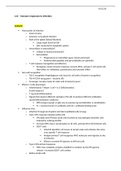
L14 – Immune responses to infection
Lecture:
Main points of infection
o Point of entry
o Systemic vs localized infection
o Role of the spleen (blood filtration)
Large organ found on left
Not connected to lymphatic system
o Intracellular vs extracellular?
Cellular or humoral immunity?
Extracellular
Phagocytosis in interstitial space, blood and lymph
Antimicrobial peptides and IgA antibodies on epithelial
o T cell response (recognition and effector)
Recognize, innate immune response, present MHC, activate T cell and B cells
then effect w/ antibodies, granulocytes and cytotoxic killers
Non-self-recognition
o TLR-2 recognition Peptidoglycan only found in cell walls of bacteria recognition
o TLR-4/CD14 recog gram – bacteria LRS
o Scavenger receptor looks for sialic acid in bacteria/yeast
Effector T cells phenotype
o Inflammatory T helper 1 cell = IL-2 (inflammation)
B cells helpers ()
o T reg (anti-inflammatory)
o Signals then lead to different subtypes of B cells to produce different antibodies
(prolif/differentiation cytokines)
Diff isotypes (eg IgG vs IgE) vary in purpose eg neutralization vs sensitization
Fc = constant factor on antibody and Fab = antibody binding factor
Influenza virus
o Infection through air droplets and infect epithelial cells in lungs
o Type I IFN response initiated within 24h
IFN alpha and IFN beta synth and secreted by macrophages/dendritic cells
induced by noticing ds RNA
Increase MHC class 1 presentation in all cells, activate NK to kill infected cells
CD8 T cells
Infected dendritic cell moves to lymph node and activates the naïve
virus specific T cell response
Antigen primed T cell recognizes MHC molecule and migrates to site
of infection
Effector secreted IFN gamma to kill host cells
o Type II IFN antiviral response
MHC class I peptide complex amplified in numbers by the IFN gamma
release = increased CD8 T cell number
o Before inside cells
L14 – Immune responses to infection
Lecture:
Main points of infection
o Point of entry
o Systemic vs localized infection
o Role of the spleen (blood filtration)
Large organ found on left
Not connected to lymphatic system
o Intracellular vs extracellular?
Cellular or humoral immunity?
Extracellular
Phagocytosis in interstitial space, blood and lymph
Antimicrobial peptides and IgA antibodies on epithelial
o T cell response (recognition and effector)
Recognize, innate immune response, present MHC, activate T cell and B cells
then effect w/ antibodies, granulocytes and cytotoxic killers
Non-self-recognition
o TLR-2 recognition Peptidoglycan only found in cell walls of bacteria recognition
o TLR-4/CD14 recog gram – bacteria LRS
o Scavenger receptor looks for sialic acid in bacteria/yeast
Effector T cells phenotype
o Inflammatory T helper 1 cell = IL-2 (inflammation)
B cells helpers ()
o T reg (anti-inflammatory)
o Signals then lead to different subtypes of B cells to produce different antibodies
(prolif/differentiation cytokines)
Diff isotypes (eg IgG vs IgE) vary in purpose eg neutralization vs sensitization
Fc = constant factor on antibody and Fab = antibody binding factor
Influenza virus
o Infection through air droplets and infect epithelial cells in lungs
o Type I IFN response initiated within 24h
IFN alpha and IFN beta synth and secreted by macrophages/dendritic cells
induced by noticing ds RNA
Increase MHC class 1 presentation in all cells, activate NK to kill infected cells
CD8 T cells
Infected dendritic cell moves to lymph node and activates the naïve
virus specific T cell response
Antigen primed T cell recognizes MHC molecule and migrates to site
of infection
Effector secreted IFN gamma to kill host cells
o Type II IFN antiviral response
MHC class I peptide complex amplified in numbers by the IFN gamma
release = increased CD8 T cell number
o Before inside cells