
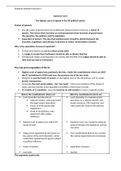
Relations between branches 1
Supreme Court
The highest court of appeal in the UK political system
Fusion of powers
The UK system of government has traditionally featured what is known as a fusion of
powers. This means there has been an overlap between three branches of government;
the executive, the judiciary and the legislation.
Separation of powers- The idea that political power should be divided between the
Executive, Legislature and Judiciary to prevent an undue concentration of power
Why is the separation of powers important?
So that each branch can act as a check on the other
If a judge is corrupt then Parliament should be able to dismiss him/her.
If Parliament makes a law that does not comply with the HRA, then judges should be able to
refer that law back to Parliament.
The role and composition of the SC
Highest court of appeal was previously the HoLs. Under the constitutional reform act 2005
the SC (established in 2009) took over the previous role of the law lords.
Designed to end the fusion of powers at the highest level of the UK judiciary and to create
greater transparency
Previously the most senior judges – the ‘Law Lords’ – had sat as members of the House of
Lords, and were known as the Appellate Committee of the House of Lords
SC consists of 12 members- cases are heard by an odd number to reach a majority verdict
Before the constitutional reform act After the constitutional reform act
Lord chancellor had the role of: Lord Chancellor is a member of the
Cabinet minister, who supervised executive- as a cabinet minister and
the legal system (executive) justice secretary. CRA made the Lord
House of lords speakership chief justice the head of the judiciary
(legislature)
Head of the judiciary, who
appointed other judges
(judiciary).
Highest court of appeal was within the Supreme court was created to separate
house of lords powers between the legislature and the
executive
Judges were appointed by the Queen on The Constitutional Reform Act created
the advice of the Lord Chancellor, which the Judicial Appointments Commission.
made those appointments appear subject
to political influence
Fusion of powers Separation of powers
Law lords Justices
The supreme courts role
, Relations between branches 1
Interprets law (in line with EU law, and the ECHR) as the highest court of appeal.
Protects civil liberties- by upholding the rule of law, and also by applying the UK
Human Rights Act and ECHR
Checks the power of government by hearing judicial reviews and ultra vires rulings
Revising and reviewing legal precedent established under common law
Establish where sovereignty lies
Appointment of members of the Supreme Court
Consists of 12 members, although cases are always heard by an odd number of justices so
that a majority verdict can be reached
The most senior figure is designated as the President. (Lord Reed as of 2021)
Supreme Court justices will usually have served as a senior judge for 2 years, or been a
qualified lawyer for at least 15 years.
When a vacancy occurs, nominations are made to JAC. The Lord Chancellor (justice
secretary) either confirms or rejects the person put forward, although he or she cannot
reject names repeatedly. The appointment is confirmed by the prime minister and then by
the monarch
Justices retire at 70 if they were appointed after 1995, or 75 otherwise.
Key doctrines & principles: Dicey’s strand of the rule of law
No one can be punished without trial- not always used e.g., terrorists and freezing assets
No one is above the law- true in liberal democracy but can be argued that the queen and
MPs are above the law
Constitution results from judges rather than parliament- statue law remains supreme.
Overturned by an act of parliament
Judicial neutrality
The principle that judges should not be influenced by their personal political opinions and
biases. Free from bias.
How is neutrality maintained?
High levels of training
Legal justification of judgments- expected to state how they came to the conclusion
Court cases are held in public- bias would be spotted and publicised in the media
How neutral is the Supreme Court?
Social background of judges- predominantly white, old, privately educated males
Judicial independence
Supreme Court
The highest court of appeal in the UK political system
Fusion of powers
The UK system of government has traditionally featured what is known as a fusion of
powers. This means there has been an overlap between three branches of government;
the executive, the judiciary and the legislation.
Separation of powers- The idea that political power should be divided between the
Executive, Legislature and Judiciary to prevent an undue concentration of power
Why is the separation of powers important?
So that each branch can act as a check on the other
If a judge is corrupt then Parliament should be able to dismiss him/her.
If Parliament makes a law that does not comply with the HRA, then judges should be able to
refer that law back to Parliament.
The role and composition of the SC
Highest court of appeal was previously the HoLs. Under the constitutional reform act 2005
the SC (established in 2009) took over the previous role of the law lords.
Designed to end the fusion of powers at the highest level of the UK judiciary and to create
greater transparency
Previously the most senior judges – the ‘Law Lords’ – had sat as members of the House of
Lords, and were known as the Appellate Committee of the House of Lords
SC consists of 12 members- cases are heard by an odd number to reach a majority verdict
Before the constitutional reform act After the constitutional reform act
Lord chancellor had the role of: Lord Chancellor is a member of the
Cabinet minister, who supervised executive- as a cabinet minister and
the legal system (executive) justice secretary. CRA made the Lord
House of lords speakership chief justice the head of the judiciary
(legislature)
Head of the judiciary, who
appointed other judges
(judiciary).
Highest court of appeal was within the Supreme court was created to separate
house of lords powers between the legislature and the
executive
Judges were appointed by the Queen on The Constitutional Reform Act created
the advice of the Lord Chancellor, which the Judicial Appointments Commission.
made those appointments appear subject
to political influence
Fusion of powers Separation of powers
Law lords Justices
The supreme courts role
, Relations between branches 1
Interprets law (in line with EU law, and the ECHR) as the highest court of appeal.
Protects civil liberties- by upholding the rule of law, and also by applying the UK
Human Rights Act and ECHR
Checks the power of government by hearing judicial reviews and ultra vires rulings
Revising and reviewing legal precedent established under common law
Establish where sovereignty lies
Appointment of members of the Supreme Court
Consists of 12 members, although cases are always heard by an odd number of justices so
that a majority verdict can be reached
The most senior figure is designated as the President. (Lord Reed as of 2021)
Supreme Court justices will usually have served as a senior judge for 2 years, or been a
qualified lawyer for at least 15 years.
When a vacancy occurs, nominations are made to JAC. The Lord Chancellor (justice
secretary) either confirms or rejects the person put forward, although he or she cannot
reject names repeatedly. The appointment is confirmed by the prime minister and then by
the monarch
Justices retire at 70 if they were appointed after 1995, or 75 otherwise.
Key doctrines & principles: Dicey’s strand of the rule of law
No one can be punished without trial- not always used e.g., terrorists and freezing assets
No one is above the law- true in liberal democracy but can be argued that the queen and
MPs are above the law
Constitution results from judges rather than parliament- statue law remains supreme.
Overturned by an act of parliament
Judicial neutrality
The principle that judges should not be influenced by their personal political opinions and
biases. Free from bias.
How is neutrality maintained?
High levels of training
Legal justification of judgments- expected to state how they came to the conclusion
Court cases are held in public- bias would be spotted and publicised in the media
How neutral is the Supreme Court?
Social background of judges- predominantly white, old, privately educated males
Judicial independence


