1.2. How are coastal landscapes developed?
2a. Coastal landforms develop due to a variety of interconnected climatic and geomorphic processes
- Formation of depositional landforms
Beaches: Salt marshes:
Beaches occur in the littoral zone between low & high tide Features of low energy environments such as estuaries, on
Constructive waves with their strong swash & weak backwash allow landward/leeward side of spits
a net increase of material Shallow gradient sloping seawards
LSD moves sediment laterally alongshore Even though the higher parts of the salt marsh are
Many beaches form in bays where there are more sheltered inundated less often, deposition rates are still quite high
conditions & shallow water as at HWM low energy may be present for 2-3 hours
Beach sediment comes from 3 main sources Vegetated areas of deposited silt & clays
- Cliff erosion (5%) As tides rise & fall they are subjected to flooding &
- Offshore: from the seabed, often during periods of rising sea exposure
levels (5%) Stems & leaves of the plants trap sediment swept in by
- Rivers (fluvial deposition): bed load through river mouth (90%) tidal currents while the roots stabilise the sediment
Spits:
Long, narrow beaches of sand & shingle attached to land at one end & extend across a
bay, estuary or indentation in coastline
Usually formed by LSD depositing material into the sea after the coastline has changed
direction
Over time the level of sand deposited will build up until it’s above sea level
More & larger material makes this feature more substantial & permanent
Distal end of spit often becomes recurved due to wave refraction around it & secondary
winds which cause waves to strike from a different direction
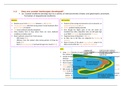
Spit creates an area of calmer water on leeward side, sheltered by a spit - lagoon, salt
marsh & dry land can develop in this area ->
- Sediment accumulates here – brackish waters – provides a substrate for pioneer
species to grow – this species favours these conditions as is salt tolerant =
halophytes
2a. Coastal landforms develop due to a variety of interconnected climatic and geomorphic processes
- Formation of depositional landforms
Beaches: Salt marshes:
Beaches occur in the littoral zone between low & high tide Features of low energy environments such as estuaries, on
Constructive waves with their strong swash & weak backwash allow landward/leeward side of spits
a net increase of material Shallow gradient sloping seawards
LSD moves sediment laterally alongshore Even though the higher parts of the salt marsh are
Many beaches form in bays where there are more sheltered inundated less often, deposition rates are still quite high
conditions & shallow water as at HWM low energy may be present for 2-3 hours
Beach sediment comes from 3 main sources Vegetated areas of deposited silt & clays
- Cliff erosion (5%) As tides rise & fall they are subjected to flooding &
- Offshore: from the seabed, often during periods of rising sea exposure
levels (5%) Stems & leaves of the plants trap sediment swept in by
- Rivers (fluvial deposition): bed load through river mouth (90%) tidal currents while the roots stabilise the sediment
Spits:
Long, narrow beaches of sand & shingle attached to land at one end & extend across a
bay, estuary or indentation in coastline
Usually formed by LSD depositing material into the sea after the coastline has changed
direction
Over time the level of sand deposited will build up until it’s above sea level
More & larger material makes this feature more substantial & permanent
Distal end of spit often becomes recurved due to wave refraction around it & secondary
winds which cause waves to strike from a different direction
Spit creates an area of calmer water on leeward side, sheltered by a spit - lagoon, salt
marsh & dry land can develop in this area ->
- Sediment accumulates here – brackish waters – provides a substrate for pioneer
species to grow – this species favours these conditions as is salt tolerant =
halophytes