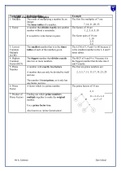
Topic/Skill Definition/Tips
Topic: Factors and Multiples Example
1. Multiple The result of multiplying a number by an The first five multiples of 7 are:
integer.
The times tables of a number. 7 , 14 , 21 ,28 , 35
2. Factor A number that divides exactly into another The factors of 18 are:
number without a remainder. 1 ,2 , 3 , 6 , 9 ,18
It is useful to write factors in pairs The factor pairs of 18 are:
1 ,18
2,9
3,6
3. Lowest The smallest number that is in the times The LCM of 3, 4 and 5 is 60 because it
Common tables of each of the numbers given. is the smallest number in the 3, 4 and 5
Multiple times tables.
(LCM)
4. Highest The biggest number that divides exactly The HCF of 6 and 9 is 3 because it is
Common into two or more numbers. the biggest number that divides into 6
Factor (HCF) and 9 exactly.
5. Prime A number with exactly two factors. The first ten prime numbers are:
Number
A number that can only be divided by itself 2 , 3 ,5 , 7 , 11, 13 , 17 ,19 , 23 , 29
and one.
The number 1 is not prime, as it only has
one factor, not two.
6. Prime A factor which is a prime number. The prime factors of 18 are:
Factor
2,3
7. Product of Finding out which prime numbers
Prime Factors multiply together to make the original
number.
Use a prime factor tree.
Also known as ‘prime factorisation’.
Mr A. Coleman Glyn School
Topic: Factors and Multiples Example
1. Multiple The result of multiplying a number by an The first five multiples of 7 are:
integer.
The times tables of a number. 7 , 14 , 21 ,28 , 35
2. Factor A number that divides exactly into another The factors of 18 are:
number without a remainder. 1 ,2 , 3 , 6 , 9 ,18
It is useful to write factors in pairs The factor pairs of 18 are:
1 ,18
2,9
3,6
3. Lowest The smallest number that is in the times The LCM of 3, 4 and 5 is 60 because it
Common tables of each of the numbers given. is the smallest number in the 3, 4 and 5
Multiple times tables.
(LCM)
4. Highest The biggest number that divides exactly The HCF of 6 and 9 is 3 because it is
Common into two or more numbers. the biggest number that divides into 6
Factor (HCF) and 9 exactly.
5. Prime A number with exactly two factors. The first ten prime numbers are:
Number
A number that can only be divided by itself 2 , 3 ,5 , 7 , 11, 13 , 17 ,19 , 23 , 29
and one.
The number 1 is not prime, as it only has
one factor, not two.
6. Prime A factor which is a prime number. The prime factors of 18 are:
Factor
2,3
7. Product of Finding out which prime numbers
Prime Factors multiply together to make the original
number.
Use a prime factor tree.
Also known as ‘prime factorisation’.
Mr A. Coleman Glyn School