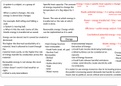
A system is a object, or a group of Specific heat capacity: The amount Energy = mass x specific heat capacity x change i
joules kg joules/kg °
objects. of energy required to change the
temperature of a 1kg object by 1
When a system changes, the way °C. Elastic potential energy = ½ x spring constan
joules newtons per mete
energy is stored also changes
Power: The rate at which energy is
For example: Ball rolling and hitting a transferred or the rate at which Power = energy transferred / time = wor
watts joules secs j
wall: work is done.
o System is moving ball.
o When it hits the wall, (some of) the Renewable energy: Energy which Efficiency = useful energy output / tota
kinetic energy is transferred as sound. can be replenished as it is used.
Gravitational potential energy = mass
Energy can be stored, but it cannot be created or joules kg
destroyed. Energy
The higher the thermal conductivity of a Main Energy Sources: Environmental Impact: Kinetic energy = ½ x
material, heat is allowed to travel through Non-renewable: Extraction of Energy: Joules kg
the - Fossil Fuels (coal, oil, gas) o Fossil fuels involve destroying landscapes.
material more easily, so the higher the rate - Nuclear Fuel o Wind turbines can be considered an Energy
of energy transfer by conduction across the Renewable: eyesore. - Transp
material. - Biofuel Use of Energy Sources: - Electr
- Wind o Fossil fuels release harmful emissions. - Heatin
Renewable energy is not always the most o Solar, wind directly create electricity with
- Hydro-electricity
reliable as: no emissions.
- Tidal
o Solar doesn’t work in bad weather or
- Solar It is easier to use energy resources due to increasing pressur
night.
- Water waves the public’s increasing power demands but harder to solve e
o Wind is only intermittent.
issues due to political, social, ethical and economic consider
joules kg joules/kg °
objects. of energy required to change the
temperature of a 1kg object by 1
When a system changes, the way °C. Elastic potential energy = ½ x spring constan
joules newtons per mete
energy is stored also changes
Power: The rate at which energy is
For example: Ball rolling and hitting a transferred or the rate at which Power = energy transferred / time = wor
watts joules secs j
wall: work is done.
o System is moving ball.
o When it hits the wall, (some of) the Renewable energy: Energy which Efficiency = useful energy output / tota
kinetic energy is transferred as sound. can be replenished as it is used.
Gravitational potential energy = mass
Energy can be stored, but it cannot be created or joules kg
destroyed. Energy
The higher the thermal conductivity of a Main Energy Sources: Environmental Impact: Kinetic energy = ½ x
material, heat is allowed to travel through Non-renewable: Extraction of Energy: Joules kg
the - Fossil Fuels (coal, oil, gas) o Fossil fuels involve destroying landscapes.
material more easily, so the higher the rate - Nuclear Fuel o Wind turbines can be considered an Energy
of energy transfer by conduction across the Renewable: eyesore. - Transp
material. - Biofuel Use of Energy Sources: - Electr
- Wind o Fossil fuels release harmful emissions. - Heatin
Renewable energy is not always the most o Solar, wind directly create electricity with
- Hydro-electricity
reliable as: no emissions.
- Tidal
o Solar doesn’t work in bad weather or
- Solar It is easier to use energy resources due to increasing pressur
night.
- Water waves the public’s increasing power demands but harder to solve e
o Wind is only intermittent.
issues due to political, social, ethical and economic consider