Valley Climates
Terminology
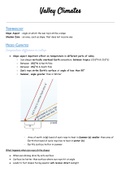
Slope Aspect - angle at which the sun ray’s strike a slope
Shadow Zone - an area, such as slope, that does not receive any
Micro-Climates
Temperature difference in valleys
● Slope aspect important effect on temperature in different parts of valley
○ Sun always vertically overhead Earth somewhere between tropics (23½°N & 23½°S)
○ Between 23½°N & North Pole
○ Between 23½°S & South Pole
○ Sun’s rays strike Earth’s surface at angle of less than 90°
○ Summer, angle greater than in Winter
- Area of earth is (a) band of sun’s rays to heat in Summer (a) smaller than area of
Earth that band of sun’s rays has to heat in winter (b)
- Earth’s surface hotter in summer
What happens when sun rays strike slopes
● When sun shining directly onto surface
● Surface be hotter than surface where sun rays hit at angle
● Leads to fact slopes facing equator will receive direct sunlight
, ● Slopes facing away from equator will not have direct sunlight
- Sun’s rays strike land at low angle to horizontal
- Sun’s rays coming from north side - direction of equator
- North-facing slope receives most heat from sun
- South-facing slope not receive any sun - slope is shadow zone
Northern Hemisphere vs Southern Hemisphere
Terminology
Slope Aspect - angle at which the sun ray’s strike a slope
Shadow Zone - an area, such as slope, that does not receive any
Micro-Climates
Temperature difference in valleys
● Slope aspect important effect on temperature in different parts of valley
○ Sun always vertically overhead Earth somewhere between tropics (23½°N & 23½°S)
○ Between 23½°N & North Pole
○ Between 23½°S & South Pole
○ Sun’s rays strike Earth’s surface at angle of less than 90°
○ Summer, angle greater than in Winter
- Area of earth is (a) band of sun’s rays to heat in Summer (a) smaller than area of
Earth that band of sun’s rays has to heat in winter (b)
- Earth’s surface hotter in summer
What happens when sun rays strike slopes
● When sun shining directly onto surface
● Surface be hotter than surface where sun rays hit at angle
● Leads to fact slopes facing equator will receive direct sunlight
, ● Slopes facing away from equator will not have direct sunlight
- Sun’s rays strike land at low angle to horizontal
- Sun’s rays coming from north side - direction of equator
- North-facing slope receives most heat from sun
- South-facing slope not receive any sun - slope is shadow zone
Northern Hemisphere vs Southern Hemisphere