Chapter 1: Biological Molecules
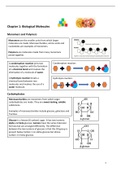
Monomers and Polymers
Monomers are the smaller units from which larger
molecules are made. Monosaccharides, amino acids and
nucleotides are examples of monomers.
Polymers are molecules made from many monomers
joined together.
A condensation reaction joins two Condensation reaction:
molecules together with the formation
of a chemical bond and involves the
elimination of a molecule of water.
A hydrolysis reaction breaks a Hydrolysis reaction:
chemical bond between two
molecules and involves the use of a
water molecule.
Carbohydrates
Monosaccharides are monomers from which larger
carbohydrates are made. They are sweet-tasting, soluble
substances.
Examples of monosaccharides include glucose, galactose and
fructose.
Glucose is a hexose (6-carbon) sugar. It has two isomers:
alpha and beta glucose. Isomers have the same molecular
formula but are arranged differently. The difference
between the two isomers of glucose is that the OH group is
present below Carbon 1 on alpha-glucose but above
Carbon 1 in beta-glucose.
1
, A pair of monosaccharides can be combined to form a
disaccharide.
• Glucose + Glucose = Maltose
• Glucose + Fructose = Sucrose
• Glucose + Galactose = Lactose
When the monosaccharides join, a molecule of water is Fructose is a natural sugar
removed, and the reaction is therefore called a condensation present in fruits, certain
reaction and the bond formed is called a glycosidic bond. When vegetables and honey.
water is added to a disaccharide, it breaks the glycosidic bond
releasing the constituent monosaccharides (hydrolysis).
Polysaccharides are formed by the condensation of many
glucose units. Examples include: Starch, Glycogen and
Cellulose.
Starch Glycogen
Structure: Polysaccharide of a-glucose. Mixture of Structure: Polysaccharides of a-glucose with
amylose and amylopectin; amylose has C1-C4 C1-C4 and C1-C6 glycosidic bonds so is highly
glycosidic bonds so is unbranched, while branched.
amylopectin has C1-C4 and C1-C6 glycosidic bonds
so is branched. Function: Energy store in animal cells.
Function: Energy store in plant cells. Structure relating to function:
Structure relating to function: • It is insoluble and therefore doesn't
affect water potential, so water is not
• It is insoluble and therefore doesn't affect drawn into the cell by osmosis.
water potential, so water is not drawn into • Being large and insoluble, it does not
the cell by osmosis. diffuse out of cells.
• Being large and insoluble, it does not • It is compact, so a lot of it can be
diffuse out of cells. stored in a small space.
• It is compact, so a lot of it can be stored in • It is more highly branched than
a small space. starch and so has more ends that can
• When hydrolysed, it forms a-glucose, be acted on simultaneously by
which is both easily transported and enzymes. Its therefore more rapidly
readily used in respiration. broken down to form glucose
• The branched form has many ends, each of monomers, which are used in
which can be acted on by enzymes respiration. This is important to
simultaneously meaning that glucose animals, which have a higher
monomers are released very rapidly. metabolic rate and therefore
respiratory rate than plants because
they are more active.
2
Monomers and Polymers
Monomers are the smaller units from which larger
molecules are made. Monosaccharides, amino acids and
nucleotides are examples of monomers.
Polymers are molecules made from many monomers
joined together.
A condensation reaction joins two Condensation reaction:
molecules together with the formation
of a chemical bond and involves the
elimination of a molecule of water.
A hydrolysis reaction breaks a Hydrolysis reaction:
chemical bond between two
molecules and involves the use of a
water molecule.
Carbohydrates
Monosaccharides are monomers from which larger
carbohydrates are made. They are sweet-tasting, soluble
substances.
Examples of monosaccharides include glucose, galactose and
fructose.
Glucose is a hexose (6-carbon) sugar. It has two isomers:
alpha and beta glucose. Isomers have the same molecular
formula but are arranged differently. The difference
between the two isomers of glucose is that the OH group is
present below Carbon 1 on alpha-glucose but above
Carbon 1 in beta-glucose.
1
, A pair of monosaccharides can be combined to form a
disaccharide.
• Glucose + Glucose = Maltose
• Glucose + Fructose = Sucrose
• Glucose + Galactose = Lactose
When the monosaccharides join, a molecule of water is Fructose is a natural sugar
removed, and the reaction is therefore called a condensation present in fruits, certain
reaction and the bond formed is called a glycosidic bond. When vegetables and honey.
water is added to a disaccharide, it breaks the glycosidic bond
releasing the constituent monosaccharides (hydrolysis).
Polysaccharides are formed by the condensation of many
glucose units. Examples include: Starch, Glycogen and
Cellulose.
Starch Glycogen
Structure: Polysaccharide of a-glucose. Mixture of Structure: Polysaccharides of a-glucose with
amylose and amylopectin; amylose has C1-C4 C1-C4 and C1-C6 glycosidic bonds so is highly
glycosidic bonds so is unbranched, while branched.
amylopectin has C1-C4 and C1-C6 glycosidic bonds
so is branched. Function: Energy store in animal cells.
Function: Energy store in plant cells. Structure relating to function:
Structure relating to function: • It is insoluble and therefore doesn't
affect water potential, so water is not
• It is insoluble and therefore doesn't affect drawn into the cell by osmosis.
water potential, so water is not drawn into • Being large and insoluble, it does not
the cell by osmosis. diffuse out of cells.
• Being large and insoluble, it does not • It is compact, so a lot of it can be
diffuse out of cells. stored in a small space.
• It is compact, so a lot of it can be stored in • It is more highly branched than
a small space. starch and so has more ends that can
• When hydrolysed, it forms a-glucose, be acted on simultaneously by
which is both easily transported and enzymes. Its therefore more rapidly
readily used in respiration. broken down to form glucose
• The branched form has many ends, each of monomers, which are used in
which can be acted on by enzymes respiration. This is important to
simultaneously meaning that glucose animals, which have a higher
monomers are released very rapidly. metabolic rate and therefore
respiratory rate than plants because
they are more active.
2