Economics and management for business
Chapter 12 – Money, banking and interest
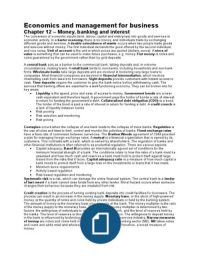
The conversion of economic inputs (land, labour, capital and enterprise) into goods and services is
economic activity. In a barter economy, there is no money, and individuals trade by exchanging
different goods and services. A double coincidence of wants occurs when two people trade goods
and services without money. The first individual demands the good offered by the second individual,
and vice versa. Unit of account is the unit in which prices are quoted (dollars, euros). A store of
value is something that can be used to make future purchases, e.g. money. Fiat money is notes and
coins guaranteed by the government rather than by gold deposits.
A central bank acts as a banker to the commercial bank, taking deposits and, in extreme
circumstances, making loans. A retail bank lends to non-banks, including households and non-bank
firms. Wholesale banks take large deposits and are involved in brokering very large loans to
companies. Most financial companies are involved in financial intermediation, which involves
channelling cash from savers to borrowers. Sight deposits provide customers with instant access to
cash. Time deposits require the customer to give the bank notice before withdrawing cash. The
services that banking offers are essential to a well-functioning economy. They can be broken into for
key areas:
Liquidity is the speed, price and ease of access to money. Government bonds are a near-
cash equivalent and therefore liquid. A government pays the holder of bonds a rate of interest
in return for funding the government’s debt. Collateralized debt obligation (CDO) is a bond.
The holder of the bond is paid a rate of interest in return for funding a debt. A credit crunch is
a lack of liquidity between banks
Risk pooling
Risk selection and monitoring
Risk pricing
Contagion occurs when the collapse of one bank leads to the collapse of more banks. Regulation is
the use of rules and laws to limit, control and monitor the activities of banks. Fixed exchange rates
have a fixes rate of conversion between currencies. The Bretton Woods agreement of 1944 provided
a plan for managing foreign exchange rates. A mutual is a financial organization that is owned by its
customers. This contrasts with a bank, which is owned by shareholders. The regulation of banks and
other financial institutions is often referred to as prudential regulation. There are various aspects:
Capital adequacy. Basel III provides an internationally agreed set of conditions for the
minimum financial strength of a bank. The conditions relate to how the risks of a bank must be
assessed and how much cash and reserves a bank must hold to protect itself against large
losses from the risks that it faces. Capital adequacy ratio is a measure of how much capital a
bank needs to protect itself from a large loss on the investments or loans that it has made.
Minimum serve requirements
Activity based regulation
Risk-based regulation and monitoring
Systematic risk is a risk, which can damage the entire financial system. The central bank is a lender
of last resort if a bank cannot raise funds from any other lender. Moral hazard occurs when someone
changes their behaviour because they are insulated from risk.
Credit creation is the process of turning existing bank deposits into credit facilities for borrowers. The
process can result in an increase in the money supply. Monetary base, or the stock of high-powered
money, is the quantity of notes and coins held by private individuals or held by the banking system.
The amount of money is the monetary base plus deposits at the bank. The money multiplier is the ratio
of the money supply to the monetary base. The size of the money multiplier is determined by two
factors: the willingness of individuals to deposit money in the bank, and the level of reserves held by
the banks. The level of reserves is directly influenced by regulation. The willingness to deposit money
in the bank is influenced by technological change in the financial services industry. Narrow measures
of money are notes and coins held in and outside of the private banking sector (M0). M4 takes notes
and coins and adds retail and wholesale banking deposits. M4 is, therefore, a broad measure of
money.
Chapter 12 – Money, banking and interest
The conversion of economic inputs (land, labour, capital and enterprise) into goods and services is
economic activity. In a barter economy, there is no money, and individuals trade by exchanging
different goods and services. A double coincidence of wants occurs when two people trade goods
and services without money. The first individual demands the good offered by the second individual,
and vice versa. Unit of account is the unit in which prices are quoted (dollars, euros). A store of
value is something that can be used to make future purchases, e.g. money. Fiat money is notes and
coins guaranteed by the government rather than by gold deposits.
A central bank acts as a banker to the commercial bank, taking deposits and, in extreme
circumstances, making loans. A retail bank lends to non-banks, including households and non-bank
firms. Wholesale banks take large deposits and are involved in brokering very large loans to
companies. Most financial companies are involved in financial intermediation, which involves
channelling cash from savers to borrowers. Sight deposits provide customers with instant access to
cash. Time deposits require the customer to give the bank notice before withdrawing cash. The
services that banking offers are essential to a well-functioning economy. They can be broken into for
key areas:
Liquidity is the speed, price and ease of access to money. Government bonds are a near-
cash equivalent and therefore liquid. A government pays the holder of bonds a rate of interest
in return for funding the government’s debt. Collateralized debt obligation (CDO) is a bond.
The holder of the bond is paid a rate of interest in return for funding a debt. A credit crunch is
a lack of liquidity between banks
Risk pooling
Risk selection and monitoring
Risk pricing
Contagion occurs when the collapse of one bank leads to the collapse of more banks. Regulation is
the use of rules and laws to limit, control and monitor the activities of banks. Fixed exchange rates
have a fixes rate of conversion between currencies. The Bretton Woods agreement of 1944 provided
a plan for managing foreign exchange rates. A mutual is a financial organization that is owned by its
customers. This contrasts with a bank, which is owned by shareholders. The regulation of banks and
other financial institutions is often referred to as prudential regulation. There are various aspects:
Capital adequacy. Basel III provides an internationally agreed set of conditions for the
minimum financial strength of a bank. The conditions relate to how the risks of a bank must be
assessed and how much cash and reserves a bank must hold to protect itself against large
losses from the risks that it faces. Capital adequacy ratio is a measure of how much capital a
bank needs to protect itself from a large loss on the investments or loans that it has made.
Minimum serve requirements
Activity based regulation
Risk-based regulation and monitoring
Systematic risk is a risk, which can damage the entire financial system. The central bank is a lender
of last resort if a bank cannot raise funds from any other lender. Moral hazard occurs when someone
changes their behaviour because they are insulated from risk.
Credit creation is the process of turning existing bank deposits into credit facilities for borrowers. The
process can result in an increase in the money supply. Monetary base, or the stock of high-powered
money, is the quantity of notes and coins held by private individuals or held by the banking system.
The amount of money is the monetary base plus deposits at the bank. The money multiplier is the ratio
of the money supply to the monetary base. The size of the money multiplier is determined by two
factors: the willingness of individuals to deposit money in the bank, and the level of reserves held by
the banks. The level of reserves is directly influenced by regulation. The willingness to deposit money
in the bank is influenced by technological change in the financial services industry. Narrow measures
of money are notes and coins held in and outside of the private banking sector (M0). M4 takes notes
and coins and adds retail and wholesale banking deposits. M4 is, therefore, a broad measure of
money.