Note 3: What to do when things go wrong in Strategic Quality
Management
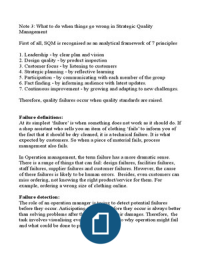
First of all, SQM is recognised as an analytical framework of 7 principles
1. Leadership - by clear plan and vision
2. Design quality - by product inspection
3. Customer focus - by listening to customers
4. Strategic planning - by reflective learning
5. Participation - by communicating with each member of the group
6. Fact finding - by informing audience with latest updates.
7. Continuous improvement - by growing and adapting to new challenges.
Therefore, quality failures occur when quality standards are raised.
Failure definitions:
At its simplest ‘failure’ is when something does not work as it should do. If
a shop assistant who sells you an item of clothing ‘fails’ to inform you of
the fact that it should be dry cleaned, it is a technical failure. It is what
expected by customers. So when a piece of material fails, process
management also fails.
In Operation management, the term failure has a more dramatic sense.
There is a range of things that can fail: design failures, facilities failures,
staff failures, supplier failures and customer failures. However, the cause
of these failures is likely to be human errors. Besides, even customers can
miss ordering, not knowing the right product/service for them. For
example, ordering a wrong size of clothing online.
Failure detection:
The role of an operation manager is trying to detect potential failures
before they occur. Anticipating problems before they occur is always better
than solving problems after they have done their damages. Therefore, the
task involves visualising every possible scenario why operation might fail
and what could be done to prevent it.
Management
First of all, SQM is recognised as an analytical framework of 7 principles
1. Leadership - by clear plan and vision
2. Design quality - by product inspection
3. Customer focus - by listening to customers
4. Strategic planning - by reflective learning
5. Participation - by communicating with each member of the group
6. Fact finding - by informing audience with latest updates.
7. Continuous improvement - by growing and adapting to new challenges.
Therefore, quality failures occur when quality standards are raised.
Failure definitions:
At its simplest ‘failure’ is when something does not work as it should do. If
a shop assistant who sells you an item of clothing ‘fails’ to inform you of
the fact that it should be dry cleaned, it is a technical failure. It is what
expected by customers. So when a piece of material fails, process
management also fails.
In Operation management, the term failure has a more dramatic sense.
There is a range of things that can fail: design failures, facilities failures,
staff failures, supplier failures and customer failures. However, the cause
of these failures is likely to be human errors. Besides, even customers can
miss ordering, not knowing the right product/service for them. For
example, ordering a wrong size of clothing online.
Failure detection:
The role of an operation manager is trying to detect potential failures
before they occur. Anticipating problems before they occur is always better
than solving problems after they have done their damages. Therefore, the
task involves visualising every possible scenario why operation might fail
and what could be done to prevent it.