

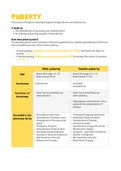
PUBERTY
The process of physical and physiological changes (known as adolescence)
It leads to:
• The development of secondary sex characteristics
• An individual becoming capable of reproduction
How does puberty start?
The pituitary gland, under stimulation from the hypothalamus, releases gonadotropins (hormone
that stimulates gonads), which initiate puberty.
- In male puberty, interstitial-cell-stimulating hormone (ICSH) stimulates the testes to
secrete testosterone.
- In female puberty, follicle-stimulating-hormone (FSH) stimulates the ovaries to produce
oestrogen.
Male puberty Female puberty
Age - Starts from ages 14-16 - Starts from age of 11-14
- Ends around 18-21 - Ends around 17-20
Hormones - testosterone - oestrogen
- progesterone
Function of - Gives rise to secondary sex - Gives rise to secondary sex
characteristics characteristics
hormones
- Help prepare endometrium in the
uterus for the implantation of
embryo
Secondary sex ‣ Increased muscle mass ‣ Increased fat deposit below skin
characteristics ‣ Development of deeper voice ‣ Widening of hips and pelvis
‣ Enlargement of the penis and ‣ Development of breasts
testes ‣ Increase in height
‣ Production of sperm ‣ Development of egg and ovaries
‣ Development of sexual drive ‣ Menstruation begins
‣ Increased sweat production ‣ Ovulation - year after !rst period
‣ Increase in facial and body hair ‣ Growth of body hair
‣ Skin becomes more oily ‣ Skin becomes more oily
‣ Behavioural changes ‣ Behavioural changes
The process of physical and physiological changes (known as adolescence)
It leads to:
• The development of secondary sex characteristics
• An individual becoming capable of reproduction
How does puberty start?
The pituitary gland, under stimulation from the hypothalamus, releases gonadotropins (hormone
that stimulates gonads), which initiate puberty.
- In male puberty, interstitial-cell-stimulating hormone (ICSH) stimulates the testes to
secrete testosterone.
- In female puberty, follicle-stimulating-hormone (FSH) stimulates the ovaries to produce
oestrogen.
Male puberty Female puberty
Age - Starts from ages 14-16 - Starts from age of 11-14
- Ends around 18-21 - Ends around 17-20
Hormones - testosterone - oestrogen
- progesterone
Function of - Gives rise to secondary sex - Gives rise to secondary sex
characteristics characteristics
hormones
- Help prepare endometrium in the
uterus for the implantation of
embryo
Secondary sex ‣ Increased muscle mass ‣ Increased fat deposit below skin
characteristics ‣ Development of deeper voice ‣ Widening of hips and pelvis
‣ Enlargement of the penis and ‣ Development of breasts
testes ‣ Increase in height
‣ Production of sperm ‣ Development of egg and ovaries
‣ Development of sexual drive ‣ Menstruation begins
‣ Increased sweat production ‣ Ovulation - year after !rst period
‣ Increase in facial and body hair ‣ Growth of body hair
‣ Skin becomes more oily ‣ Skin becomes more oily
‣ Behavioural changes ‣ Behavioural changes


