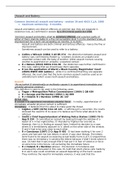
Assault and Battery.
Common (technical) assault and battery - section 39 and 40(3) C.J.A. 1988
maximum sentencing - 6 months.
Assault and battery are distinct offences at common law; they are separate in
existence now, as confirmed in statute by s.39 Criminal Justice Act 1988.
‘Common assault and battery shall be summary offences and a person guilty of
either of them shall be liable to a fine not exceeding level 5 on the standard scale, to
imprisonment for a term not exceeding six months, or to both’.
- Assault and battery are both criminal and tortious offences - hence the fine or
imprisonment.
- Sometimes assault can be used to refer to a battery.
Collins v Wilcock (1984) 3 All ER 374 - the distinction between assault and
battery was confirmed by Robert LJ, ‘a battery involves an unlawful and
unwanted contact with the body of another, whilst assault involves causing
another to apprehend an unlawful, unwanted contact.’
R v Nelson (2013) EWCA Crim 30 - the distinction was further confirmed in
this case, stating that we should keep them separate.
R (on the application of Ward) v Black Country Magistrates’ Court
(2020) EWHC 680 (admin.) - while it is confirmed that they are separate
offences, the court said that the term common assault could be used as an
umbrella term which covers both assault and battery.
Assault
“An act which D intentionally or recklessly causes V to apprehend immediate and
unlawful personal violence”.
This definition is seen to be used in the following cases.
Fagan v Metropolitan Police Commissioner (1969) 1 QB 439
R v Savage and Parmenter (1992) 1 AC 699
R v Ireland; R v Burstow (1998) AC 147
Actus reus
D caused V to apprehend immediate unlawful ‘force’ - in reality, apprehension of
immediate unlawful physical contact is sufficient.
Immediacy - V believes that D is about to make good the threat.
Logdon v DPP (1976) Crim LR 121 - in affirming D’s conviction, the courts
stressed the need for D to cause V to believe such force what about to be
inflicted.
Smith v Chief Superintendent of Woking Police Station (1983) 76 Cr
App R 234 - D committed an assault by looking through the window of a
bedsit at V in her nightclothes. D intended to frighten her and did so.
However, Kerr LJ, in finding an assault here, limited his decision to a case
where D is immediately adjacent to V, albeit on the other side of the window.
D and V had to be very close to each other.
R v Constanza (1997) 2 Cr App R 492 - D had been stalking V for over 2
years and had sent her two letters in which V saw clear threats. The letters
were found to be assault occasioning actual bodily harm (s.47). D argued that
there was no immediacy in sending the letters because V didn’t know where D
was. CA held that it was enough that D had put V in fear of violence or force
at some time in the future, not excluding the immediate future.
R v Ireland; R v Burstow (above) - the decision in Constanza was
subsequently attenuated in this case. HL held that silent phone calls made by
D in each case could constitute an assault depending on the harm caused.
They reinforce the need for immediate violence. It was said that the
, requirement in assault is that V apprehends immediate violence, and not
immediately apprehend some violence later on.
J. Horder, ‘Reconsidering Psychic Assault’ (1998) Criminal Law Review 392 -
o Immediacy is dependent on the facts of the case.
D’s inability to carry out the threat - there may be assault even where D has no
means of carrying out the threat.
R v Lamb (1967) 2 QB 981- D pointed an unloaded gun at V, V knew that
the gun was unloaded/imitation and so there was no assault as V was not put
in fear.
Logdon v DPP (above) - if V believes an imitation gun to be a real loaded
gun, there can be an assault based on what V believed, because V would fear
(apprehend) immediate personal violence.
D’s words negating the threat in D’s actions?
Tuberville v Savage (1669) 1 Mod Rep 3 - V insulted D and D lay his
hands on his sword and said, ‘if it were not assize-time, I would not take such
language from you’. It was held that this did not amount to an assault as the
words indicated that no violence would ensue.
D’s words as a conditional threat - where D makes a conditional threat upon V’s
actions.
Blake v Barnard (1840) 9 C & P 626 - D put a gun at the head of V and
said, ‘be quiet or I blow your brain out’. Found there was no assault where V
did what he is told.
Read v Coker (1853) 13 CB 850 - D threatened to break V’s neck if he did
not leave the premises. The court of common pleas found that this was an
assault even if the act was never carried out.
‘Caused’
Usual rules on factual and legal causation apply.
Mens rea
D intended or was reckless as to V’s apprehension of immediate unlawful physical
contact.
Intention OR recklessness will suffice
R v Venna (1976) QB 421- mens rea upheld in this case.
Test for recklessness
presumed to be that in R v G & R (2003) UKHL 50 - A person acts recklessly
with respect to (i) a circumstance when he is aware of a risk that exists or will
exist and (ii) a result when he is aware of a risk that will occur and it is, in the
circumstances known to him, unreasonable to take the risk.
Battery
“A battery consists of the intentional or reckless infliction by D of unlawful personal
violence upon V”
Actus reus
An act by which D intentionally or recklessly inflicts unlawful personal violence upon
the victim.
How much violence is needed?
“Any intentional touching of another person without the consent of that
person and without lawful excuse” - Faulkner v Talbot (1981) per
LViolence.
What about everyday contacts between people?
Collins v Wilcock (1984) - implied consent of everyday contacts between
people. Goff LJ stated that there is an exception to unlawful touching, which
embraces all physical contact, which is generally acceptance in the ordinary
conduct of daily life e.g., touching someone on the shoulder to say ‘hi’.
Act or omission?
Common (technical) assault and battery - section 39 and 40(3) C.J.A. 1988
maximum sentencing - 6 months.
Assault and battery are distinct offences at common law; they are separate in
existence now, as confirmed in statute by s.39 Criminal Justice Act 1988.
‘Common assault and battery shall be summary offences and a person guilty of
either of them shall be liable to a fine not exceeding level 5 on the standard scale, to
imprisonment for a term not exceeding six months, or to both’.
- Assault and battery are both criminal and tortious offences - hence the fine or
imprisonment.
- Sometimes assault can be used to refer to a battery.
Collins v Wilcock (1984) 3 All ER 374 - the distinction between assault and
battery was confirmed by Robert LJ, ‘a battery involves an unlawful and
unwanted contact with the body of another, whilst assault involves causing
another to apprehend an unlawful, unwanted contact.’
R v Nelson (2013) EWCA Crim 30 - the distinction was further confirmed in
this case, stating that we should keep them separate.
R (on the application of Ward) v Black Country Magistrates’ Court
(2020) EWHC 680 (admin.) - while it is confirmed that they are separate
offences, the court said that the term common assault could be used as an
umbrella term which covers both assault and battery.
Assault
“An act which D intentionally or recklessly causes V to apprehend immediate and
unlawful personal violence”.
This definition is seen to be used in the following cases.
Fagan v Metropolitan Police Commissioner (1969) 1 QB 439
R v Savage and Parmenter (1992) 1 AC 699
R v Ireland; R v Burstow (1998) AC 147
Actus reus
D caused V to apprehend immediate unlawful ‘force’ - in reality, apprehension of
immediate unlawful physical contact is sufficient.
Immediacy - V believes that D is about to make good the threat.
Logdon v DPP (1976) Crim LR 121 - in affirming D’s conviction, the courts
stressed the need for D to cause V to believe such force what about to be
inflicted.
Smith v Chief Superintendent of Woking Police Station (1983) 76 Cr
App R 234 - D committed an assault by looking through the window of a
bedsit at V in her nightclothes. D intended to frighten her and did so.
However, Kerr LJ, in finding an assault here, limited his decision to a case
where D is immediately adjacent to V, albeit on the other side of the window.
D and V had to be very close to each other.
R v Constanza (1997) 2 Cr App R 492 - D had been stalking V for over 2
years and had sent her two letters in which V saw clear threats. The letters
were found to be assault occasioning actual bodily harm (s.47). D argued that
there was no immediacy in sending the letters because V didn’t know where D
was. CA held that it was enough that D had put V in fear of violence or force
at some time in the future, not excluding the immediate future.
R v Ireland; R v Burstow (above) - the decision in Constanza was
subsequently attenuated in this case. HL held that silent phone calls made by
D in each case could constitute an assault depending on the harm caused.
They reinforce the need for immediate violence. It was said that the
, requirement in assault is that V apprehends immediate violence, and not
immediately apprehend some violence later on.
J. Horder, ‘Reconsidering Psychic Assault’ (1998) Criminal Law Review 392 -
o Immediacy is dependent on the facts of the case.
D’s inability to carry out the threat - there may be assault even where D has no
means of carrying out the threat.
R v Lamb (1967) 2 QB 981- D pointed an unloaded gun at V, V knew that
the gun was unloaded/imitation and so there was no assault as V was not put
in fear.
Logdon v DPP (above) - if V believes an imitation gun to be a real loaded
gun, there can be an assault based on what V believed, because V would fear
(apprehend) immediate personal violence.
D’s words negating the threat in D’s actions?
Tuberville v Savage (1669) 1 Mod Rep 3 - V insulted D and D lay his
hands on his sword and said, ‘if it were not assize-time, I would not take such
language from you’. It was held that this did not amount to an assault as the
words indicated that no violence would ensue.
D’s words as a conditional threat - where D makes a conditional threat upon V’s
actions.
Blake v Barnard (1840) 9 C & P 626 - D put a gun at the head of V and
said, ‘be quiet or I blow your brain out’. Found there was no assault where V
did what he is told.
Read v Coker (1853) 13 CB 850 - D threatened to break V’s neck if he did
not leave the premises. The court of common pleas found that this was an
assault even if the act was never carried out.
‘Caused’
Usual rules on factual and legal causation apply.
Mens rea
D intended or was reckless as to V’s apprehension of immediate unlawful physical
contact.
Intention OR recklessness will suffice
R v Venna (1976) QB 421- mens rea upheld in this case.
Test for recklessness
presumed to be that in R v G & R (2003) UKHL 50 - A person acts recklessly
with respect to (i) a circumstance when he is aware of a risk that exists or will
exist and (ii) a result when he is aware of a risk that will occur and it is, in the
circumstances known to him, unreasonable to take the risk.
Battery
“A battery consists of the intentional or reckless infliction by D of unlawful personal
violence upon V”
Actus reus
An act by which D intentionally or recklessly inflicts unlawful personal violence upon
the victim.
How much violence is needed?
“Any intentional touching of another person without the consent of that
person and without lawful excuse” - Faulkner v Talbot (1981) per
LViolence.
What about everyday contacts between people?
Collins v Wilcock (1984) - implied consent of everyday contacts between
people. Goff LJ stated that there is an exception to unlawful touching, which
embraces all physical contact, which is generally acceptance in the ordinary
conduct of daily life e.g., touching someone on the shoulder to say ‘hi’.
Act or omission?