Chapter 5: Evolution
Evidence of Evolution
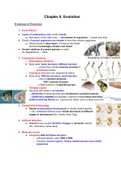
1) Fossil Record
● Layers of sedimentary rock contain fossils
a) New layers cover older ones → succession of organisms → record over time
● Fossils of ancient organisms are simpler in form than modern organisms
a) Oldest fossils in deep layers: moving up the fossils
become increasingly complex and recent
● Ancient relatives of present species on earth.
Ex: Megatherium → Sloth
2) Comparative Anatomy
○ Homologous structure
● Body parts: Same structure, different function
→ means they shared common ancestor in
evolutionary history
○ Analogous structure (ex: wing bird & insect)
● Body parts: Different structure, same function
→ Due to selective pressure,
NOT common ancestry
→ Flight evolved in 3 separate groups
○ Vestigial organs
● Structure with small or no function
→ Remnants of structures that were functional in ancestral species
→ Deleterious mutation accumulate in genes for non-critical structures
without reducing fitness (ex: Leg bone on whale, eyes on blind cave fish)
3) Comparative Embryology
● Similar embryological development in closely related species
→ ALL vertebrate embryos have similar structures at different
stages of development (Ex: Snake, birds, frog)
4) Artificial Selection
● Humans have caused heritable changes in domestic animals
(Ex: Chihuahua, Great dane)
5) Molecular record
● Comparing DNA & Protein structure
○ Universal genetic code: DNA & RNA
○ Compare common genes: closely related species have similar
sequences
, Natural Selection, Variation and Overproduction
Natural selection: Evolution is gradual change of species
● Darwin: “Descent with modification”
Populations evolve:
1. Natural selection acts on individuals
a. Differential survival
b. Differential reproductive success
2. Populations evolve
a. Genetic makeup of population changes over time
b. Favorable traits (greater fitness) become more common
For evolution to occur: there must be variation
Fitness: Ability to survive & reproduce in an environment
● Survival & Reproductive success
● Individuals with one phenotype leave more surviving offspring
Variation & Natural selection: Variation is the raw material for natural selection
● There have to be differences within population
● Some individuals must be more fit than others
● The more variation, the better ability to survive → That’s why small populations are at
high risk of dying out (they are getting more and more related to each other)
Where does variation come from
● Mutation
○ Random changes to DNA
■ Errors in gamete production
■ Environmental damage
● Sex
○ Mixing of alleles
■ Recombination of alleles
● New arrangements in every offspring
■ New combinations of traits
○ Spreads variation
■ Offspring inherit traits from parent
○ Crossing over: Chromosomal segments are exchanged between homologous
chromosomes
○ Independent assortment: random distribution of alleles occurs during gamete
formation
Random fertilization: Adds to genetic variation because any sperm can fuse with any ovum
(unfertilized egg) Extra: 70 trillion diploid combinations without crossing over
Evidence of Evolution
1) Fossil Record
● Layers of sedimentary rock contain fossils
a) New layers cover older ones → succession of organisms → record over time
● Fossils of ancient organisms are simpler in form than modern organisms
a) Oldest fossils in deep layers: moving up the fossils
become increasingly complex and recent
● Ancient relatives of present species on earth.
Ex: Megatherium → Sloth
2) Comparative Anatomy
○ Homologous structure
● Body parts: Same structure, different function
→ means they shared common ancestor in
evolutionary history
○ Analogous structure (ex: wing bird & insect)
● Body parts: Different structure, same function
→ Due to selective pressure,
NOT common ancestry
→ Flight evolved in 3 separate groups
○ Vestigial organs
● Structure with small or no function
→ Remnants of structures that were functional in ancestral species
→ Deleterious mutation accumulate in genes for non-critical structures
without reducing fitness (ex: Leg bone on whale, eyes on blind cave fish)
3) Comparative Embryology
● Similar embryological development in closely related species
→ ALL vertebrate embryos have similar structures at different
stages of development (Ex: Snake, birds, frog)
4) Artificial Selection
● Humans have caused heritable changes in domestic animals
(Ex: Chihuahua, Great dane)
5) Molecular record
● Comparing DNA & Protein structure
○ Universal genetic code: DNA & RNA
○ Compare common genes: closely related species have similar
sequences
, Natural Selection, Variation and Overproduction
Natural selection: Evolution is gradual change of species
● Darwin: “Descent with modification”
Populations evolve:
1. Natural selection acts on individuals
a. Differential survival
b. Differential reproductive success
2. Populations evolve
a. Genetic makeup of population changes over time
b. Favorable traits (greater fitness) become more common
For evolution to occur: there must be variation
Fitness: Ability to survive & reproduce in an environment
● Survival & Reproductive success
● Individuals with one phenotype leave more surviving offspring
Variation & Natural selection: Variation is the raw material for natural selection
● There have to be differences within population
● Some individuals must be more fit than others
● The more variation, the better ability to survive → That’s why small populations are at
high risk of dying out (they are getting more and more related to each other)
Where does variation come from
● Mutation
○ Random changes to DNA
■ Errors in gamete production
■ Environmental damage
● Sex
○ Mixing of alleles
■ Recombination of alleles
● New arrangements in every offspring
■ New combinations of traits
○ Spreads variation
■ Offspring inherit traits from parent
○ Crossing over: Chromosomal segments are exchanged between homologous
chromosomes
○ Independent assortment: random distribution of alleles occurs during gamete
formation
Random fertilization: Adds to genetic variation because any sperm can fuse with any ovum
(unfertilized egg) Extra: 70 trillion diploid combinations without crossing over