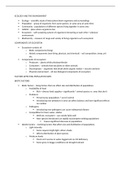
ECOLOGY AND THE ENVIRONMENT
Ecology – scientific study of interactions btwn organisms and surroundings
Population – group of organisms from same species, in same area at same time
Community – populations of different species living together in same area
Habitat – place where organisms live
Ecosystem – self-sustaining system of organisms interacting w each other + physical
environment
Biodiversity – measure of range and variety of living organisms w/in ecosystem
COMPONENTS OF ECOSYSTEM
Ecosystem consists of:
o Biotic components (living)
o Abiotic components (non-living, physical, and chemical) – soil composition, temp, pH
etc.
Components of ecosystem
o Producers – plants which photosynthesize
o Consumers – animals that eat plants or other animals
o Decomposers – organisms that break down organic matter + recycle nutrients
o Physical environment – all non-biological components of ecosystem
FACTORS AFFECTING POPULATION SIZES
BIOTIC FACTORS
Biotic factors – living factors that can affect size and distribution of populations
o Availability of food
Rich + diverse food supplies = significantly ^ animal species vs. ones that don’t
o Predators
Prevent prey populations ^ out of control
Introducing new predators in area can affect balance and have significant effects
on number
o Pathogens
Introducing new pathogens can cause widespread disease
o Competition for food, water, shelter
Well-est. ecosystem – can coexist fairly well
New species introduced can rapidly outcompete existing populations
Causes significant decrease in populations
Abiotic factors – nonliving factors that affect size and distribution of populations
o Light intensity
Some require bright light, others shade
Affects distribution of plant species
o Moisture levels
Most can’t survive in water-logged soil cos O2 deficiency
Some grow in boggy conditions not drought tolerant
, o Temperature
Both animals and plants grow optimally at specific temp
o Oxygen level
Aquatic organisms require certain dissolved O2 levels
o pH of soil or water
some plants grow in alkaline soil, other acidic, others can’t
aquatic organisms can cope w acidic waters
affects distribution
o Availability of minerals
w/out minerals – growth and reproduction low
o CO2 levels
Areas w ^CO2 levels = healthier plants cos photosynthesis
BIODIVERSITY
Measure of range and variety of living organisms w/in ecosystem
Biodiversity due to:
o Genetic diversity
o Species diversity
o Ecosystem diversity
Ecosystem’s biodiversity combination of:
o Species richness – no. of different species present
o Relative abundance of each species
Biodiversity is good for ecosystem
More stable w ^ biodiversity
o Ecosystem dominated by one species - ^likely to be affected by ecological disaster
Disease could wipe out dominant species
Impact on other species that rely on them for food + shelter
o W ^ biodiversity resources can be supplied w help of other species
INVESTIGATING POPULATION SIZE
Sample – small representative part of population
Quadrat – square frame of wood or metal divided into smaller squares inside
o Placed on ground and plants found inside can be counted
o Placement of quadrat = random to avoid biased results
When using quadrat:
o Place randomly so representative sample is taken
o Validity + reliability of results ^ w ^quadrat samples taken
TRANSECTS
Method used when there is a transition across an area
Transect – line across habitat/part of habitat
No. of organisms of each species observed + recorded at regular intervals along transect
Line transect only records organisms that actually touch line
Ecology – scientific study of interactions btwn organisms and surroundings
Population – group of organisms from same species, in same area at same time
Community – populations of different species living together in same area
Habitat – place where organisms live
Ecosystem – self-sustaining system of organisms interacting w each other + physical
environment
Biodiversity – measure of range and variety of living organisms w/in ecosystem
COMPONENTS OF ECOSYSTEM
Ecosystem consists of:
o Biotic components (living)
o Abiotic components (non-living, physical, and chemical) – soil composition, temp, pH
etc.
Components of ecosystem
o Producers – plants which photosynthesize
o Consumers – animals that eat plants or other animals
o Decomposers – organisms that break down organic matter + recycle nutrients
o Physical environment – all non-biological components of ecosystem
FACTORS AFFECTING POPULATION SIZES
BIOTIC FACTORS
Biotic factors – living factors that can affect size and distribution of populations
o Availability of food
Rich + diverse food supplies = significantly ^ animal species vs. ones that don’t
o Predators
Prevent prey populations ^ out of control
Introducing new predators in area can affect balance and have significant effects
on number
o Pathogens
Introducing new pathogens can cause widespread disease
o Competition for food, water, shelter
Well-est. ecosystem – can coexist fairly well
New species introduced can rapidly outcompete existing populations
Causes significant decrease in populations
Abiotic factors – nonliving factors that affect size and distribution of populations
o Light intensity
Some require bright light, others shade
Affects distribution of plant species
o Moisture levels
Most can’t survive in water-logged soil cos O2 deficiency
Some grow in boggy conditions not drought tolerant
, o Temperature
Both animals and plants grow optimally at specific temp
o Oxygen level
Aquatic organisms require certain dissolved O2 levels
o pH of soil or water
some plants grow in alkaline soil, other acidic, others can’t
aquatic organisms can cope w acidic waters
affects distribution
o Availability of minerals
w/out minerals – growth and reproduction low
o CO2 levels
Areas w ^CO2 levels = healthier plants cos photosynthesis
BIODIVERSITY
Measure of range and variety of living organisms w/in ecosystem
Biodiversity due to:
o Genetic diversity
o Species diversity
o Ecosystem diversity
Ecosystem’s biodiversity combination of:
o Species richness – no. of different species present
o Relative abundance of each species
Biodiversity is good for ecosystem
More stable w ^ biodiversity
o Ecosystem dominated by one species - ^likely to be affected by ecological disaster
Disease could wipe out dominant species
Impact on other species that rely on them for food + shelter
o W ^ biodiversity resources can be supplied w help of other species
INVESTIGATING POPULATION SIZE
Sample – small representative part of population
Quadrat – square frame of wood or metal divided into smaller squares inside
o Placed on ground and plants found inside can be counted
o Placement of quadrat = random to avoid biased results
When using quadrat:
o Place randomly so representative sample is taken
o Validity + reliability of results ^ w ^quadrat samples taken
TRANSECTS
Method used when there is a transition across an area
Transect – line across habitat/part of habitat
No. of organisms of each species observed + recorded at regular intervals along transect
Line transect only records organisms that actually touch line