

100% satisfaction guarantee Immediately available after payment Both online and in PDF No strings attached 4.6 TrustPilot
logo-home
Exam (elaborations)

NURS 7755 NCLEX__hurst Questions And Answers (2022/23)

Rating
-
Sold
-
Pages
106
Grade
A
Uploaded on
05-07-2022
Written in
2021/2022

o Calcium has an inverse relation to phosphorus  When Calcium goes up, Phosphorus goes down (Hypophosphatemia) and vice versa o Sodium has an inverse relation to Potassium  When sodium goes up, Potassium goes down and vice versa  HyperParathyroidsm = HYPERCALCEMIA = HYPOPHOSPATEMIA Every time you see Hyperparathyroidism that’s the same exact thing as Hypercalcemia o Epinephrine is secreted – vasoconstrictor When Hypovolemic (blood volume deficit), ADH and aldosterone will be secreted so keep blood volume up **Weight is the best indicator for fluid status EXCEPT for Burns, Its Urine Output** Also for ventilator alarms HOLD High alarm- Obstruction due to incr. secretions, kink, pt. coughs, gag or bites Low press alarm- Disconnection or leak in ventilator or in pt. airway cuff, pt. stops spontaneous breathing To remember blood sugar: hot and dry-sugar high (hyperglycemia) cold and clammy-need some candy (hypoglycemia) Eu = Normal for example: Euthyroid is normal thyroid Increase of LDL, THINK Coronary Artery Disease Increase secretion of PTH makes serum calcium go up Decrease secretion of PTH makes serum calcium go down You dangle artery problems and you elevate vein issue problems IMPORTANT WHEN IT ASKS FOR PRIOIRTY, ASK YOURSELF YOURE GOING TO DO THAT OVER AND OVER AGAIN AND NOTHING ELSE  EXAMPLE: client is hemorrhaging, do you check for vital signs or call the HCP Hypervolemia: Too much fluid in the vascular space (too much water in the hose) Will Cause: HF  Weak Heart  low Cardiac output  Low Urine Perfusion  Low Urine Output Heart Failure Renal Failure S/S: Bounding Pulse SOB; Dyspnea Crackles/ wet lung sounds (listen to the low area in the back) Distended Neck (JVD) and Peripheral Veins Peripheral Edema (sacrum area) and Third spacing Rapid Weight gain Low urine output (specific gravity of 1.010 or less) Central Venous Pressure (CVP): More volume (Hypervolemia) = More Pressure CVP normal is 2-8 Low volume (Hypovolemia) = Low Pressure Position: Semi Fowler; BED REST FOR THESE PATIENTS (hyper & Hypo) Diet: Hypertension, heart failure, CAD—low sodium, calorie-restricted, Low fat Treatment: Hydrochlorothiazide: Will make you lose Potassium Furosemide: Will make you lose Potassium Bumetanide: Will make you lose Potassium  Give SPIRONOLACTONE to retain Potassium but watch for Hyperkalemia o KEEP CLIENT ON BED REST (helps reduce sodium and water) Teaching: Check Daily weights and Input and Output ***clients with History of HF and Kidney, give fluids slow and watch for Hypervolemia*** HYPOVOLEMIA: Fluid not in the vascular space  SHOCK (COLD AND CLAMMY) Look for Hypovolemia in (anything that causes losing fluid): Trauma SURGERY patients NG tube Paracentesis  you losing fluid Vomiting and diarrhea Ascites: fluid in the abdomen; Edema: Fluid in the wrong spot so check for Hypovolemia Polyuria: Fluid in the wrong spot so check for Hypovolemia Will Cause: Third spacing: When fluid goes somewhere else other than Other than the vascular space Ascites: fluid in the abdomen  People with liver Disease will have this Edema Polyuria: When you see this, THINK Shock First ** When you go into HYPOVOLEMIC STATE (Hemorrhage, vomiting, or anything that causes you to lose water), the ALDOSTERONE hormone secretion will increase to preserve/retain sodium and water*** S/S: Increased temp Decreased skin Turgor Low mucous COLD AND CLAMMY Rapid/weak/thready pulse, High pulse (tachycardic) and Tachypnea Increased Respirations Hypotension (Orthostatic/postural mainly) Anxiety, weight loss Decreased Urine output Urine specific gravity 1.030 Low CVP pressure Vessels are vasoconstricted *Concentrated makes labs go up like hematocrit and dilute makes it go down* Position/Nursing Intervention for SHOCK: THINK DIZZINISS Bedrest with extremities elevated 20 degrees Knees straight Head slightly elevated (modified Trendelenburg) Treatment: Give Fluids Safety precautions (high risk for falls) Monitor IV fluids (weight check and I and O) TYPES OF IV FLUIDS ISOTONIC (0.9%) - *D5W - Normal Saline - Lactated Ringers - D5 ¼ NS (used for Peds) **Contraindicated: Hypertensive, Renal, and heart disease** HYPOTONIC SOLUTION (0.33%) - D2.5W - ½ NS OR 0.33 NS ***Use for: Hypertension, Heart problem, Renal Disease*** **Watch for Cellular Edema** Hypertonic Solution (TPN): - D10W, 3% NS, 5% NS - D5 LR, D1/2 NS, D5NS - **TPN (most common) - Albumin **Watch for pulmonary edema, Fluid volume excess, Hypertension** Aldosterone = Steroids aka Mineralocorticoids retains sodium and water Cushing’s Syndrome: Too much Aldosterone (steroids) Hyperaldosteronism (Conn’s Syndrome): Too much Aldosterone (steroids) S/S: HyperNa: If you are obese, you have to much sodium HypoK Hyperglycemia, Prone to infection, Muscle wasting; weakness, Edema; Obesity HTN, Hirsutism, Moon face Buffalo hump Diet: Low sodium, High potassium diet. Increase protein, Increase Calcium ***Cushing: Everything is High Except Potassium*** CLIENT NEEDS QUITE ROOM Risk for osteoporosis Protein means kidney damage Glucose and ketones are for long term use which will show in urine sample Uric acid is kidney stones ADDison disease is ABSENT of steroids.  think of a bodybuilder who’s on steroids, he’s very big vs the other guy who is not taking steroids. He will be SMALL, AND WEAK AND TAN With Addison disease, they have Absent of steroids meaning LOW so everything will be LOW except 2 things LOW BP (CRITICAL)  Shock LOW weight (water loss) LOW sodium (hyponatremia) LOW glucose (Hypoglycemia) LOW or slow periods (amenorrhea) LOW resistance to stress Fractures Alopecia Weight loss GI distress HIGH Potassium (hyperKalemia) HIGH pigmentation “Bronze Pigment”  don’t get this confused with the Acanthosis nigricans Loss of libido and decreased axillary and pubic hair are common in Addison's disease due to lower levels of androgens. Diet: Increased sodium, low potassium diet. Addisonian Crisis: N/V Confusion Abdominal pain Extreme weakness Hypoglycemia Dehydration Decreased BP - Treatment: Meds:  NEVER STOP TAKING MEDS ABRUPTLY  Prednisolone: 2x a day in split days  Fluicosteriods: this is Aldosterone SIADH: too much ADH  potential complication of head injury Syndrome of inappropriate antidiuretic hormone (SIADH) is potential complication of head injury or Pituitary (located right through the bridge of the nose so any nose/sinus injury can also be it too) or a TRANSSPHENOIDAL HYPOPHYSCEMETY and INTERCRANIAL PRESSURE. In SIADH, the extra ADH leads to excessive water absorption by the kidneys. IF YOU HAVE ICP, ABSERVE FOR ADH PROBLEMS DO NO GIVE YOUR PATIENT FLUIDS IF THEY HAVE SIADH.  KEEP THEM ON FLUID RESTRICTIONS S/S OF SIADH: Low urine output (cuz their brain is absorbing it all so no point in giving them more unless you tryna kill your patient!! HAH ROT IN JAIL) Increased urine gravity Decrease in urine osmolality (if one is increased the other one is obviously decreased Ex: high urine output so low urine osmolality) BASICALLY REMEMBER OPPOSITES ATTRACT - ALSO WILL BE HYPONATERMIA!! - Changes in LOC - Decreased deep Tendon Reflexes - Tachycardia - N/V -  Side note: all these are bullshit, just know SIADH has to do with LOW URINE OUTPUT which obviously means Increase in urine gravity o The higher the urine output, the lower urine gravity o The lower the urine output, the higher urine gravity Treatment: Administer Desmopressin Diuretics Declomycin Lab work: Urine specific Gravity Sodium Hematocrit SIADH: causes include central nervous system disorders (eg, stroke, trauma, neurosurgery) and some commonly used medications (eg, desmopressin, carbamazepine Diabetes insipidus (DI): think D for dehydrated so they are Dry Inside  Diabetes Insipidus R N Y S I ***WHEN YOU SEE DI, REMEMBER D FOR DIURESES*** D E  High Urine Output (because they are peeing everything out, so they are dry inside)  Low urine gravity which automatically means they’ll have high osmolality  HyperNatremia  this goes with the High Osmolality, if you have high osmolality, you’ll have high sodium and vice versa  Polydipsia aka DIURESIS (since they are dry inside, they’ll be thirsty  Dry mucous membranes CUZ they DRY INSIDE DUHH!  HYPOTENSION REMEMBER CARDIAC, when you have a low fluid inside, you turn HYPOTENSIVE  SHOCK  DESMOPRESSION AKA VASOPRESSIN gets your BP up AND decreases Urine output  can cause deadly headaches because it also decreases sodium ***BIGGEST COMPLICATION IS SHOCK FOR DI*** TREATMENT: Any Med with -RESSIN (desmopressin, Pitressin) Hyper Magnesium and Hyper Calcium: Think Act like Sedatives Everything goes Down!!! Magnesium: normal: 1.5-2.5 mEq/L HYPER magnesium: Excreted through Kidneys and GI - Causes of Hyper magnesium:  Kidney Failure  if you can’t excrete it, then it will cause this  Antacids  has too much magnesium  S/S: (vasodilation) ----- Hyper Magnesia: will make everything go down o Depresses the CNS/ LOC o Hypotension o Facial flushing/warmth  vasodilation o Muscle weakness o Absent deep tendon reflexes o Shallow/Decreased respirations o Arrhythmias o Emergency ** Sometimes Magnesium is given to Preeclampsia patients to prevent seizures because magnesium relaxes everything**  Treatment: o Ventilator if O2 is 10 breathe o Dialysis: kidneys not working o Calcium Gluconate  antidote o Safety precautions: HYPERCalcemia:  Causes of Hypercalcemia:  Too much PTH (parathyroid Hormone)  Thiazides: makes you retain calcium  Immobilization: If you’re immobile, calcium goes into the blood which makes PTH go up  ^Intervention: client must be weight bearing and mobile  S/S: (same s/s as hyper magnesium but these 2 added) o Brittle Bones o Kidney Stones  Treatment: o Move o Fluids – To prevent Kidney stones o Increase Phosphorus (diet)  Calcium has an inverse relation to phosphorus o Steroids: decreases calcium levels so increase in steroids o Safety precautions  Meds: o Biphosphate – Adrenalin and Calcitonin  Calcitonin treats osteoporosis Hypo Magnesium and Hypo Calcium: Not enough Sedatives Everything goes Down!!! HYPO magnesium: Excreted through Kidneys and GI - Causes of Hypo magnesium:  Diarrhea  Alcoholic – Suppresses the release of ADH so Decrease of ADH mean client will Diuresis (Urinate more) more - S/S: (not sedated so everything down) o Rigid and tight muscles o Possible seizures o Stridor/ Laryngospasm and Tetany (spasms of the hands and feet, cramps, spasm of the voice box (larynx)) o POSTIVIE CHVOSETK’S (hyper irritability) AND TROUSSEAU o Arrythmias o Increase deep tendon reflex o Mind changes (wild, see things, depression, etc) o Swallowing problems (dysphagia) - Treatment: o Give Magnesium  Check kidney function before giving IV Mg  Diet: High in Mg (Remember Vegetables , seeds, and peppermint) o Spinach o Greens o Squash o Broccoli o Halibut o Turnip o Pumpkin seeds o Peppermint o Cucumber o Green beans o Celery o Kale o Sunflower seeds o Sesame seeds o Flax seeds HYPOCalcemia:  Causes of Hypocalcemia:  Not enough Parathyroid Hormone (PTH)  Hypoparathyroidism  Radical Neck  Thyroidectomy  S/S: SAME AS HYPOMAGNESIUM o Rigid and tight muscles o Possible seizures o Stridor/ Laryngospasm and Tetany (spasms of the hands and feet, cramps, spasm of the voice box (larynx)) o POSTIVIE CHVOSETK’S (hyper irritability) AND TROUSSEAU o Arrythmias o Increase deep tendon reflex o Mind changes (wild, see things, depression, etc) o Swallowing problems (dysphagia)  Treatment: o Give Calcium: Make sure client has heart monitor on when giving calcium  Give IV calcium slowly b/c too fast will cause widened QRS aka Arrythmias o Vitamin D: This Utilizes the calcium for better absorption o Phosphate binders to excrete phosphate: Calcium acetate (hydrochloride)  Diet: o Decrease in Phosphate foods Sodium: Think Neuro changes!!! Hypernatremia: Dehydration  Causes of HyperNatremia: Think what causes Dehydration  Hyperventilation: When you exhale too much, you lose water  Heat stroke  DI  Vomiting  Diarrhea  S/S: o Thirsty o Dehydration o Swollen Tongue o Neuro Changes (disorientation/delusions) o Increased temp o Weakness o Hypotension o Tachycardia  Treatment:  Restrict Sodium  IV fluids (Hypotonic Solutions)  DAILY WEIGHTS AND I&O  Lab work ***Clients on Tube feedings, Check Sodium levels*** HYPO Natremia: Too much water and not enough sodium  Causes of HypoNatermia:  Psychogenic polydipsia (drinking too much water)  Too much water  SIADH  S/S: o Headache o Seizures o Coma o Nausea o Muscle cramps o Increased ICP; Hypertension o Muscular twitching  Treatment:  Not water, but give Sodium (Hypertonic Solution)  3% NS or 5% NS Potassium: Excreted by kidney HyperKalemia: Excreted by Kidney  Causes of HyperKalemia:  Kidney Trouble  Drugs such as Spironolactone  S/S: Early to Late (severe) sign -Mnemonic is (FMURDER) o Muscle Weakness and twitching o Flaccid Paralysis o Urine (oliguria/anuria) o Respiratory depression o Decreased cardiac contractility o ECG changes o Reflexes  Treatment: o Dialysis: Kidneys not working o Calcium Gluconate o Glucose and insulin  Watch for Hypokalemia and Hypoglycemia o Sodium Polystyrene (kayexalate)  used only for clients who are hyperkalemic ONLY   given as enema o Push Fluids HypoKalemia:  Causes of HypoKalemia  They are all losing potassium  NG Suction  Vomiting  Diuretics  Not eating  S/S: Early to Severe o Muscle Cramps o Muscle Weakness o Arrhythmias  Treatment: o Give potassium Spironolactone o Increase K Foods  Raisins  Bananas  Apricots  Oranges  Beans  Potatoes  Carrots  Celery  Safety Issues with Potassium: o Oral Potassium causes GI upsets – Give with foods o **Assess Urinary Output before/during IV Potassium** o Always put IV Potassium on a Pump o Mix well o Never give potassium PUSH o Burns during infusion? Yes, very common Acid/ Base Solution (Listen to MARK!!) From the a** (diarrhea)= metabolic acidosis From the mouth (vomitus)=metabolic alkalosis s Burns:  Safety Considerations: o Electrical sockets covered o Smoke alarm o Heating elements: Only one heating element per socket o Dryers o Practice escape plan o Pot handles o Stove attached to walls o No tablecloths if toddlers present o Watch for small appliances (iron) o Water heater 120 F*  Elderly with neuropathy: use Antiscald devices with devices with showerheads and faucet fixtures  S/S: They can go in SHOCK  HYPOTENSION: vessels are leaking o Hypotension  SHOCK o Tachycardia o Hypothermia o Low hemoglobin o Low urine Output: volume deficit so low urine output o Low kidney perfusion: kidneys aren’t working properly OR needs to hold water o Epinephrine is secreted – vasoconstrictor o ADH and aldosterone are secreted: Will make blood volume go up  Rule of nine o Head = 9% o Each arm = 9% o Each Leg = 18% o Stomach = 18% o Back = 18% o Genitals = 1%  BURNS o 1st Degree - Red and Painful o 2nd Degree – Blisters o 3rd Degree - No Pain because of blocked and burned nerves  Diet: o high protein o high caloric, o Increase in Vitamin C  Treatment: o Fluid replacement: 2 large bore IVs  Lactated ringers or Albumin (colloids)…. Give half of fluid for the first 8 hrs, The remaining half is given over the next 16 hrs. o Oxygen o Make sure to time what time the burn occurred  Management: o Wrap client in blanket  Helps with hypothermia o Cool Water: No more than 10 min – NO ICE o Remove Jewelry o Remove non-adherent clothing o Do not remove stuck Clothes o Inhalation injury  Give 100% oxygen b/c low hemoglobin o Intubate if airway is compromised **Weight is the best indicator for fluid status EXCEPT for Burns, Its Urine Output**  Immunizations: o Tetanus  If client doesn’t know he had it, give Immunoglobulin  Oncology: KNOW ALL THESE!!  Risk Factors:  Tobacco and alcohol  Obesity  Low fiber diet: you retain more carcinogens  Increased red meat consumption  Increased animal fat  Nitrates: processed sandwich meats. Salt cured or smoke meats  Preservatives and additives  Aging  African Americans  Radiation  Stress  Chronic Irritations  GERD  History  Diet: o High fiber: Increase in fruits o High Calorie o High Protein  Cancer  Primary Prevention: Teaching o No smoking o Exercise o Lose weight o Vaccines – Heb B, and HPV o Wear sunscreen, and avoid sun, and secondhand smoking  Secondary Prevention  Screening  Tertiary Prevention  Treatment (support group and Rehab) o  The warning signs of cancer can be remembered with the acronym CAUTION:  Change in bowel or bladder habits  A sore that does not heal  Unusual bleeding or discharge from a body orifice  Thickening or a lump in the breast or elsewhere  Indigestion or difficulty in swallowing  Obvious change in a wart or mole  Nagging cough or hoarseness  Bone Marrow cancer leads to  Anemia: Low RBC (hypotension) and Hypoxic; increase in pulse (Tachycardic)  Leukopenia  Thrombocytopenia  Blood Tests: o CBC & differentials  Monitor Neutrophils o Liver Enzymes  AST & ALT monitor closely o Tumor markers  Substance that increase in the urine, blood, or bloody tissue bio markers  Treatment: o Trach   When changing the string, you have to hold onto the trach  If Trach falls out, You CAN reinsert the dirty trach back in o Total Laryngectomy: Removal of Epiglottis, vocal cords and Thyroid cartilage)  Will have permanent Tracheostomy so suction frequently  Post op care for Total Laryngectomy: o NG feedings o Monitor drains o Watch for carotid artery rupture (Hemorrhage) o Provide frequent mouth care o NO SWIMMING o Cannot whistle or drink from a straw o When client gets discharged, they will have a protective Bib to cover the trach  NO PLASTIC BIB  No cloth fibers  No powder: it will irritate it  Humidifier is good  Can not whistle or drink from a straw *** CALL HCP IF PATIENT HAS HEMOORHAGE, DON’T PICK VITAL SIGNS FOR PRIORITY***  Mastectomy post op care: o Check back of draining: blood Pooling can occur into the tissues o Abdominal surgical site: if own skin has been used o Check Hemovac or Jackson pitt drains:  Hemovac- Used after mastectomy, o Empty when full or q8hr, o Remove plug, empty contents, o Place on flat surface, o Cleanse opening and plug with alcohol sponge o compress evacuator completely to remove air o Release plug, o Check system for operation  Nursing care for Mastectomy: o Stay away from the arm that is affected side forever o No constriction  No BP cuffs  No elastic  No watch  No pulse  No nail biting  No injections  Wear gloves when gardening  Watch for cuts  No IV o  CAN DO: USE WITH AFFECTED SIDES o Brush hair o Squeeze tennis balls o Wall climbing o Flexing and extending the elbow  Treatment: Radiation therapy  Nursing assignment should be rotated daily so same nurse isn’t getting radiation everyday  One client per shift  no pregnant nurse can be assigned o Hazards to others for 24-48 hrs  Short visits  Distance should be as far as possible  Wear lead shield (shielding) o Precautions:  Private room  Film badge at all times  Restrict visitors – limit 30 min/day per visitor and 6ft away  No pregnant visitors or less than 16 yrs of age or nurses  Mark the room for isotope (radiation room)  Wear gloves  Radiation dislodgment device: (DURING) o Keep bed rest o Low fiber diet o Prevent bladder distension – will have indwelling catheter to prevent bladder distention  IF DISLODGES:  Wear gloves  Pick it up with forceps  Place in lead lined container (YELLOW containers)  Call the radiation people to grab it  Post-op: o Do not share bed for 1-11 days o No public transport o Stay away from children for 3 days o No work immediately o No sharing or cooking o When flushing, close the lid and flush 2-3 times  Chemotherapy precautions: This is also for body fluids excretion!!  Wear coated chemotherapy gown (change if gown is contaminated)  2 pairs of chemotherapy gloves (NO LATEX)  Goggles  Mask if splash or inhalation can occur o TEACH FAMILY ABOUT WEARING THESE IF FLUID EXCRETIONS ARE INVOLVED!!! EXCRETIONS CAN LAST 3-7 DAYS *If chemo spills, what to do? 1. Wash Hands 2. Get the spill kit 3. Wear respirator so you don’t inhale 4. Wear chemo gown 5. 2 set of gloves 6. Wear goggles 7. Use absorbent pads to wipe up spills **Vesicant drugs should be given through PICC line so it doesn’t infiltrate (extravasation)** IF extravasation happens: S/S is PAIN  Stop the infusion  Get the extravasation kit  Stay with the client  Side effects of chemo drugs: o GI:  Nausea and vomiting: antiemetics meds (Ondansetron) given for the first week to help with this or herbal stuff: ginger, acupuncture  Stomatitis: diarrhea included: watch out for fluid and electrolyte imbalance and nutrient deficiency o Integumentary System:  Alopecia (hair loss)  Mastectomy  Scar tissue o Hematopoietic system:  Low RBC, WBC, and platelet: watch for infection, anemia, and bleeding Other general side effects include:  Fatigue  Pain: give opioids o Side effect of opioid is constipation so give stool softeners  Complications: o Low neutrophils (best indicator for infection)  Neutropenic clients:  No live vaccines  No Fresh fruits/vegetable,  No milk  No flowers  DVT b/c prolonged bed rest  DVT can delvelop into PE  Thrombocytopenia: Decrease of platelets  Avoid: (NSAID) o Aspirin o Clopidogrel o Heparin o warfarin o Endocrine: Thryoid gives you energy Thyroid: produces 3 hormones: T3, T4, Calcitonin Calcitonin decreases calcium levels. Calcitonin if given with med can decrease Osteoporosis You need Iodine to make all these 3 hormones  Graves’ Disease: Hyperthyroidism o Attention Span Decreases o Appetite up o Weight decrease o Arrythmias o Sweating and hot o Heat tolerance and soft hair o Exophthalmos (bulging eyes) o Diarrhea and increased bowel sounds o BP and Pulse increase (Arrythmias and palpatations) o Diagnosis: o Increase in T3 and T4 o TSH will decrease o Thyroid scan:  CLIENT MUST STOP ANY IODINE MED ONE WEEK BEFORE THIS TEST.  Must wait 6 weeks to start any iodine med after test o Ultrasound o CT and MRI  Treatment: Med o Methimazole (stops making thyroids)  also used in preop to stop the thyroids from making more o Iodine Compounds (Potassium Iodine solutions, and SSKI): decreases the size and vascularity of the gland BASICALLY it will decrease them from bleeding… Give these meds in milk, juice and USE A STRAW o Beta Blockers: helps with the symptoms only like BP ALSO DECREASES ANXIETY  DIABETIC AND ASTHMA PATIENTS SHOULD NOT BE TAKING THIS ** BETA BLOCKERS DECREASE HEART RATE AND BP SO YOU WILL NOT GIVE PEOPLE THIS IF THE HEART RATE IS LOW** **Euthyroid= Normal**  Curative Procedure: o Radioactive iodine therapy: Destroys the thyroid cells so you will become Hypothyroid (THIS IS EXPECTED)  STAY AWY FROM BABIES  DON’T KISS PEOPLE FOR ONE WEEK ANYBODY WHO HAS THYROID ISSUE CAN GO TO A THYROID STORM AT ANYTIME Thyrotoxicosis (THYROID STORM) (eg, fever, chills, tachycardia), including small rises in body temperature  Surgery: thyroidectomy o Post op care:  HEMORRHAGE  S/S: o Report any feelings of pressure on the neck o Check for bleeding or swelling behind the neck and at the incision sites for pooling  Assess for Laryngeal damage by listening for an increase HOARNESS OR WEAK VOICE: can lead to vocal paralysis  Keep Trach at bedside: for possibility of hypocalcemia  Assess for parathyroid removal (serum calcium will go down) so look for s/s of hypocalcemia (not sedated)  Support the neck by using pillows and put personal items close to them  Elevate HOB to decrease Edema  Thyroidectomy: Biggest thing is risk for Hypocalcemia…. facial or extremity numbness or tingling, stridor, Trousseau and Chvostek signs Thyrotoxicosis (THYROID STORM) (eg, fever, chills, tachycardia), including small rises in body temperature  Position:  Elevate HOB to decrease Edema  Diet:  Avoid spicy food for people with Hyperthyroidism  MORE CALORIES b/c they are losing weight  HYPO thyroidism/ Myxedema: everything is slow People with hypothyroidism usually also have CORONARY ARTERY DISEASE o S/S:  No energy  Dry skin and hair  Slow and slurred speech  Tired/sleepy  Weight gain  GI slow  Cold intolerance  Amenorrhea  Diagnosis: o Decreased T3 and T4 o Increased TSH  Treatment: LIFELONG MED o Levothyroxine: start from low dose b/c risk for MI  HR and BP increase with this med so WATCH for Rhythm changes and chest pain  TAKE IT ON AN EMPTY STOMACH!!  Parathyroid: Secretes PTH so Serum calcium will go up  HyperParathyroidsm = HYPERCALCEMIA = HYPOPHOSPATEMIA Every time you see Hyperparathyroidism that’s the same exact thing as Hypercalcemia o S/S:  Serum Calcium is high  Serum phosphorus is low  Fatigue  Muscle weakness  Renal calculi,  Back and joint pain o Treatment:  Partial Parathyroidectomy o Look for S/S of HypoCalcemia  Diet: o High Protein o Low Calcium  HYPO Parathyroid: Every time you see HYPOparathyroidism that’s the same exact thing as HYPOcalcemia  S/S: o Serum Calcium is low so think of s/s of Hypocalcium o Serum Phosphorus High  Treatment: o IV calcium (Selvidmere, Calcium acetate)  Pheochromocytoma: Benign tumors that secrete epi and nor epi  Adrenal gland problem Avoid palpating the abdomen with Pheochromocytoma because it will cause a sudden outburst of epi and nor epi o S/S:  Persistent HTN  Increased HR and have palpations  Flushed and headaches (comes and goes)  Hyperglycemia  Diaphoresis  Tremor  Pounding Headaches  Diagnosis: o Catecholamine test o VMA test: Vanilla will alter this test o 24 hr urine test: throw away the first one and the keep the last  Client teaching before the test  Avoid stress  Treatment:  Frequent bathing and rest breaks  Avoid cold and stimulating foods  Surgery to remove tumor Adrenal Cortex are steroids Steroids puts a patient on high risk for infection  4 major actions of steroids o Changes mood – can cause depression, and insomnia o Lowers/ Suppress the immune system and inflammatory response o Makes glucose higher o Breaks down fat **NEVER STOP STERIODS ABRUPTLY** With steroid medications, you increase if you have stress!!  Mineral corticosteroids makes you retain Aldosterone (sodium and water)  Also helps you lose Potassium  Given to Addison Patients  Diabetes Mellites: body starts breaking down fat and protein, When you break down fat, you get ketones Diabetes Lab values that are effected are fat and protein in the urine  Type 1: Think MAC Kussmauls (Metabolic acidosis  kusmaals respirations  DKA = Hydrate them first no matter what IF YOU SEE DKA, PICK DEHYDRATION  first thing you do is give normal saline  Patients who go DKA, will be Hyperkalemic (potassium goes up) so make sure to give them potassium even if their potassium levels are stable because you don’t want it going down after giving them Insulin Monitor: Hourly outputs ECG: because of the hypokalemia Watch for HypoKalemia and hypoglycemia when giving them insulin  Type 2 Diabetes Mellitis: is usually Found by accident  Diagnose: o wound that won’t heal o Repeated vaginal infections o Acanthosis nigricans is a skin condition that occurs with diabetes  Treatment: Meds  oral or subQ o Metformin: Discontinue if undergoing surgery or any radiologic procedure (contrast (with dye) xray o Can resume after 48 hrs. if kidney function is good and creatinine is good **Clients should eat when insulin is at its peak**  Hypoglycemia: o S/S:  Cold & Clammy  Confusion  Shaky  Headache  Nervous  Nausea  Increased pulse and low BP  Hunger ** When treating Hypoglycemia, DO NOT pick a food that’s high on fat, Pick simple carbs like coke or juice** Then Eat complex carbs after recovering NPH Peak (cloudy): 4-12 hrs Duration: 16-24 hrs Long Acting: Peak: no peak Duration: 24 hrs Detemir is a long-acting (basal) insulin  Client Teaching o Clients should have an A1C drawn every 3-6 months o Increase insulin dose when sick  Illness= DKA o Rotate sites o Wear well fitting shoes o Inspect feet everyday o No harsh chemicals o Infusion pumps are only used for Rapid acting insulin  Gestational Diabetes o Scan on 1st prenatal visit, then retest 24-28 weeks o All moms ate 24-28 weeks  Complications to baby if mom has GD:  Increased birth weight  Hypoglycemia Cardiac Left ventricle = Cardiac Output  Meds that affect (increase) HR and BP  Beta blockers  Calcium channel blockers  Digoxin  Meds that affect (increase) BP only:  Furosemide  Nitrates (nitroglycerin)  Inotropes (dopamine,  Ace inhibitors (enalprines)  ARBS (losartan) Atropine is AN agent used to increase heart rate in clients with symptomatic bradycardic - ATROPINE (ANTI CHEOLNERGIC MEDS CAN TREAT COPD AND OVERACIVE BLADDERS) Anything 50 and below give atropine!!!  Coronary Artery Disease: Decrease blood flow to the heart ..Angina or CAD or any heart disease is also linked with ISCHEMIA  meaning no oxygen so when YOU THINK HEART, also think ISCHEMIA CAN HAPPEN  which can bring on temp pain and pressure to the chest o Treatment: Nitroglycerin  Causes Venous and Arterial dilation (which is good)  Have to take it every 5 min x (up to) 3 doses  DO NOT SWALLOW NITRO  KEEP IN DARK GLASS BOTTLE  DO NOT MIX AND DO NOT OPEN FREQUENTLY  KEEP IT DRY  May burn or fizz in client’s mouth (normal and expected)  Headache is normal and expected so don’t report  Replace every 6 months and 2 years if it’s a spray Nitroglycerin is used for chest pain BUT can worsen hypotension and should be held. Other pain medications (eg, morphine) may be given for chest pain if blood pressure is low. (CONTRAINDICATED FOR PEOPLE WITH HYPOTENSTION)  Beta blockers – prevents angina NOT for angina attacks  Drops BP, AND Pulse  Calcium channel blockers- Prevention of angina Digoxin: used in long-term treatment of heart failure. When you are getting a cardiac test done, DO NOT take your cardiac meds such as: Nitrates (nitroglycerine or isosorbide) Dipyridamole Beta blockers And DO NOT TAKE THEOPHYLINE: used for asthma or COPD Over the counter meds increase BP not Decrease so if a client is having hypertensive and is feeling dizziness, PLEASE DON’T ASKM if hes taking any OTC meds CUZ AGAIN those things INCREEASE BP o Patient education:  Rest frequently and reduce stress  Avoid overeating; LOSE weight  Low fat and high fiber diet  Avoid excess caffeine  Wait 2 hours after eating to exercise  Avoid extreme temperatures  Stop smoking  Lose weight  AVOID ISOMETRIC EXERCISE (weight lifting) o Diet:  Low fat and high fiber diet  low- sodium,  calorie-restricted  Avoid excess caffeine o Procedure to Diagnose: Cardiac Catherization  dye excretes from kidney  Pre- procedure:  Ask if allergic to iodine or shellfish  Check kidney function if poor renal function DON’T give  Give Acetylcysteine (mucomyst): protects the kidneys  Will receive “hot shot” (dye) but called hot shot b/c they will feel warm and flushed  this is for any dyebased things  PALPATATIONS are NORMAL  Do baseline assessment  Post procedure:  Hold Glucophage meds for 48 hours  Monitor vital signs  Watch for hematoma or bleeding  Assess extremity DISTAL to the puncture site  Assess for 5 P’s:  Pulselessness  Pallor  Pain  Paralysis  Paresthesia: Abnormal sensation of the skin (tingling)  Check circulation  Bed rest, flat, 4-6 hrs  Worry about HEMMORRHAGE/ BLEEDING o Position: flat o Complication: bleeding and Hemorrhage  Acute Coronary Syndrome: Ischemia and Necrosis can occur  this isn’t cause by client’s action, they can be asleep and still have an MI  REST OR NITRO WILL NOT relieve this pain o S/S:  Crushing pain OR “elephant sitting on me”  Discomfort in left jaw  Women present with GI pains  Indigestion  Feeling of fullness in the abdomen  Chronic fatigue  Inability to catch ones breathe  #1 sign in the elderly patients  Cold and clammy  BP is dropping  ECG changes and PVC  Vomiting o Complications for Acute coronary syndrome  Sudden death  Arrythmias  Pulseless v- tach  V-fib……  REMEMBER for V-fib, you Defib  Asystole V-fib, you Defib also do CPR till you get a heartbeat (CPR between Defib) If client remains in V-fib after doing Defib, give Epinephrine, and if that doesn’t work, give Amiodarone (Cardarone)  Amiodarone or Lidocaine is used to prevent a second V-fib  Lidocaine: toxicity Watch for neuro change o Amiodarone: Watch for Hypotension b/c it can lead to Asystole o Treatment for Acute Coronary Syndrome: Follow the order o Oxygen if O2 is 90 o Aspirin (chewable works faster than tablets) o Nitro o Morphine (if pain is not relieved by morphine) o Position for Acute Coronary sydrome:  Head up (Semi fowler)  Thrombolytic therapy eg, alteplase, tissue plasminogen activator [tPA]) is used to dissolve blood clots and restore perfusion to brain tissue in clients with an ischemic stroke unless contraindicated (eg, active bleeding, uncontrolled hypertension, aneurysm). ***Anything with the suffix -Place (mostly -place) or - Kinase will be a thrombolytic*** o Complication for Thrombolytic is BLEEDING so ask for any recent surgeries, or bleeding histories  Bleeding precautions when using: o Acetameiphine o Liver problems o Contraindication for thrombolytic: If given, will cause Hemorrhage  Intercranial neoplasm or bleed  Suspected aortic dissection  Internal bleeding ***Do NOT draw ABGs on thrombolytic patients***  Heart patients: Teaching  No Isometric  No straining  Client will be on docusate  You can have sex, if you walk a flight of stairs or 1 week to 10 days o Safest time for sex is morning  Walking best exercise for MI client  Teach them about S/S:  Weight gain  Ankle edema  SOB  Confusion ***ANYTIME an elderly client has mood/behavioral changes, its not normal, she can be having a UTI ***  Assume the worst  Heart failure: o Causes:  Cardiomyopathy  Valvular heart disease  Endocarditis  Acute MI  Hypertension (leading cause) Left sided heart failure: blood is not moving forward from the Aorta to the body, rather it’s moving back to the lungs o Left = Lungs  That’s why your S/S are all pulmonary o S/S:  LEFT  D- DSYPNEA  O- ORTHOPNEA  C- COUGH and CRACKLES  H- HEMOPTYSIS (coughing up blood aka lung bleeding)  A-ADVENTIOUS SOUNDS  P- PULMONARY EDEMA/CONGESTION Right Sided Heart Failure: Blood is not moving forward so it will go back into the venous system o Right = Venous system o S/S:  RIGHT  A - Anorexia  W- weight gain  H- hepatomegaly  E- edema pitting  A-Acities  D- distended veins Pulmonary Embolism is right Sided heart failure!! Hypoxic will always be right sided heart failure!! NSAIDS ARE CONTRAINDICATED WITH HEART FAILURE!!!  Diagnosis: Clients with heart failure are expected to have elevated brain natriuretic peptide (BNP) levels  best indicator Turn off Nesiritide 2 hrs before you draw a BNP b/c it will give a false positive o BNP o Enlarged heart (xray) o ECG  When you are getting a cardiac test done, DO NOT take your cardiac meds such as:  Nitrates (nitroglycerine or isosorbide)  Dipyridamole  Beta blockers  And DO NOT TAKE THEOPHYLINE: used for asthma or COPD o Treatment for HF:  ACE inhibitors o Drug of choice for HF o Blocks Aldosterone (you will lose water and sodium BUT retain Potassium) so monitor for HyperKalemia o Increases stroke volume (which is good) o Side effect: Nagging Dry cough (normal)  ARBS:  Beta blockers: also drug of choice  Digoxin: Used in long-term treatment of heart failure, sinus rhythm or A-fib o Slows heart rate down; hold if below 50 o Monitor for Toxicity anything over 2, you are toxic o Monitor electrolytes Especially Potasassium (hyperkalemia)  Early signs for Digoxin toxicity  Nausea/vomiting  Anorexia  Late signs for Digoxin toxicity  Arrythmias  Vision changes (halos)  Diuresis: Lasix o Give in the morning o Nursing consideration for HF patients: o Do NOT give whole blood unless if going into surgery o Always diuresis HF clients o Digitalizing dose (loading dose)  first few doses will be a larger dose o Check APICAL pulse before giving Digioxin  5 th intercostal space and left mid clavicular line Fluid retention think HF first o Diet:  Low fat and high fiber diet  low- sodium,  calorie-restricted  Avoid excess caffeine  Pacemakers: sends out impulses to make the heart o Post procedure:  Monitor the incision  Electrode displacement aka the wires are pulled out (common complication)  Immobilize the arm  You can do some range of motion to Prevent frozen shoulder  NEVER EVER raise higher than shoulder wires can get pulled out  Monitor ECG for pacemaker malfunction o S/S:  Loss of capture Contraction does not follow the stimulus  Any sign of decrease Cardiac output or pulse o Client Education:  Check pulse daily  Carry ID card or bracelet  Avoid magnet fields like cellphones sould be used in the opposite ears  Stay away from MRI  They CAN use a microwave  Pulmonary Edema: can’t move the volume forward o Causes: Usually occurs at night  Anybody getting fluids fast  Young or very old  Anyone with heart or kidney disease o S/S:  Sudden onset  Breathless: hard to breathe when lungs are filling up with fluid  Restless, and anxious  Severe hypoxia  Pink frothy sputum ***Anytime you see restless and anxious, think of severe HYPOXIA*** frothy, pink-tinged sputum or blood tinged is always going to be pulmonary edema crackles (left sided HF) o Treatment:  Administer high flow oxygen and keep above 90%  Lasix  give slowly over 1-2 min to prevent hypotension and ototoxicity  Bumetanide: to provide rapid fluid removal  Nitroglycerine: it decreases afterload  Morphine IV push: vasodilator  Nesiritide: vasodilator and has a diuretic effect o Position:  Upright; legs down o Prevention:  Check lung sounds  Avoid fluid volume excess --------  Cardiac Tamponade: When you have blood, fluid or exucdates that has leaked into the pericardial sac RESULTING into compression of the heart muscle When assessing clients with pericarditis, it is critical for the nurse to observe for signs of cardiac tamponade (eg, muffled or distant heart tones, hypotension, jugular venous distension) o Risks:  MI  Car accident  Right ventricle biopsy  Hemorrhage post CABG (open heart transplant) Remember High BP = High CVP and  EXCEPT FOR CARDIC TAMP Low BP = Low CVP  EXCEPT FOR CARDIC TAMP Hallmark sign for cardiac Tamponade: Low BP and High CVP o S/S: BIGGEST sign is Low BP and High  Muffled/distant heart sounds: because you’re listening through blood, fluid or excaudate  Neck vein distended BUT client will have clear lung sounds  Shock: due to decreased BP  Narrowed pulse pressure  Tachycardic  Tachypnea; dyspnea  o Treatment:  Pericardiocentesis: To remove the blood around the heart  Surgery so monitor fluid output -------------  Atherosclerosis: if you have it in one place, you have it everywhere  Emergency only if you have an ACUTE arterial occlusion Remember Arterial blood is oxygenated blood**** and veins= deoxygenated blood IF you see Artery think OXYGEN  Artery can include: o Carotid: feeds brain o Femoral: feeds legs o Radial Artery: hands C is correct o S/S:  Numbness and pain  Extremeity will be cold  No palpable pulses  Decreased peripheral pulse: Priority nursing assessment  Decreased muscle tone: lack of oxygen to muscles  Bruit: Anytime you see bruit, think turbulent blood flow  Symptomatic Lower extremities  Intermittent claudication AKA Pain is the biggest sign You ONLY have intermittent claudication with Artery problems NOT vein problems You dangle artery problems and you elevate vein issue problems o Position:  Dangle legs o Treatment:  Angioplasty  Angina or CAD or any heart disease is also linked with ISCHEMIA  meaning no oxygen so when YOU THINK HEART, also think ISCHEMIA CAN HAPPEN Distended jugular veins and lung crackles indicate volume overload. The main risk with ectopic pregnancy is hypovolemic (hemorrhagic) shock. Jugular veins would be flat in hypovolemic shock. Atropine is AN agent used to increase heart rate in clients with symptomatic bradycardic - ATROPINE (ANTI CHEOLNERGIC MEDS CAN TREAT COPD AND OVERACIVE BLADDERS) Anything 50 and below give atropine!!! Spironolactone makes potassium high so avoid high potassium foods Hypokalemia results in muscle weakness/paralysis and soft, flabby muscles. Paralytic ileus (abdominal distension, decreased bowel sounds) is also common with hypokalemia. However, the most serious complication is cardiac arrhythmias. frothy, pink-tinged sputum or blood tinged is always going to be pulmonary edema crackles (left sided HF) cardiac is mostly with water and fluid overload for the lungs If you see cardioversion or cardioverter, PICK SOMETHING WITH SYNC Right sided VS Left Sided HF: Atorvastatinis a lipid-lowering medication Dipine: calcium channel Verapamil: same as metoprolol Lisinopril may cause hyperkalemia and hypotension, and should be administered only to clients with normokalemia and normotension Metoprolol lowers blood pressure and heart rate Docusate sodium is a stool softener that reduces straining during bowel movements When giving Furosimide, Assess for BP, BUN, creatinine, and Potasissum Partial thrmobinplastin time (PTT) checks of overose of heparin Normal Value of PTT is 100 seconds or less Cardiac Tamponade s/s:  Hypotension with narrowed pulse pressure (Option 1)  Muffled or distant heart tones (Option 4)  Jugular venous distension (Option 5)  Pulsus paradoxus  Dyspnea, tachypnea  Tachycardia A coronary arteriogram(angiogram) is an invasive diagnostic study of the coronary arteries, PACEMAKER IS WITH HEART RATE SO IF YOU SEE PACEMAKER, GO WITH HEART RATE ***Pace maker CANNN use microwave Nitroglycerin is used for chest pain BUT can worsen hypotension and should be held. Other pain medications (eg, morphine) may be given for chest pain if blood pressure is low. (CONTRAINDICATED FOR PEOPLE WITH HYPOTENSTION) When MAP is asked use formula: Systolic + (diastolic x2) / 3 A normal MAP is 70-105 mm Hg Dry, shiny, hairless skin are common clinical manifestations of chronic peripheral arterial disease Positioning the client on the left side is appropriate if a central line is inadvertently pulled out Hypotension has to do with dehydration which means fluid volume deficiency VITAMIN K is a reversal agent for WARFARIN therapeutic aPTT level between 46-70 seconds Antidote for Heparin is Protamine sulfate About 1 question so know these KNOW BOTH LEFT AND RIGHT HEAT FAILUTE!!! Know what’s below Left: D- DSYPNEA O- ORTHOPNEA C- COUGH H- HEMOPTYSIS (coughing up blood aka lung bleeding) A-ADVENTIOUS SOUNDS P- PULMONARY EDEMA/CONGESTION Right: A - Anorexia W- weight gain H- hepatomegaly E- edema A-Acities D- distended veins CVP is a measurement of right ventricular preload (volume within the ventricle at the end of diastole) and reflects fluid volume problems. The normal CVP is 2-8 mm Hg. An elevated CVP can indicate right ventricular failure or fluid volume overload. Clinical signs of fluid volume overload include the following:  Peripheral edema  Increased urine output that is dilute  Acute, rapid weight gain  Jugular venous distension  S3heart sound in adults  Tachypnea, dyspnea, crackles in lungs  Bounding peripheral pulses Dry mucous membranes and hypotension are signs of deficient fluid volume or dehydration. Ventricular tachcardia^ Anticoagulation with heparin is indicated if the client's pain is determined to be due to acute coronary syndrome  you give heparin if patient has acute CORONARY SYNDROME The client should avoid lifting the arm above the shoulder on the side of the pacemaker until approved by the HCP as this can cause dislodgement of the pacemaker lead wires. Elevating the legs promotes venous return but does not promote arterial circulation SO DO NOT PUT LEGS UP WHEN A PATIENT HAS PAD (PERIPHERAL ATERIAL DISEASE) (PERIPHERAL ATERIAL DISEASE): Heating pads should not be used in clients with altered perfusion or sensation due to the increased risk for burns. When assessing clients with pericarditis, it is critical for the nurse to observe for signs of cardiac tamponade (eg, muffled or distant heart tones, hypotension, jugular venous distension) Rescue breaths every 5-6 seconds (10-12 breaths/min) are given to clients who have a pulse but are not breathing normally. For clients with no pulse, the nurse should deliver cycles of 30 compressions followed by 2 rescue breaths. CHEST TUBE OUTPUT IS THE SAME THING AS CHEST DRAINAGE They just wanna trick you to see if you know what they both are SO 100 or less is good 100 or more REPORT TO THE DAMN DOCTOR When you think of vomiting, what do you think of??? DEHYDRATION (forget this and you can sit your ass back to nursing school and kiss business goodbye) Over the counter meds increase BP not Decrease so if a client is having hypertensive and is feeling dizziness, PLEASE DON’T ASKM if hes taking any OTC meds CUZ AGAIN those things INCREEASE BP A normal platelet count is 150,000-400,000/mm3 BUT 80,000 is expected for liver cirhossis A normal prothrombin time is 11-16 seconds for WARFARIN Digoxin: used in long-term treatment of heart failure. When you are getting a cardiac test done, DO NOT take your cardiac meds such as: Nitrates (nitroglycerine or isosorbide) Dipyridamole Beta blockers And DO NOT TAKE THEOPHYLINE: used for asthma or COPD Clients with heart failure are expected to have elevated brain natriuretic peptide (BNP) levels. Stridor is consistent with a laryngospasm or edema, of the upper airway, and epiglottitis. Bronchial breath sounds are normally heard over the trachea When you see the word TRANSPLANT, always remember client is at risk for INFECTION IF central venous catheter (CVC) gets dislodged, you are at risk of developing AIR EMBOLISM  you want to put them on their left side TRENDELONBURG POSITION, so all the blood comes rushing to the heart. --- DO NOT PICK FOWLERS, CUZ THAT’S NOT GOING TO DO ANYTHING BUT CAUSE THEM HARM. BY MAKING THEIR RESPRITORY DISTRESS EVEN WORSE Diuretic medications cause clients to urinate more. Morning is the appropriate time to take this type of medication. Evening administration would cause nocturia and interrupted sleep. NSAIDS ARE CONTRAINDICATED WITH HEART FAILURE ANY ENDOVASCULAR repairs are not invasive so NO INCISIONS  think of Endo as Easy; E for Easy……… Make sure to palpate or monitor peripheral body and monitor urine output Patients with HF, their BNP will go up VENOUS INSUFFUCIENCY are varicose vein Know your damn TRENDELUNBURG AND REVERSE TRENEDELONBRUG Bounding pulse has to do with fluid overload aka hypertension You check INR only for clients who are taking WARFRIN CARDIAC TAMPONADE: life threatening BP is becoming slow so they dying  remember BLM (Black lives matter) for signs and symptoms B: Big jugular vein distention (JVD) L: Low BP M: Muffled heart sounds or distant heart sounds aka YOU CAN’T HEAR THE DAMN HEART SOUNDS AKA when you see distant heart sounds/tone PICK IT!!! Cardioverters have the same restrictions as a pace maker so meaning you cant put your hands above your heart Septic shock can lead to HYPOTENSION so give fluids Psychiatric….REVIEW SECTION 3!!!! Anhedonia: loss of pleasure For suicide, use closed ended statements You never give naloxone PO and YES, they do need hosputalizaion after emergency treatment of Naloxone… AND must be administered every few hours till opiod levels are non toxic  Treamtment for Opoid is Methoadone:  Long acting opoid  Can later on be titrated to ease withdrawal symptoms Alcohol: seizure precautions You can give them Anxiolytic drugs ----------------- Renal: Kidneys and heart coincide so if you have heart problem you’ll have kidney problem -Glomerulo = Filtering -Nephr = Kidney  Glomerulonephritis: Inflammation of the filtering portion of the kidneys so DECREASED filtering will occur o It can start with sore throat or skin disease o Causes: o Strep – Group A Beta heart and kidney can be infected if not treated o Skin infection – impetigo, hepatitis o S/S:  Flank pain aka Costovertebral angle tenderness or CVA tenderness  Decreased urinary output  Urine gravity is increased  Hematuria – Blood in the urine  Proteinuria – protein in the urine  Periorbital Edema  Raised BP – fluid volume excess  Raised BUN and Creatinine  Malaise (discomfort) and headache o Treatment: o Cure the Strep o Monitor I &O and daily weights o Diuretics o Monitor BP o Restrict fluids – To determine how much fluid to give= 24hr fluid loss + 500 mL o Balanced activity with rest o Diet: everything low except carbs  Increased carbs  Protein restricted  Restrict/low sodium  Fluid restricted  Potassium restricted  Phosphorus restricted o Client education:  Client will dieurese within 1-3 weeks after onset  Blood and protein may stay in the urine for months  Teach S/S of Renal failure: o Malaise (discomfort) o Headache o Anorexia o N/V o Decreased Output o Weight gain Notify doctor if you see these symptoms ----------------------------  Nephrotic Syndrome: inflamed kidneys (glomeurlous) where big holes starts forming and protein leaks out Protein = Albumin  So they will be hypoalbuminemia (low albumin) KNOW ABOUT ALBUMINS (HYPERALBUMINIEMIA AND HYPOALBUMENIA When Albumins are low (HYPO), pitting edema and Ascites can occur proteins (albumin) in the blood that pulls water into the circulatory system. Albumin (normal: 3.5-5.0 g/dL [35-50 g/L]) When Albumin is low, Aldosterone kicks which makes you retain sodium and water  Anasarca is extreme edema  When you Lose protein, you can develop:  Blood clots (thrombosis)  High Cholesterol and triglycerides o Causes:  Infection  NSAIDS  Cancer  Lupus and diabetes o S/S:  Massive Proteinuria  Hypoalbuminemia  Edema (anasarca)  Hyperlipidemia o Treatment:  Diuretics (Thiazides or diuretics prescribed)  Ace inhibitors to block aldosterone secretions  Prednisone for inflammation  Cyclophosphamide: chemotherapy agent that decreases body’s immune response  So, it will shrink holes and inflammation  But they will be immunosuppressed  So, INFECTION is major complication o Diet:  Small frequent meals  sodium-restricted  high calorie  high protein: only kidney problem where you increase protein  potassium- restricted  give lipid lowering drugs – anything with statins  dialysis  Anticoagulants therapy for up to 6 months o Nursing considerations:  Monitor Daily weights and I&Os  Measure abdominal girth and extremity size  Good skin care with edema  Acute Kidney Injury (AKI): o Causes:  Pre-Renal Failure:  Hypotensive  Decreased Heart rate: means Decreased cardiac output which will decrease the amount of blood coming to the kidneys  Any type of shock   Intra-Renal Failure o Damage inside the kidney – Glomuronephritis, nephrotic syndrome o Malignant hypertension: aka uncontrolled hypertension o Diabetes o Hypotension o Sepsis o Drugs that causes kidney injury – mycin and NSaids drugs o Dyes can damage kidneys too  Post-kindey: urine cant leave the kidney o Enlarged prosate o Kidney stones o Ureter obstructions o Tumors o Edematous stoma  4 phases of Acute kidney injury: o Initiation Phase  Injury occurs o Oliguric phase  Output is less 100ml/24hr o Diuretic phase Kidneys are recovering o Recovery phase  3-12 months o S/S:  BUN and Creatinine levels increase  Serum Calcium levels Decrease: Clients with kidney injuries retain phosphorus clients will be hypocalceamic o To compensate, the body will pull calcium from the bones so now they have Osteoporosis too now  Anemia can occur: Anytime kidney is damaged, they can’t produce a good amount of erythropoietin (blood)  Hyperkalemia: we get rid of Potassium from our kidneys so If kidneys are damaged, the body cant excrete potassium  Metabolic Acidosis: Client cant filter acids produced by the body  Specific gravity will increase BUT Severe Kidney injury, you’ll get a fixed specific gravity  Hypertension and HF: b/c they are retaining fluids  Anorexia: they are retaining toxins  Can’t fliter Hydrogen and Bicarb  Itching frost (Uremic Frost)  Maintain good skin care: too much urea and it will come out from your skin  Phosphorus is linked with calcemia o Nursing Consideratons:  Monitor hourly outputs  Checking CVP  Looking for S/S of urinary infection so if they have an indwelling catheter, GET RID OF IT  Assess BP and treat Hypotension QUICKLY o Give them fluids o Bed rest o Elevate the leg  Prevent infections  Use aseptic technique  Prevent pressure ulcers  Mouth care  No catheter  Protect from infection disease  Renal replacement therapy may be needed: they replace kidney functions aka dialysis  Client and family support o Treatment:  Bedrest to decrease Metabolism  Turn, cough, and deep breathe  Monitor intake and output  Daily weights  Monitor vital signs closely  Meds: o Loop and osmotic Diuretics o IV glucose and insulin: for hyperkalemia  IV and insulin moves the potassium out of the blood and back to the cells o Make sure to check drugs o IV calcium Gluconate: for dysrhythmias o K-acelate: to decrease Potassium o Phosphate bindings drugs: to prevent Hypocalcemia  Give IV meds in small volumes so you don’t overload with fluids o Diet:  Increase calories, carbs and fat  Low protein  Avoid phosphate food  Low sodium  Low potassium: coffee  Renal Replacement Therapy  Hemodialysis: o Before Dialysis begins, assess fluid status  weight, BP, peripheral edema, lungs and heart sounds, and temp o Electrolyte and BP are monitored constantly o Vital signs 30-60 min during dialysis o Some can’t tolerate hemodialysis: some go to shock every single time o Client is given Heparin during dialysis so watch for bleeding precautions, and avoid invasive procedure o Depression  suicide by eating too many bananas  Vascular access: During Dialysis, 2 needles are inserted into the vascular access  One will allow the blood to go to the dialysis machine and the other from the dialysis machine To the dialysis machine = Arterial From the dialysis machine = Low pressure venous o Care of Access:  Do not use as IV access  No BP  No needle Stick  No constriction – no watches, no carrying purses o Assessment of access: to ensure patency  Palpate for thrill  Auscultate for bruit  Continuous renal replacement therapy is used for Acute kidney injury  Peritoneal Dialysis: o Warm the dialysis o Drainage should look clear or straw colored …. Cloudy = infection o If all fluid doesn’t come out, turn client side to side o Increase protein and fiber when doing dialysis  Kidney stones: Fancy words Nephrolithiasis, Urolithiasis, or Ureterolithiasis  Sharp flank pain  N/V due to extreme flank pain  Increased WBC in the urine  Hematuria*** blood in the urine  Anytime you suspect kidney stone, get a urine specimen and checked for RBC (hematuria)  If kidney stone is present, the client will get pain medication immediately o Treatment:  Ondansetron  NSAIDS or opioid narcotics  Alpha adrenergic blockers (relax smooth muscles of ureter)  Increase fluids FOREVER  Maybe surgery to remove stone  Lithotripsy to crush stone  Strain urine – to keep and send stones for analysis o Diet:  Increased fluid intake  Calcium-controlled  Low oxalate Total means Always and it will never be always GI:  Pancreatitis: o Cause:  Gallbladder Disease: #1 cause for acute or chronic  Alcohol: #2 leading cause o S/S:  Pain increases  Abdominal distention: can lead to ascites  Abdominal mass: that’s your swollen pancreas  Rigid board-like abdomen: this means they’re bleeding inside, and it can lead to peritonitis  Peritonitis  Bruising: They can have bruising around the umbilical area AKA Cullen’s sign  Bruising in the Flank pain: called Gray Turner’s sign  Fever and inflammation  N/V  Jaundice: means liver is involved  Hypotensive: b/c they might be bleeding or cuz of ascites o Diagnosis: everything will go up  Lipase and Amylase serum going to increase o Lipase is the most specific enzyme for pancreatitis  WBC increase  Blood sugar will increase you can be diabetic forever  ALT and AST will increase:  These are your liver enzymes…….*Hint liver enzymes will always go up or be normal but NEVER down**  PT and aPTT will be longer: which means it takes longer for your blood to clot  If it was shorter, you would be at risk for too many clots  Serum bilirubin will increase: Liver  HgB and HcT can go up or down:  If you are bleeding it will go down  If you are dehydrated, it will go up o Treatment:  KEEP THEM NPO and daily weights  Fix pain o Meds: Morphine is contraindicated in Pancreatitis. It causes spasm of the Sphincter of Oddi. Therefore, Demerol should be given  Demerol  Anticholinergic drugs: they keep the stomach dry  PPI  Antacids  TPN (total parenteral nutrition)  Insulin: because pancreas is sick so no adequate insulin o Diet:  low-fat,  regular, small frequent feedings;  tube feeding or total parenteral nutrition. ----------  Liver: o 4 main functions:  Detoxifying your body  Helps your blood to clot: so with liver problems, bleeding is the biggest complication  Breaks down drugs: NEVER GIVE ACTEMINOPHEN OR TYLONOL to patients with liver problems  Synthetizes albumin Antidote for Tylenol: Acetylcysteine or Mucomyst  Should be mixed with carbonated drink cuz it smells like rotten eggs  Cirrhosis: Liver cells are destroyed so it alters the circulation within the liver o BP goes up in the liver known as Portal Hypertension which can lead to hepatic coma o S/S:  Firm nodular liver: it becomes HUGE  Jaundice  Abdominal pain  Chronic dyspepsia (GI upset)  Change in bowel habits  Ascites  Splenomegaly  Peripheral Edema  Fatigue  Anemia  Hepatic encephalopathy: anytime you have liver problems, look for the ammonia levels  Rye syndrome o Diagnosis:  Decreased serum Albumin: Main reason why people have ascites is because their albumin is messed up. Albumin is in charge to keep water in the vascular o Liver makes ALBUMIN  Increased ALT and AST  Confirmed with Liver biopsy: concerned about bleeding so do o Clotting studies: PT, aPTT, INR o Vital signs: b/c of hemorrhage o Position:  Pre-Procedure:  Supine with right arm behind head  Then exhale and hold breathe: to move the diaphragm  Post procedure: Lie on right side o Treatment:  Antacids, vitamins, diuretics  No more alcohol  Monitor I&O and daily weights  Rest  Prevent bleeding: no aspirin, or no IM injection  Measure abdominal girth: cuz of ascites  Paracentesis o Have client void before o High fowler position; NO SUPPINE or semi fowl o Get baseline vitals and check it later  Monitor Jaundice  Skin care  Avoid Narcotics o Diet:  Low protein: if they eat high protein, it will make their ammonia levels go up which will make their LOC decrease  Low sodium  Low Fluids COOL Side info: When you eat protein, it transforms into ammonia, then your liver turns it into Urea. Urea gets excreted through the kidneys  Hepatic Coma: when your body can’t transform ammonia into urea o S/S:  LOC down  Asterixis: hand tremors  Handwriting changes: First sign of ammonia changes  Reflexes decreases  EEG will be slow  Breathe smells like ammonia  GI bleeders o Treatment:  Lactulose: decreases Ammonia  Enemas: need to take too much blood out from body cuz blood increases ammonia levels  When giving this, place client on left side  Decreased protein  Monitor Ammonia levels everyday ---------  Bleeding Esophageal Varices: You have High BP in your liver, and that pressure, excretes back to the esophageal o No one realizes they have this, till it pops o Once it ruptures, most commonly you start vomiting large bright red blood o Treatment:  Replace blood  Check vital signs  Check CVP  Anemic = oxygen  Enema: to get rid of blood  Lactulose  Saline lavage: to get blood out of the stomach  Sengstaken- Blakemore tube AKA balloon tamponade: o It holds pressure on the bleeding varices so hemorrhage doesn’t occur o Mark the tube o These clients are usually hypoxic b/c they were bleeding so much and alcoholic, so they are confused o Doctor might order restraints b/c clients will want to remove it o IF THE PATIENT CAN’T BREATHE, CUT IT!! ** In the NCLEX, stay away from restraints, they don’t lke nurses to use restraints*** ---------  Peptic Ulcer: H. pylori o Common cause of GI bleeding o S/S:  Erosion is present  Can lead to burning pain or knowing sensation all the way to the back  Heart burn or dyspepsia o Diagnosis:  Gastroscopy (EGD)  These things can be applied to any tube going to the mouth o NPO pre procedure o Sedated o NPO till gag reflex returns o Watch for perforation: S/S: pain, bleeding or trouble swallowing  monitor for these when they come back  Upper GI serious: Looks at stomach and esophagus with dye o NPO past midnight o No gum, no mints o REMOVE nicotine patch  this applies to anyone whos NPO too o No smoking either: it will increase stomach secretions o Treatment:  Antacids: liquid only to coat stomach o Empty and at bedtime (only med where you take at bedtime)  Usually after meals you would take Antacids  Proton pump inhibitors  Any drug with suffix -prazole  H2 Antagonist: like Pepcid  Antibiotics for H. Pylori  Sucralfate o Client Teaching:  Decrease stress  No smoking  Eat what you can handle (Avoid spicy food)  Avoid caffeine  Follow up b/c it takes long for it to heal  Hiatal Hernia: The hole in the diaphragm is too large, so the stomach moves up into the thoracic cavity o S/S:  Large abdomen: b/c something is pushing it up  Heartburn  Fullness after eating  Regurgitation: This is when they tie their shoes, and all the food and water comes up 

Show more Read less
Institution
Course


Whoops! We can’t load your doc right now. Try again or contact support.

Written for

Institution
Course

Document information

Uploaded on
July 5, 2022
Number of pages
106
Written in
2021/2022
Type
Exam (elaborations)
Contains
Questions & answers

Subjects

Content preview

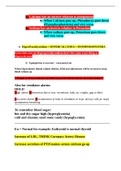
o Calcium has an inverse relation to phosphorus
 When Calcium goes up, Phosphorus goes down
(Hypophosphatemia) and vice versa
o Sodium has an inverse relation to Potassium
 When sodium goes up, Potassium goes down
and vice versa


 HyperParathyroidsm = HYPERCALCEMIA = HYPOPHOSPATEMIA

Every time you see Hyperparathyroidism that’s the same exact thing as
Hypercalcemia

o Epinephrine is secreted – vasoconstrictor

When Hypovolemic (blood volume deficit), ADH and aldosterone will be secreted so keep
blood volume up

**Weight is the best indicator for fluid status EXCEPT for Burns, Its Urine Output**


Also for ventilator alarms
HOLD
High alarm- Obstruction due to incr. secretions, kink, pt. coughs, gag or bites

Low press alarm- Disconnection or leak in ventilator or in pt. airway cuff, pt. stops
spontaneous breathing

To remember blood sugar:
hot and dry-sugar high (hyperglycemia)
cold and clammy-need some candy (hypoglycemia)


Eu = Normal for example: Euthyroid is normal thyroid

Increase of LDL, THINK Coronary Artery Disease

Increase secretion of PTH makes serum calcium go up

,Decrease secretion of PTH makes serum calcium go down

You dangle artery problems and you elevate vein issue
problems

,IMPORTANT

WHEN IT ASKS FOR PRIOIRTY, ASK YOURSELF YOURE
GOING TO DO THAT OVER AND OVER AGAIN AND
NOTHING ELSE  EXAMPLE: client is hemorrhaging, do you check for
vital signs or call the HCP

, Hypervolemia: Too much fluid in the vascular space (too much water in the hose)

Will Cause: HF  Weak Heart  low Cardiac output  Low Urine Perfusion  Low
Urine Output
Heart Failure
Renal Failure


S/S: Bounding Pulse
SOB; Dyspnea
Crackles/ wet lung sounds (listen to the low area in the back)
Distended Neck (JVD) and Peripheral Veins
Peripheral Edema (sacrum area) and Third spacing
Rapid Weight gain
Low urine output (specific gravity of 1.010 or less)

Central Venous Pressure (CVP): More volume (Hypervolemia) = More Pressure
CVP normal is 2-8 Low volume (Hypovolemia) = Low Pressure

Position: Semi Fowler; BED REST FOR THESE PATIENTS (hyper & Hypo)

Diet: Hypertension, heart failure, CAD—low sodium, calorie-restricted, Low fat

Treatment: Hydrochlorothiazide: Will make you lose Potassium
Furosemide: Will make you lose Potassium
Bumetanide: Will make you lose Potassium
 Give SPIRONOLACTONE to retain Potassium but watch for
Hyperkalemia
o KEEP CLIENT ON BED REST (helps reduce sodium and water)

Teaching: Check Daily weights and Input and Output

***clients with History of HF and Kidney, give fluids slow and
watch for Hypervolemia***

$13.49
Get access to the full document:

100% satisfaction guarantee
Immediately available after payment
Both online and in PDF
No strings attached


Also available in package deal

Get to know the seller

Seller avatar
Reputation scores are based on the amount of documents a seller has sold for a fee and the reviews they have received for those documents. There are three levels: Bronze, Silver and Gold. The better the reputation, the more your can rely on the quality of the sellers work.
INTELLECT CAPELLA UNIVERSITY
Follow You need to be logged in order to follow users or courses
Sold
2759
Member since
5 year
Number of followers
2534
Documents
3197
Last sold
1 week ago
BEST HOMEWORK HELP AND TUTORING

I have done papers of various topics and complexities. I am punctual and always submit work on-deadline. I write engaging and informative content on all subjects. Send me your research papers, case studies, psychology papers, etc, and I’ll do them to the best of my abilities. Writing is my passion when it comes to academic work. I’ve got a good sense of structure and enjoy finding interesting ways to deliver information in any given paper. I love impressing clients with my work, and I am very punctual about deadlines. Send me your assignment and I’ll take it to the next level. I strive for my content to be of the highest quality. Your wishes come first— send me your requirements and I’ll make a piece of work with fresh ideas, consistent structure, and following the academic formatting rules. For every student you refer to me with an order that is completed and paid transparently, I will do one assignment for you, free of charge!!!!!!!!!!!!

Read more Read less
3.7

338 reviews

5
157
4
52
3
51
2
19
1
59

Why students choose Stuvia

Created by fellow students, verified by reviews

Quality you can trust: written by students who passed their tests and reviewed by others who've used these notes.

Didn't get what you expected? Choose another document

No worries! You can instantly pick a different document that better fits what you're looking for.

Pay as you like, start learning right away

No subscription, no commitments. Pay the way you're used to via credit card and download your PDF document instantly.

Student with book image

“Bought, downloaded, and aced it. It really can be that simple.”

Alisha Student

Frequently asked questions
