100% satisfaction guarantee Immediately available after payment Both online and in PDF No strings attached 4.2 TrustPilot
logo-home
Exam (elaborations)

HIEU 201 MINDTAP CHAPTER 8 QUIZ / HIEU201 MINDTAP CHAPTER 8 QUIZ(COMPLETE ANSWERS -100% VERIFIED) LIBERTY UNIVERSITY

Rating
-
Sold
-
Pages
6
Grade
A+
Uploaded on
05-07-2022
Written in
2021/2022

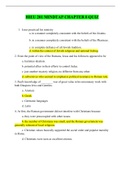
HIEU 201 MINDTAP CHAPTER 8 QUIZ / HIEU201 MINDTAP CHAPTER 8 QUIZ(COMPLETE ANSWERS -100% VERIFIED) LIBERTY UNIVERSITYHIEU 201 MINDTAP CHAPTER 8 QUIZ 1. Jesus practiced his ministry a. in a manner completely consistent with the beliefs of the Zealots. b. in a manner completely consistent with the beliefs of the Pharisees. c. in complete defiance of all Jewish tradition. d. within the context of Jewish religious and national feeling 2. From the point of view of the Romans, Jesus and his followers appeared to be a. harmless idealists. b. potential allies in their efforts to control Judea. c. just another mystery religion, no different from any other. d. subversives who seemed to emphasize political resistance to Roman rule. 3. Paul's knowledge of ________ was of great value in his missionary work with both Diaspora Jews and Gentiles. a. Aramaic b. Greek c. Germanic languages d. Latin 4. At first, the Roman government did not interfere with Christians because a. they were preoccupied with other issues. b. the number of Christians was small, and the Roman government was generally tolerant of local religions. c. Christian values basically supported the social order and popular morality in Rome. d. Christians were seen as excellent citizens. 5. Because there were obvious and important differences between Christian thought and Greek philosophy a. all early Christians rejected classical learning as a dangerous influence. b. conservative church fathers rejected classical philosophy in its entirety. c. only Jews continued to study Greek philosophy. d. most early Christians rejected the mysterious elements in Christianity, such as the belief in miracles. 6. Some ardent Christians a. withdrew to deserts and mountains seeking spiritual renewal. b. committed extreme acts of self-denial in their zeal to emulate Jesus. c. were dismayed by the moral laxity of some of the clergy. d. all of the above 7. According to Arius (A.D. 250–336) a. all priests should marry and have children. b. God and Christ were the same substance, coequal and coeternal. c. only celibate men and women were worthy of salvation. d. Jesus was more than man but less than God 8. The early Christians a. did not call for freeing of slaves but taught that slaves were children of God and should be converted to Christianity. b. mildly disapproved of slavery, saying it should be tolerated, but not encouraged. c. actively supported slavery, claiming that slaves could not be converted. d. denounced slavery as a contradiction of the common humanity of all people. 9. In the City of God, Saint Augustine stated that a. salvation and politics were tied together and that Christians should become actively involved in earthly governance. b. Christianity would survive the collapse and fall of Rome and that Christian ethics should be pursued under any subsequent social and political system. c. the collapse of Rome was an ominous sign that Christianity had weakened the Empire. d. Rome's decline should be the central concern of Christians because Rome represented God's city on earth. 10. Christianity and Stoic ethics were similar in that both a. saw history as having an end, a time when the meaning of the world would come to fruition. b. taught that human will alone can create moral transformation. c. held that ethical standards were expressions of universal reason. d. believed that all human beings are related and possess a fundamental dignity. 11. The greatest achievement of ________ was the translation of the Old and New Testaments from Hebrew and Greek into Latin. a. Saint Jerome b. Saint Ambrose c. Saint Peter d. Saint Augustine 12. The Pharisees were Palestinian Jews who a. insisted on strict interpretation of Mosaic Law. b. favored a more liberal attitude toward Mosaic Law. c. demanded that Jews pay no taxes to Rome and resist Roman Rule. d. rejected the temple priest as corrupt. 13. Similarities between the Qumran community that produced the Dead Sea Scrolls and the Jesus movement include a. a belief in the end of days, thought to occur at a distant, unknown point in the future. b. a rejection of the concept of a Messiah. c. the advocacy of the overthrow of Roman rule as a prerequisite for establishing a just society on earth. d. the anticipation of a coming messianic age. 14. The word Gentiles refers to a. a radical Jewish sect, even more fanatical than the Zealots. b. people who were not born Jews, but converted in later life. c. Jews who rejected the teachings of the temple priests. d. non-Jews. 15. Paul believed that Mosaic Law a. had been superseded by Jesus' teachings. b. should be used to differentiate between Jew and Gentile. c. had to be followed in its entirety to demonstrate the truth of Jesus' teachings. d. was an older and therefore more legitimate description of God's will than Jesus' teachings. 16. Christianity succeeded in becoming the dominant religion in the Roman Empire partly because a. Christians welcomed all people, regardless of wealth, sex, or any other social, physical, or economic qualities. b. the Romans persecuted Christianity less vigorously than they did other outlawed faiths. c. its emphasis on faith led it to reject all aspects of Greek philosophy and thought. d. it was totally different from the mystery religions that were popular at the time 17. The case for the supremacy of the bishop of Rome over the entire church was based on a. the belief that Jesus' disciple Peter, on whom Jesus supposedly had announced he would "build my church," had been the first bishop of Rome. b. Jesus having proclaimed that the church should have a pope and that he should live in Rome. c. Saint Paul's teaching that the Roman Gentiles should continue to rule Jews and other non-Christians. d. the Roman emperor's appointment of the bishops of Rome as the supreme religious authorities of the Empire. 18. The monastic rule of Saint Benedict a. forbade work and study, which it was believed, interfered with religious acts of devotion. b. imposed order and discipline on monks' spiritual impulse to withdraw from the world, by requiring that they work and obey the abbot. c. encouraged monks to celebrate their religious devotion by the pursuit of physical pleasure. d. inspired extreme forms of self-denial and punishment among hermit monks. 19. Paul taught that women a. possessed moral autonomy but were subject to their husbands' authority. b. could serve in positions of authority in the church. c. were not subject to divine law. d. were equal in all things with their husbands. 20. The Christian concept of God and the Greek concept of God differed in that a. Christians only approached God through reason and the mind, not through the faith or the heart. b. Greeks alone saw God in deeply personal terms, as a loving father. c. the idea of God did not carry the same significance for the Greeks as it did for Christians because religion was at the periphery of classical humanism. d. Greeks saw God as an abstraction, while the Christians saw God as an active participant in human lives.

Show more Read less
Institution
Course


Whoops! We can’t load your doc right now. Try again or contact support.

Written for

Institution
Course

Document information

Uploaded on
July 5, 2022
Number of pages
6
Written in
2021/2022
Type
Exam (elaborations)
Contains
Questions & answers

Subjects

Content preview

HIEU 201 MINDTAP CHAPTER 8 QUIZ


1. Jesus practiced his ministry
a. in a manner completely consistent with the beliefs of the Zealots.

b. in a manner completely consistent with the beliefs of the Pharisees.

c. in complete defiance of all Jewish tradition.
d. within the context of Jewish religious and national feeling
2. From the point of view of the Romans, Jesus and his followers appeared to be
a. harmless idealists.
b. potential allies in their efforts to control Judea.
c. just another mystery religion, no different from any other.
d. subversives who seemed to emphasize political resistance to Roman rule.
3. Paul's knowledge of ________ was of great value in his missionary work with
both Diaspora Jews and Gentiles.
a. Aramaic
b. Greek
c. Germanic languages
d. Latin
4. At first, the Roman government did not interfere with Christians because
a. they were preoccupied with other issues.
b. the number of Christians was small, and the Roman government was
generally tolerant of local religions.
c. Christian values basically supported the social order and popular morality
in Rome.
d. Christians were seen as excellent citizens.

, 5. Because there were obvious and important differences between Christian
thought and Greek philosophy
a. all early Christians rejected classical learning as a dangerous influence.
b. conservative church fathers rejected classical philosophy in its entirety.
c. only Jews continued to study Greek philosophy.
d. most early Christians rejected the mysterious elements in Christianity,
such as the belief in miracles.
6. Some ardent Christians
a. withdrew to deserts and mountains seeking spiritual renewal.
b. committed extreme acts of self-denial in their zeal to emulate Jesus.
c. were dismayed by the moral laxity of some of the clergy.
d. all of the above
7. According to Arius (A.D. 250–336)
a. all priests should marry and have children.
b. God and Christ were the same substance, coequal and coeternal.
c. only celibate men and women were worthy of salvation.
d. Jesus was more than man but less than God
8. The early Christians
a. did not call for freeing of slaves but taught that slaves were children of
God and should be converted to Christianity.
b. mildly disapproved of slavery, saying it should be tolerated, but not
encouraged.
c. actively supported slavery, claiming that slaves could not be converted.
d. denounced slavery as a contradiction of the common humanity of all
people.
9. In the City of God, Saint Augustine stated that

$9.99
Get access to the full document:

100% satisfaction guarantee
Immediately available after payment
Both online and in PDF
No strings attached


Also available in package deal

Get to know the seller

Seller avatar
Reputation scores are based on the amount of documents a seller has sold for a fee and the reviews they have received for those documents. There are three levels: Bronze, Silver and Gold. The better the reputation, the more your can rely on the quality of the sellers work.
ATIHUB CHAMBERLAIN UNIVERSITY
Follow You need to be logged in order to follow users or courses
Sold
318
Member since
4 year
Number of followers
289
Documents
981
Last sold
7 months ago

3.3

47 reviews

5
15
4
8
3
11
2
2
1
11

Recently viewed by you

Why students choose Stuvia

Created by fellow students, verified by reviews

Quality you can trust: written by students who passed their tests and reviewed by others who've used these notes.

Didn't get what you expected? Choose another document

No worries! You can instantly pick a different document that better fits what you're looking for.

Pay as you like, start learning right away

No subscription, no commitments. Pay the way you're used to via credit card and download your PDF document instantly.

Student with book image

“Bought, downloaded, and aced it. It really can be that simple.”

Alisha Student

Frequently asked questions