Electric Fields
Electric field strength
● Protons and electrons are charged particles
○ Both create electric fields and so affect each other
● The electric field strength of an electric field at a point in
space is defined as the force experienced per unit positive
charge at that point
● Electric field strength E is
𝐹
○ E= 𝑄
where F is the force experienced by the positive
charge Q
○ The SI unit for electric field strength is NC-1
● Electric field strength is a vector quantity
○ The direction of the electric field at a point is the
direction in which a positive charge would move
when placed at that point
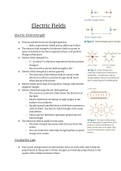
● Electric fields point away from positive charges and towards
negative charges
● Electric field lines map electric field patterns
○ The arrow on an electric field shows the direction of
the field
○ Electric field lines are always at right angles to the
surface of a conductor
○ Equally spaced, parallel electric field lines represent a
uniform field - the electric field strength is the same
everywhere
○ Closer electric field lines represent greater electric
field strength
● The electrical field is radial in both cases
○ The field strength decreases with distance from the
center
○ You can model the uniformly charged sphere as point
charge at its center
Coulomb’s Law
● Any 2 point charges exert an electrostatic force on each other that is directly
proportional to the product of their charges and inversely proportional to the
square of the distance between them
, ● Q and q are the magnitudes of the charges (Fig.2)
● The electrostatic force experienced by each point charge is F
● The point charges interact, and according to Newton’s 3rd Law, will exert equal but
opposite forces on each others
● From Coulomb’s Law we have:
1
○ F ∝ Qq and F ∝ 𝑟2
● We can write this using the equation where k is the constant of
proportionality
○ This constant can be written in terms of the permittivity of free space 𝜺0
○ 𝜺0 is equal to 8.85 x 10⁻¹² Fm-1
○
● The equation for Coulomb’s Law, which can be applied to any point charges, is
○
Radial fields
● A sphere produces a radial field and the
separation between 2 adjacent electric field
lines increases with the distance from the
center of the sphere
○ The electric field strength decreases
as you move further away from the
center of the sphere
● The electric field E at a distance r from the
center of the sphere is equal to the force
experienced by a positive ‘test’ charge divided
by the charge q on the test charge
○ Therefore,
● The electric field strength is thus directly proportional to the charge Q and obeys
an inverse square law with distance r
● Point masses and point charges both produce radial fields
Electric field strength
● Protons and electrons are charged particles
○ Both create electric fields and so affect each other
● The electric field strength of an electric field at a point in
space is defined as the force experienced per unit positive
charge at that point
● Electric field strength E is
𝐹
○ E= 𝑄
where F is the force experienced by the positive
charge Q
○ The SI unit for electric field strength is NC-1
● Electric field strength is a vector quantity
○ The direction of the electric field at a point is the
direction in which a positive charge would move
when placed at that point
● Electric fields point away from positive charges and towards
negative charges
● Electric field lines map electric field patterns
○ The arrow on an electric field shows the direction of
the field
○ Electric field lines are always at right angles to the
surface of a conductor
○ Equally spaced, parallel electric field lines represent a
uniform field - the electric field strength is the same
everywhere
○ Closer electric field lines represent greater electric
field strength
● The electrical field is radial in both cases
○ The field strength decreases with distance from the
center
○ You can model the uniformly charged sphere as point
charge at its center
Coulomb’s Law
● Any 2 point charges exert an electrostatic force on each other that is directly
proportional to the product of their charges and inversely proportional to the
square of the distance between them
, ● Q and q are the magnitudes of the charges (Fig.2)
● The electrostatic force experienced by each point charge is F
● The point charges interact, and according to Newton’s 3rd Law, will exert equal but
opposite forces on each others
● From Coulomb’s Law we have:
1
○ F ∝ Qq and F ∝ 𝑟2
● We can write this using the equation where k is the constant of
proportionality
○ This constant can be written in terms of the permittivity of free space 𝜺0
○ 𝜺0 is equal to 8.85 x 10⁻¹² Fm-1
○
● The equation for Coulomb’s Law, which can be applied to any point charges, is
○
Radial fields
● A sphere produces a radial field and the
separation between 2 adjacent electric field
lines increases with the distance from the
center of the sphere
○ The electric field strength decreases
as you move further away from the
center of the sphere
● The electric field E at a distance r from the
center of the sphere is equal to the force
experienced by a positive ‘test’ charge divided
by the charge q on the test charge
○ Therefore,
● The electric field strength is thus directly proportional to the charge Q and obeys
an inverse square law with distance r
● Point masses and point charges both produce radial fields