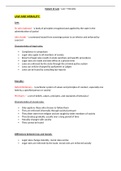
Nature of Law - Law + Morality
LAW AND MORALITY:
Law:
Sir John Salmond - 'a body of principles recognised and applied by the state in the
administration of justice'
John Austin - 'a command issued from sovereign power to an inferior and enforced by
coercion'
Characteristics of legal rules:
Compliance is compulsory
Legal rules apply to all members of society
Breach of legal rules results in state sanctions and specific procedures
Legal rules are made and take effect at a precise time
Laws are enforced by the state through the criminal justice system
Laws can only be changed by parliament or judges
Laws can be found by consulting law reports
Morality:
Oxford Dictionary - 'a particular system of values and principles of conduct, especially one
held by a specified person or society'
Phil Harris - ' a set of beliefs, values, principles, and standards of behaviour'
Characteristics of moral rules:
Only apply to those who choose to follow them
They are enforced informally through societal pressure
They often stem from religion and are taught by elder members of society
They develop gradually, usually over a long period of time
Morality changes with society
They cannot be found
Differences between law and morals:
Legal rules change instantly, moral rules evolve
Legal rules are enforced by the state, moral rules are enforced socially
, Durkheim
Increasing specialisation of labour
Growing ethnic diversity within society
Fading influence of religious beliefs
Natural Law vs Legal Positivism
Natural law:
Argues that just because a rule has been created in a certain way, this does not mean it is
law so they argue that in order to be a law, a rule must reflect natural law.
St Thomas Aquinas - if human law was at variance with the divine law, it was not legal but
rather a corruption of the law
Professor Lon Fuller - argues that law must have an inner morality, meaning that it must
comply with 8 principles including being understandable.
Positivists:
Jeremy Bentham - a legal positivist, described natural law theory as nonsense on stilts.
Bentham argued that a law is a law if it has been created in a certain way. A law which exists
is a law, though we happen to dislike it.
John Austin - developed the command theory of law:
Laws are commands issued by the sovereign
Such commands are enforced by sanctions
A sovereign is one who is obeyed by the majority
Hart v Fuller debate - (Debate on Nazis and Jews in WW2)
Fuller (natural law) = legal system was immoral, not based on legal principles.
Hart (positivist) = a law is a law if it’s made in a certain way - disliked the laws created by the
Nazis but had to follow them as they were laws.
LAW AND MORALITY:
Law:
Sir John Salmond - 'a body of principles recognised and applied by the state in the
administration of justice'
John Austin - 'a command issued from sovereign power to an inferior and enforced by
coercion'
Characteristics of legal rules:
Compliance is compulsory
Legal rules apply to all members of society
Breach of legal rules results in state sanctions and specific procedures
Legal rules are made and take effect at a precise time
Laws are enforced by the state through the criminal justice system
Laws can only be changed by parliament or judges
Laws can be found by consulting law reports
Morality:
Oxford Dictionary - 'a particular system of values and principles of conduct, especially one
held by a specified person or society'
Phil Harris - ' a set of beliefs, values, principles, and standards of behaviour'
Characteristics of moral rules:
Only apply to those who choose to follow them
They are enforced informally through societal pressure
They often stem from religion and are taught by elder members of society
They develop gradually, usually over a long period of time
Morality changes with society
They cannot be found
Differences between law and morals:
Legal rules change instantly, moral rules evolve
Legal rules are enforced by the state, moral rules are enforced socially
, Durkheim
Increasing specialisation of labour
Growing ethnic diversity within society
Fading influence of religious beliefs
Natural Law vs Legal Positivism
Natural law:
Argues that just because a rule has been created in a certain way, this does not mean it is
law so they argue that in order to be a law, a rule must reflect natural law.
St Thomas Aquinas - if human law was at variance with the divine law, it was not legal but
rather a corruption of the law
Professor Lon Fuller - argues that law must have an inner morality, meaning that it must
comply with 8 principles including being understandable.
Positivists:
Jeremy Bentham - a legal positivist, described natural law theory as nonsense on stilts.
Bentham argued that a law is a law if it has been created in a certain way. A law which exists
is a law, though we happen to dislike it.
John Austin - developed the command theory of law:
Laws are commands issued by the sovereign
Such commands are enforced by sanctions
A sovereign is one who is obeyed by the majority
Hart v Fuller debate - (Debate on Nazis and Jews in WW2)
Fuller (natural law) = legal system was immoral, not based on legal principles.
Hart (positivist) = a law is a law if it’s made in a certain way - disliked the laws created by the
Nazis but had to follow them as they were laws.