water
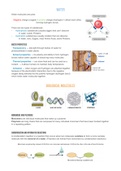
Water molecules are polar.
Negative charge (oxygen) + positive charge (hydrogen) = attract each other,
forming hydrogen bonds.
There are two types of substances:
- Hydrophobic substances (usually bigger) that can’t dissolve
in water. Lipids, Proteins.
- Hydrophilic substances (usually smaller) that can dissolve
in water. Ions, Sugars, most Amino Acids, some Proteins.
Water properties
• Transparency → lets light through bodies of water for
photosynthesis in water plants.
• Solvent properties → its polarity and ability to form hydrogen
bonds makes water capable of dissolving many molecules.
• Thermal properties → can store heat and can be used as a
coolant. → it allows humans to maintain body temperature.
• Cohesion → when oxygen and hydrogen are attached together
because of the electrostatic interaction due to the negative
oxygen being attracted by the positive hydrogen (hydrogen bond)
which holds water molecules together.
Biological molecules
MONOMERS AND POLYMERS
Monomers are individual molecules that make up a polymer.
Polymers are long chains that are composed of many individual monomers that have been bonded together
in a repeating pattern.
CONDENSATION AND HYDROLYSIS REACTIONS
A condensation reaction is a reaction that occurs when two molecules combine to form a more complex
molecule with the removal of a water. (Polymers are formed from monomers by condensation reactions).
, A Hydrolysis reaction occurs when larger molecules are broken down into smaller molecules with the
addition of water. (Polymers are broken down into individual monomers by hydrolysis reactions).
carbohydrates
Carbohydrates are organic molecules that only contain carbon, hydrogen and oxygen. They are used as a
source and storage energy and for structural function.
monosaccharides
→ monosaccharides are soluble and sweet-tasting carbohydrates (single sugar monomers).
GLUCOSE (a & b) – main sugar used in respiration. It is soluble and has
an osmotic effect.
FRUCTOSE – fruit sugar. It is soluble and
has an osmotic effect.
GALACTOSE – is soluble and has an osmotic effect. -OH groups on carbon 1 and
carbon 4 lie on the opposite side of the ring compared with their position in
glucose.
Disaccharides
→ disaccharides are soluble and sweet-tasting carbohydrates (sugar composed of two monosaccharides
joined together by a condensation reaction).
MALTOSE – found in germinating seeds (complex carbohydrates broken
down for energy)
α glucose + α glucose → maltose + water
SUCROSE – transported in the phloem tissue; provides sugars to other
parts of the plant.
α glucose + fructose → sucrose
LACTOSE – energy source in mammalian milk
beta glucose + galactose → lactose
Water molecules are polar.
Negative charge (oxygen) + positive charge (hydrogen) = attract each other,
forming hydrogen bonds.
There are two types of substances:
- Hydrophobic substances (usually bigger) that can’t dissolve
in water. Lipids, Proteins.
- Hydrophilic substances (usually smaller) that can dissolve
in water. Ions, Sugars, most Amino Acids, some Proteins.
Water properties
• Transparency → lets light through bodies of water for
photosynthesis in water plants.
• Solvent properties → its polarity and ability to form hydrogen
bonds makes water capable of dissolving many molecules.
• Thermal properties → can store heat and can be used as a
coolant. → it allows humans to maintain body temperature.
• Cohesion → when oxygen and hydrogen are attached together
because of the electrostatic interaction due to the negative
oxygen being attracted by the positive hydrogen (hydrogen bond)
which holds water molecules together.
Biological molecules
MONOMERS AND POLYMERS
Monomers are individual molecules that make up a polymer.
Polymers are long chains that are composed of many individual monomers that have been bonded together
in a repeating pattern.
CONDENSATION AND HYDROLYSIS REACTIONS
A condensation reaction is a reaction that occurs when two molecules combine to form a more complex
molecule with the removal of a water. (Polymers are formed from monomers by condensation reactions).
, A Hydrolysis reaction occurs when larger molecules are broken down into smaller molecules with the
addition of water. (Polymers are broken down into individual monomers by hydrolysis reactions).
carbohydrates
Carbohydrates are organic molecules that only contain carbon, hydrogen and oxygen. They are used as a
source and storage energy and for structural function.
monosaccharides
→ monosaccharides are soluble and sweet-tasting carbohydrates (single sugar monomers).
GLUCOSE (a & b) – main sugar used in respiration. It is soluble and has
an osmotic effect.
FRUCTOSE – fruit sugar. It is soluble and
has an osmotic effect.
GALACTOSE – is soluble and has an osmotic effect. -OH groups on carbon 1 and
carbon 4 lie on the opposite side of the ring compared with their position in
glucose.
Disaccharides
→ disaccharides are soluble and sweet-tasting carbohydrates (sugar composed of two monosaccharides
joined together by a condensation reaction).
MALTOSE – found in germinating seeds (complex carbohydrates broken
down for energy)
α glucose + α glucose → maltose + water
SUCROSE – transported in the phloem tissue; provides sugars to other
parts of the plant.
α glucose + fructose → sucrose
LACTOSE – energy source in mammalian milk
beta glucose + galactose → lactose