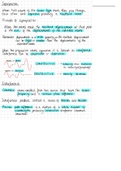
Superposition
when two the
type
other
waves
and
of same meet,
they pass through
each
superpose ,
producing a resultant wave .
Principle of superposition :
When two waves meet the resultant displacement at that point
,
is the sum of the displacements of the individual waves .
Remember displacement
: is a vector
quantity ,
so the resultant
displacement
can be
larger or smaller than the displacements of the
individual waves
when two
progressive waves
superpose it is known as
interference .
Interference can be constructive or destructive :
waves in phase
+ =
CONSTRUCTIVE intensity also increases
as
intensity ✗ (amplitude
waves in anti phase
+ =
DESTRUCTIVE intensity decreases
Interference
coherence : waves emitted from two sources that have the same
frequency and a constant phase difference .
Interference patterns contain a series of maxima and minima
Maxima :
pathdifference is a multiple of a whole number of
wavelengths producing constructive interference (maximum
,
amplitude)
, Minima :
path difference is an odd number of half wavelengths ,
destructive
interference ( minimum amplitude)
producing
Maxima :
phase difference of
an even multiple of
IT radians so , waves
meet in
phase and
interfere constructively
Minima :
phase difference of an
odd multiple of IT radians ,
so waves meet in antiphase
and interfere destructively
Young double-slit experiment
•
Coherent waves are needed to
form interference pattern
monochromatic
light source ( colour
filter)
narrow slits to diffract light
light diffracted by single slit arrives at
•
double slit in phase
Diffract again at double slit
causing area
of overlap and therefore
•
,
interference .
•
Interference pattern seen on screen -
alternate
bright + dark
regions (fringes
•
Therefore Young , proved that light acts as a wave .
ax
wavelength t.in metres
=
, ,
m
D slit
separation a in metres m
,
, ,
fringe separation x in metres , , ,
on
distance to screen .
D , in metres , m
when two the
type
other
waves
and
of same meet,
they pass through
each
superpose ,
producing a resultant wave .
Principle of superposition :
When two waves meet the resultant displacement at that point
,
is the sum of the displacements of the individual waves .
Remember displacement
: is a vector
quantity ,
so the resultant
displacement
can be
larger or smaller than the displacements of the
individual waves
when two
progressive waves
superpose it is known as
interference .
Interference can be constructive or destructive :
waves in phase
+ =
CONSTRUCTIVE intensity also increases
as
intensity ✗ (amplitude
waves in anti phase
+ =
DESTRUCTIVE intensity decreases
Interference
coherence : waves emitted from two sources that have the same
frequency and a constant phase difference .
Interference patterns contain a series of maxima and minima
Maxima :
pathdifference is a multiple of a whole number of
wavelengths producing constructive interference (maximum
,
amplitude)
, Minima :
path difference is an odd number of half wavelengths ,
destructive
interference ( minimum amplitude)
producing
Maxima :
phase difference of
an even multiple of
IT radians so , waves
meet in
phase and
interfere constructively
Minima :
phase difference of an
odd multiple of IT radians ,
so waves meet in antiphase
and interfere destructively
Young double-slit experiment
•
Coherent waves are needed to
form interference pattern
monochromatic
light source ( colour
filter)
narrow slits to diffract light
light diffracted by single slit arrives at
•
double slit in phase
Diffract again at double slit
causing area
of overlap and therefore
•
,
interference .
•
Interference pattern seen on screen -
alternate
bright + dark
regions (fringes
•
Therefore Young , proved that light acts as a wave .
ax
wavelength t.in metres
=
, ,
m
D slit
separation a in metres m
,
, ,
fringe separation x in metres , , ,
on
distance to screen .
D , in metres , m