Question 5: Writing a Narrative Top Tips
Top Tips for writing a story:
Plan: This will ensure that your narrative is well structured. (Beginning, Middle, Climax,
End)
Planning questions:
Who is your main protagonist? Whose voice is telling the story? 1st, 2nd, or 3rd person?
- Appearance -Behaviour/actions -Speech -Relationships
with others
What does your main protagonist want? Give them something they seek or desire, a goal or a
target – story and drama occurs when they encounter obstacles towards that goal.
When & where – create a detailed sense of setting to create atmosphere.
What is the focus for each paragraph? Try to give each paragraph a particular focus for
the protagonist or narrator’s attention.
Keep to the time scale and keep the plot short.
Keep the plot moving.
Choose past or present tense and stick to it.
Use the senses!
Vary vocabulary and sentence lengths.
Use a range of language techniques (SPAMCAVES)
Try to make the ending unexpected!
What does the examiner want to see?
A range of different ideas.
Varity of different sentence lengths used effectively
A range of different vocabulary.
A range of language devices.
A range of punctuation.
Interesting and engaging tone throughout.
Paragraphs, including one line paragraphs.
Accurate SPaG.
Structuring a Narrative/ Story
Possible structures:
Circular: the ending echoes or mirrors the beginning in some way.
Countdown: the protagonist is against the clock somehow – waiting for something to
happen, or rushing to do something. Use a repeating reference to time throughout.
Alternating: the focus of the narrative switches between 2 contrasting perspectives
eg protagonist and antagonist; predator and prey.
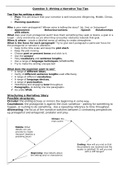
Climax: the
main event
Middle: What
details can you
provide to create
interest? (Outline a
problem/ issue)
Ending: How will you end so that
the problems are resolved and the
reader is satisfied? Or will you end
with a cliff hanger?
Beginning: Give details about
the setting and/ or character(s)
Top Tips for writing a story:
Plan: This will ensure that your narrative is well structured. (Beginning, Middle, Climax,
End)
Planning questions:
Who is your main protagonist? Whose voice is telling the story? 1st, 2nd, or 3rd person?
- Appearance -Behaviour/actions -Speech -Relationships
with others
What does your main protagonist want? Give them something they seek or desire, a goal or a
target – story and drama occurs when they encounter obstacles towards that goal.
When & where – create a detailed sense of setting to create atmosphere.
What is the focus for each paragraph? Try to give each paragraph a particular focus for
the protagonist or narrator’s attention.
Keep to the time scale and keep the plot short.
Keep the plot moving.
Choose past or present tense and stick to it.
Use the senses!
Vary vocabulary and sentence lengths.
Use a range of language techniques (SPAMCAVES)
Try to make the ending unexpected!
What does the examiner want to see?
A range of different ideas.
Varity of different sentence lengths used effectively
A range of different vocabulary.
A range of language devices.
A range of punctuation.
Interesting and engaging tone throughout.
Paragraphs, including one line paragraphs.
Accurate SPaG.
Structuring a Narrative/ Story
Possible structures:
Circular: the ending echoes or mirrors the beginning in some way.
Countdown: the protagonist is against the clock somehow – waiting for something to
happen, or rushing to do something. Use a repeating reference to time throughout.
Alternating: the focus of the narrative switches between 2 contrasting perspectives
eg protagonist and antagonist; predator and prey.
Climax: the
main event
Middle: What
details can you
provide to create
interest? (Outline a
problem/ issue)
Ending: How will you end so that
the problems are resolved and the
reader is satisfied? Or will you end
with a cliff hanger?
Beginning: Give details about
the setting and/ or character(s)