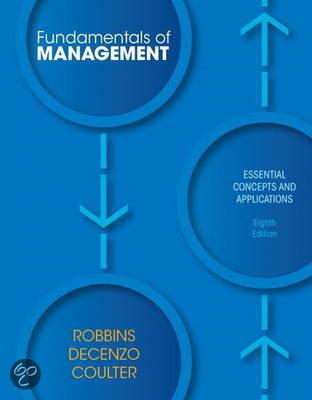
Fundamentals of Management, 8e (Robbins et al.)
Chapter 1 Managers and Management
1) Part of what defines an organization is its purpose.
Answer: TRUE
Explanation: The goals or purpose of an organization define the organization's reason for
existing. Without a common purpose, a group of individuals does not qualify as an
organization.
Diff: 2 Page Ref: 4
Objective: 1.1
2) All organizations have a structure that in some ways serves to define and limit the
behavior of members of the organization.
Answer: TRUE
Explanation: The structure of an organization, whether formal or informal, defines how
organization members interact. For example, a school's informal guidelines might
determine how teachers fraternize. A school's formal guidelines might set up rules for
interaction between students and teachers.
Diff: 2 Page Ref: 4
Objective: 1.1
3) In order to be considered a manager, an individual must direct or oversee the work of
others.
Answer: TRUE
Explanation: Directing and overseeing work distinguishes managers from nonmanagerial
employees. Managers direct and oversee work of others. Nonmanagerial employees have
no supervisory responsibilities.
Diff: 2 Page Ref: 5
,Objective: 1.1
Learning Outcome: Describe the roles of managers and the skills they need to succeed
within an organization
4) A manager does not work directly on tasks for the organization.
Answer: FALSE
Explanation: Managers may work on tasks in addition to their supervisory duties. For
example, a manager of a shop that designs clothing may also create designs on his or her
own.
Diff: 2 Page Ref: 5
Objective: 1.1
Learning Outcome: Describe the roles of managers and the skills they need to succeed
within an organization
5) Supervisors and team leaders may both be considered first-line managers.
Answer: TRUE
Explanation: First-line managers are managers who oversee workers directly and are
involved in day-to-day operations. For example, a team manager in an auto assembly
plant might oversee and help solve everyday problems that arise on the assembly line.
Higher level managers typically would not spend time helping to solve assembly line
problems directly.
Diff: 1 Page Ref: 5
Objective: 1.1
6) Effectiveness refers to the relationship between inputs and outputs.
Answer: FALSE
Explanation: Efficiency is concerned with maximizing the output-to-input ratio.
Effectiveness, on the other hand, refers not to how well resources are used but to which
resources to use, and whether or not those resources help the organization attain its goals.
Diff: 2 Page Ref: 6
,Objective: 1.2
7) A goal of efficiency is to minimize output costs while maximizing input costs.
Answer: FALSE
Explanation: The goal of efficiency is the opposite—to maximize outputs while
minimizing inputs. An efficient operation uses the fewest resources to generate the
greatest amount of product.
Diff: 2 Page Ref: 6
Objective: 1.2
8) Effectiveness refers to the attainment of the organization's goals.
Answer: TRUE
Explanation: Effectiveness is concerned with "doing the right things"—choosing the
tasks that will help the organization achieve its goals. Efficiency, on the other hand,
refers to "doing things right," that is, once tasks are chosen they are done with a
minimum of waste.
Diff: 2 Page Ref: 6
Objective: 1.2
9) Managers who are effective at meeting organizational goals always act efficiently.
Answer: FALSE
Explanation: A manager may be effective but not efficient. For example, a manager may
excel at achieving goals but waste a lot of money, energy, and resources in achieving
them.
Diff: 3 Page Ref: 6
Objective: 1.2
10) The four contemporary management processes are planning, organizing, leading, and
commanding.
, Answer: FALSE
Explanation: Leading is a term that replaced commanding and coordinating. So
commanding is considered to be part of leading and not distinct from it.
Diff: 1 Page Ref: 8
Objective: 1.2
Learning Outcome: Describe the roles of managers and the skills they need to succeed
within an organization
11) Determining who reports to whom is part of the controlling function of management.
Answer: FALSE
Explanation: The controlling function is largely a process of monitoring and evaluation.
Subordinates are observed to see if they are working efficiently. Programs are evaluated
to make sure they are progressing toward organizational goals. Deciding who reports to
whom is not a part of this function.
Diff: 1 Page Ref: 9
Objective: 1.3
Learning Outcome: Describe the roles of managers and the skills they need to succeed
within an organization
12) Providing motivation is part of the controlling function of management.
Answer: FALSE
Explanation: Motivating employees falls under the category of leadership for a manager,
not controlling.
Diff: 2 Page Ref: 9
Objective: 1.3
Learning Outcome: Describe the roles of managers and the skills they need to succeed
within an organization
Chapter 1 Managers and Management
1) Part of what defines an organization is its purpose.
Answer: TRUE
Explanation: The goals or purpose of an organization define the organization's reason for
existing. Without a common purpose, a group of individuals does not qualify as an
organization.
Diff: 2 Page Ref: 4
Objective: 1.1
2) All organizations have a structure that in some ways serves to define and limit the
behavior of members of the organization.
Answer: TRUE
Explanation: The structure of an organization, whether formal or informal, defines how
organization members interact. For example, a school's informal guidelines might
determine how teachers fraternize. A school's formal guidelines might set up rules for
interaction between students and teachers.
Diff: 2 Page Ref: 4
Objective: 1.1
3) In order to be considered a manager, an individual must direct or oversee the work of
others.
Answer: TRUE
Explanation: Directing and overseeing work distinguishes managers from nonmanagerial
employees. Managers direct and oversee work of others. Nonmanagerial employees have
no supervisory responsibilities.
Diff: 2 Page Ref: 5
,Objective: 1.1
Learning Outcome: Describe the roles of managers and the skills they need to succeed
within an organization
4) A manager does not work directly on tasks for the organization.
Answer: FALSE
Explanation: Managers may work on tasks in addition to their supervisory duties. For
example, a manager of a shop that designs clothing may also create designs on his or her
own.
Diff: 2 Page Ref: 5
Objective: 1.1
Learning Outcome: Describe the roles of managers and the skills they need to succeed
within an organization
5) Supervisors and team leaders may both be considered first-line managers.
Answer: TRUE
Explanation: First-line managers are managers who oversee workers directly and are
involved in day-to-day operations. For example, a team manager in an auto assembly
plant might oversee and help solve everyday problems that arise on the assembly line.
Higher level managers typically would not spend time helping to solve assembly line
problems directly.
Diff: 1 Page Ref: 5
Objective: 1.1
6) Effectiveness refers to the relationship between inputs and outputs.
Answer: FALSE
Explanation: Efficiency is concerned with maximizing the output-to-input ratio.
Effectiveness, on the other hand, refers not to how well resources are used but to which
resources to use, and whether or not those resources help the organization attain its goals.
Diff: 2 Page Ref: 6
,Objective: 1.2
7) A goal of efficiency is to minimize output costs while maximizing input costs.
Answer: FALSE
Explanation: The goal of efficiency is the opposite—to maximize outputs while
minimizing inputs. An efficient operation uses the fewest resources to generate the
greatest amount of product.
Diff: 2 Page Ref: 6
Objective: 1.2
8) Effectiveness refers to the attainment of the organization's goals.
Answer: TRUE
Explanation: Effectiveness is concerned with "doing the right things"—choosing the
tasks that will help the organization achieve its goals. Efficiency, on the other hand,
refers to "doing things right," that is, once tasks are chosen they are done with a
minimum of waste.
Diff: 2 Page Ref: 6
Objective: 1.2
9) Managers who are effective at meeting organizational goals always act efficiently.
Answer: FALSE
Explanation: A manager may be effective but not efficient. For example, a manager may
excel at achieving goals but waste a lot of money, energy, and resources in achieving
them.
Diff: 3 Page Ref: 6
Objective: 1.2
10) The four contemporary management processes are planning, organizing, leading, and
commanding.
, Answer: FALSE
Explanation: Leading is a term that replaced commanding and coordinating. So
commanding is considered to be part of leading and not distinct from it.
Diff: 1 Page Ref: 8
Objective: 1.2
Learning Outcome: Describe the roles of managers and the skills they need to succeed
within an organization
11) Determining who reports to whom is part of the controlling function of management.
Answer: FALSE
Explanation: The controlling function is largely a process of monitoring and evaluation.
Subordinates are observed to see if they are working efficiently. Programs are evaluated
to make sure they are progressing toward organizational goals. Deciding who reports to
whom is not a part of this function.
Diff: 1 Page Ref: 9
Objective: 1.3
Learning Outcome: Describe the roles of managers and the skills they need to succeed
within an organization
12) Providing motivation is part of the controlling function of management.
Answer: FALSE
Explanation: Motivating employees falls under the category of leadership for a manager,
not controlling.
Diff: 2 Page Ref: 9
Objective: 1.3
Learning Outcome: Describe the roles of managers and the skills they need to succeed
within an organization