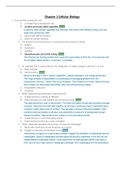
Chapter 1 Cellular Biology
1. It is true that a eukaryotic cell
A. is smaller than a prokaryotic cell.
B. contains structures called organelles. Correct
Eukaryotic cells contain organelles and histones, they have a well-defined nucleus, and are
larger than prokaryotic cells.
C. lacks a well-defined nucleus.
D. does not contain histones.
2. The function of a histone found in a eukaryote cell focuses on cellular
A. division.
B. movement.
C. activities.
D. deoxyribonucleic acid (DNA) folding. Correct
The histones are binding proteins that cause the supercoiling of DNA into chromosomes and
do not affect cellular division, movement, or activities.
3. An organelle that is responsible for the metabolism of cellular energy is referred to as a/an
A. Golgi complex.
B. mitochondrion. Correct
Mitochondria play a role in cellular metabolism, cellular respiration, and energy production.
The Golgi complex is responsible for processing and packaging proteins from the
endoplasmic reticulum, where they are synthesized. The nucleolus is a small, dense structure
that contains the ribonucleic acid (RNA), DNA, and DNA-binding proteins.
C. endoplasmic reticulum.
D. nucleolus.
4. Which statement best describes a desmosome?
A. A desmosome is a barrier to diffusion.
B. Desmosomes hold cells together by continuous bands. Correct
The desmosome is a type of cell junction. The other two types include tight junctions and gap
junctions. Desmosomes hold cells together by forming a continuous band of epithelial tissue
or belt (or button-like) points of contact. They are also a source of structural stability. Tight
junctions serve as barriers to diffusion and prevent the movement of substances through
transport proteins. Gap junctions are clusters of communicating tunnels.
C. A desmosome is a communicating tunnel.
D. Desmosomes function as a zona occludens.
5. Which statement describes the function of a second messenger?
A. Binds with membrane-bound receptors via a ligand
B. Triggers a cascade of intracellular events Correct
The binding of a ligand to a cell surface receptor triggers the activation of intracellular second
messengers. Second messengers activate signal transduction pathways in the cell that can
initiate different intracellular events. Cyclic adenosine monophosphate (cAMP) and calcium
(Ca++) are the two major second-messenger pathways. First messengers are the extracellular
, ligands that bind to cell surface receptors. Binding of first messengers can result in the
opening or closing of specific cell membrane channels or the activation of second
messengers.
C. Opens specific channels in the cell membrane
D. Blocks a membrane-bound receptor signal
6. 6.ID: 18662092965
Which statement is correct regarding cellular energy?
A. Glycolysis is the building of sugar molecules.
B. Oxidative cellular metabolism is a single reaction making adenosine triphosphate (ATP).
C. Oxidative phosphorylation occurs in the mitochondria. Correct
Oxidative phosphorylation occurs in the mitochondria. This is the mechanism by which the
energy produced from carbohydrates, fats, and proteins is transferred to ATP. Glycolysis is a
process that breaks down glucose molecules; it produces a net of two ATP molecules.
Oxidation is a process during which a pair of electrons are removed and transferred.
Oxidative cellular metabolism involves 10 biochemical reactions. Anaerobic glycolysis occurs
in the absence of oxygen. Aerobic means in the presence of oxygen.
D. Anaerobic glycolysis occurs in the presence of oxygen.
7. 7.ID: 18662092957
Movement of a solute molecule from an area of high concentration to an area of low concentration is
called
A. diffusion. Correct
Diffusion is the movement of a solute from an area of high concentration to an area of low
concentration. Osmosis is the movement of water down a concentration gradient from an
area of higher water concentration to an area of lower water concentration. Filtration is the
movement of water and solute through a membrane because of a greater pushing pressure
on one side of the membrane than the other. Hydrostatic pressure is the mechanical force of
water pushing against a cell membrane.
B. filtration.
C. osmosis.
D. hydrostatic pressure.
8. 8.ID: 18662092967
Which is an example of an energy-releasing process?
A. Anabolism
B. Catabolism Correct
Catabolism is an energy-releasing process. The energy-using process is anabolism. A
substrate is a specific substance that is converted to a product in the reaction. A second
messenger is a “pass-it-on signal.” This occurs when a first messenger activates a receptor
that then triggers a pass-it-on signal.
C. Substrate-induced reaction
D. Second messenger system
9. 9.ID: 18662092959
Which describes an amphipathic molecule?
A. It is permeable to water only.
1. It is true that a eukaryotic cell
A. is smaller than a prokaryotic cell.
B. contains structures called organelles. Correct
Eukaryotic cells contain organelles and histones, they have a well-defined nucleus, and are
larger than prokaryotic cells.
C. lacks a well-defined nucleus.
D. does not contain histones.
2. The function of a histone found in a eukaryote cell focuses on cellular
A. division.
B. movement.
C. activities.
D. deoxyribonucleic acid (DNA) folding. Correct
The histones are binding proteins that cause the supercoiling of DNA into chromosomes and
do not affect cellular division, movement, or activities.
3. An organelle that is responsible for the metabolism of cellular energy is referred to as a/an
A. Golgi complex.
B. mitochondrion. Correct
Mitochondria play a role in cellular metabolism, cellular respiration, and energy production.
The Golgi complex is responsible for processing and packaging proteins from the
endoplasmic reticulum, where they are synthesized. The nucleolus is a small, dense structure
that contains the ribonucleic acid (RNA), DNA, and DNA-binding proteins.
C. endoplasmic reticulum.
D. nucleolus.
4. Which statement best describes a desmosome?
A. A desmosome is a barrier to diffusion.
B. Desmosomes hold cells together by continuous bands. Correct
The desmosome is a type of cell junction. The other two types include tight junctions and gap
junctions. Desmosomes hold cells together by forming a continuous band of epithelial tissue
or belt (or button-like) points of contact. They are also a source of structural stability. Tight
junctions serve as barriers to diffusion and prevent the movement of substances through
transport proteins. Gap junctions are clusters of communicating tunnels.
C. A desmosome is a communicating tunnel.
D. Desmosomes function as a zona occludens.
5. Which statement describes the function of a second messenger?
A. Binds with membrane-bound receptors via a ligand
B. Triggers a cascade of intracellular events Correct
The binding of a ligand to a cell surface receptor triggers the activation of intracellular second
messengers. Second messengers activate signal transduction pathways in the cell that can
initiate different intracellular events. Cyclic adenosine monophosphate (cAMP) and calcium
(Ca++) are the two major second-messenger pathways. First messengers are the extracellular
, ligands that bind to cell surface receptors. Binding of first messengers can result in the
opening or closing of specific cell membrane channels or the activation of second
messengers.
C. Opens specific channels in the cell membrane
D. Blocks a membrane-bound receptor signal
6. 6.ID: 18662092965
Which statement is correct regarding cellular energy?
A. Glycolysis is the building of sugar molecules.
B. Oxidative cellular metabolism is a single reaction making adenosine triphosphate (ATP).
C. Oxidative phosphorylation occurs in the mitochondria. Correct
Oxidative phosphorylation occurs in the mitochondria. This is the mechanism by which the
energy produced from carbohydrates, fats, and proteins is transferred to ATP. Glycolysis is a
process that breaks down glucose molecules; it produces a net of two ATP molecules.
Oxidation is a process during which a pair of electrons are removed and transferred.
Oxidative cellular metabolism involves 10 biochemical reactions. Anaerobic glycolysis occurs
in the absence of oxygen. Aerobic means in the presence of oxygen.
D. Anaerobic glycolysis occurs in the presence of oxygen.
7. 7.ID: 18662092957
Movement of a solute molecule from an area of high concentration to an area of low concentration is
called
A. diffusion. Correct
Diffusion is the movement of a solute from an area of high concentration to an area of low
concentration. Osmosis is the movement of water down a concentration gradient from an
area of higher water concentration to an area of lower water concentration. Filtration is the
movement of water and solute through a membrane because of a greater pushing pressure
on one side of the membrane than the other. Hydrostatic pressure is the mechanical force of
water pushing against a cell membrane.
B. filtration.
C. osmosis.
D. hydrostatic pressure.
8. 8.ID: 18662092967
Which is an example of an energy-releasing process?
A. Anabolism
B. Catabolism Correct
Catabolism is an energy-releasing process. The energy-using process is anabolism. A
substrate is a specific substance that is converted to a product in the reaction. A second
messenger is a “pass-it-on signal.” This occurs when a first messenger activates a receptor
that then triggers a pass-it-on signal.
C. Substrate-induced reaction
D. Second messenger system
9. 9.ID: 18662092959
Which describes an amphipathic molecule?
A. It is permeable to water only.