Omics
Lesson 1:
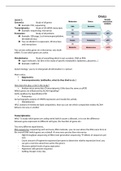
Genomics: Study of all genes
Example: PCR, sequencing
Transcriptomics: Study of all mRNA transcripts
Example: sequencing, microarray
Proteomics: Study of all proteins
Example: SDS-page, (co)-immunoprecipitation,
2D-elektroforese
You can divide it in expression, 3D structure
and interactions
You can see active genes on a microarray, you study
mRNA. To see which genes are active.
Metabolomics: Study of everything which is not a protein, DNA or RNA
sugar molecules, fat (this is the study of specific metabolites: lipidomics, glycomics..)
Example: maldi tof,
System biology: you try to intergrade all information in 1 picture
More omics..
• Epigenomics
• Immunoproteomics (antibodies, what do they bind to etc.)
How does this play a role in the study?
• Analyse micro array data (Transcriptomics) (this does the same as qPCR)
Which genes are influenced by ALCAM signalling?
Verify positives by Quantitative-PCR
• Proteomics
Gel zymography analysis of MMP2 expression and mostly the activity
• Metabolomics
HPLC analysis of membrane lipid composition, than you can see which composition makes ALCAM
behave one way or another
Transcriptomics
Why? To study which genes are acting weird (which causes a disease), or to see the difference
between gene expression in different cell types, the function of genes etc..
Two very different experiments..
RNA sequencing: sequencing each and every RNA molecule, you can see where the RNA came from in
the overall DNA (which genes are related) way more precise than microarray
- High throughput sequencing of RNA (next generation sequencing billions of sequences per
run)
- Count amount of fragments sequenced per gene to determine relative expression level, you
can get a overview about how active the gene is
- Measures global levels of gene expression
- Alignment with genome sequence
- Getting cheaper every day
, In practice:
1. isolation of a RNA population
(e.g. poly-A-tailed is at the end
of mRNA)
poly-t-tail with beads
2. reverse transcription into cDNA
(complementary) + addition of
adapters
It’s the best to convert it to cDNA as
fast as you can. This makes it stable,
because mRNA is very unstable
3. high throughput (next gen)
sequencing 30-400 bp of each fragment
on the glass plate are some sequences where the adapters can bind to, the sequenced RNA
sequences are going to be random. They can start in the middle of a strand. So the end result
will have different lengths.
We take 30-400 bp because if you take to little, the chances of it being complementary is too
high. To many bp will lead to having very long fragments.
4. resulting reads aligned with reference genome / transcriptome
EST sequencing
= Expressed Sequence Tag
You put the insert in the vector, transfect the plasmid into an E. Coli cell and replicate it, it takes way
longer than the other type of sequencing
Microarrays: hybridisation (the process of joining two complementary strands of nucleic acids - RNA,
DNA or oligonucleotides)
The steps: isolate mRNA reverse transcriptase hybridise on the array
So then there is the last technique in the list of how to do transcriptomics, which is by using
microarrays. In fact, you can see microarrays as multiple parallel Northern blots. With a northern blot
you use a labelled gene specific probe (most of the times DNA) to detect the presence of an RNA
molecule on the blot. A microarray is the other way around, where you use a labelled RNA or cDNA
sample to detect to which gene specific probes on the array it can bind. These probes present on the
array can either be complete or partial cDNAs or oligos.
• Northern blot:
- labelled probe (DNA) made out of labelled fluorescent nucleotides, detect RNA on blot
• Microarray:
- labelled cDNA/RNA , to detect to which probes (cDNA/oligo) on array it binds
if the gene is active the mRNA is going to hybridise
two types of microarrays;
- cDNA microarrays: A cDNA microarray is normally performed in
such a way that you compare the gene expression levels of two
samples. Here sample A and sample B. These RNA samples are
turned into cDNA using labelled nucleotides. In this way one
sample is labelled green and the other red. The two samples are
then mixed and added to the slide where they can hybridise.
Because they are added at the same time you will get competitive
hybridisation. If the gene is expressed more in sample A than in B
more green label will bind than red label. If the gene is not
expressed, nor in A or in B, then the spot will stay black. The
Lesson 1:
Genomics: Study of all genes
Example: PCR, sequencing
Transcriptomics: Study of all mRNA transcripts
Example: sequencing, microarray
Proteomics: Study of all proteins
Example: SDS-page, (co)-immunoprecipitation,
2D-elektroforese
You can divide it in expression, 3D structure
and interactions
You can see active genes on a microarray, you study
mRNA. To see which genes are active.
Metabolomics: Study of everything which is not a protein, DNA or RNA
sugar molecules, fat (this is the study of specific metabolites: lipidomics, glycomics..)
Example: maldi tof,
System biology: you try to intergrade all information in 1 picture
More omics..
• Epigenomics
• Immunoproteomics (antibodies, what do they bind to etc.)
How does this play a role in the study?
• Analyse micro array data (Transcriptomics) (this does the same as qPCR)
Which genes are influenced by ALCAM signalling?
Verify positives by Quantitative-PCR
• Proteomics
Gel zymography analysis of MMP2 expression and mostly the activity
• Metabolomics
HPLC analysis of membrane lipid composition, than you can see which composition makes ALCAM
behave one way or another
Transcriptomics
Why? To study which genes are acting weird (which causes a disease), or to see the difference
between gene expression in different cell types, the function of genes etc..
Two very different experiments..
RNA sequencing: sequencing each and every RNA molecule, you can see where the RNA came from in
the overall DNA (which genes are related) way more precise than microarray
- High throughput sequencing of RNA (next generation sequencing billions of sequences per
run)
- Count amount of fragments sequenced per gene to determine relative expression level, you
can get a overview about how active the gene is
- Measures global levels of gene expression
- Alignment with genome sequence
- Getting cheaper every day
, In practice:
1. isolation of a RNA population
(e.g. poly-A-tailed is at the end
of mRNA)
poly-t-tail with beads
2. reverse transcription into cDNA
(complementary) + addition of
adapters
It’s the best to convert it to cDNA as
fast as you can. This makes it stable,
because mRNA is very unstable
3. high throughput (next gen)
sequencing 30-400 bp of each fragment
on the glass plate are some sequences where the adapters can bind to, the sequenced RNA
sequences are going to be random. They can start in the middle of a strand. So the end result
will have different lengths.
We take 30-400 bp because if you take to little, the chances of it being complementary is too
high. To many bp will lead to having very long fragments.
4. resulting reads aligned with reference genome / transcriptome
EST sequencing
= Expressed Sequence Tag
You put the insert in the vector, transfect the plasmid into an E. Coli cell and replicate it, it takes way
longer than the other type of sequencing
Microarrays: hybridisation (the process of joining two complementary strands of nucleic acids - RNA,
DNA or oligonucleotides)
The steps: isolate mRNA reverse transcriptase hybridise on the array
So then there is the last technique in the list of how to do transcriptomics, which is by using
microarrays. In fact, you can see microarrays as multiple parallel Northern blots. With a northern blot
you use a labelled gene specific probe (most of the times DNA) to detect the presence of an RNA
molecule on the blot. A microarray is the other way around, where you use a labelled RNA or cDNA
sample to detect to which gene specific probes on the array it can bind. These probes present on the
array can either be complete or partial cDNAs or oligos.
• Northern blot:
- labelled probe (DNA) made out of labelled fluorescent nucleotides, detect RNA on blot
• Microarray:
- labelled cDNA/RNA , to detect to which probes (cDNA/oligo) on array it binds
if the gene is active the mRNA is going to hybridise
two types of microarrays;
- cDNA microarrays: A cDNA microarray is normally performed in
such a way that you compare the gene expression levels of two
samples. Here sample A and sample B. These RNA samples are
turned into cDNA using labelled nucleotides. In this way one
sample is labelled green and the other red. The two samples are
then mixed and added to the slide where they can hybridise.
Because they are added at the same time you will get competitive
hybridisation. If the gene is expressed more in sample A than in B
more green label will bind than red label. If the gene is not
expressed, nor in A or in B, then the spot will stay black. The