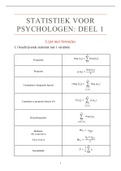
STATISTIEK VOOR
PSYCHOLOGEN: DEEL 1
Lijst met formules
I.1 beschrijvende statistiek met 1 variabele
"
freq (x! ) = * freq +x! ,
Frequentie
#$%
freq (x! )
Proportie p (x! ) =
n
"
cfreq +𝑥# , = * freq (x!& )
Cumulatieve frequentie functie
# ! $%
'"! ('"
"
Cumulatieve proportie-functie (F) F +𝑥# , = * p (x!& )
# ! $%
'"! ('"
"
Klassefrequentie * freq (x! )
#$%
'# ('" ('$
Mediaan: Me' = 𝑥)*%
+
Als n oneven is
𝑥) + 𝑥)*%
+ +
Als n even is Me' =
2
)
1
𝑋6 = * 𝑥,
Gemiddelde 𝑛
,$%
1
, "
1
𝑋6 = * 𝑥# . freq +𝑥# ,
𝑛
#$%
"
𝑋6 = * 𝑥# . 𝑝(𝑥# )
#$%
*(𝑥, − 𝑐)+ = *(𝑥, − 𝑥̅ )+ + 𝑛 . (𝑥̅ − 𝑐)+
, ,
Regel van Steiner 1 1
*(𝑥, − 𝑐)+ = *(𝑥, − 𝑥̅ )+ + (𝑥̅ − 𝑐)+
𝑛 𝑛
, ,
)
1
Variantie 𝑠'+ = *(𝑥, − 𝑥̅ )+
𝑛
,$%
)
1
Standaarddeviantie 𝑠' = ? *(𝑥, − 𝑥̅ )+
𝑛
,$%
Als 𝑘 > 1 dan
%
𝑝 (|𝑋 − 𝑥̅ | ≥ 𝑘 . 𝑠' ) ≤ -%
Ongelijkheid van Tchebychev De proportie van de observaties die k of meer
standaarddevianties afwijken van het
!
gemiddelde bedraagt hoogstens
"!
log 𝑥 = 𝑎 ⇔ 10. = 𝑥
Transformaties En dus:
10/01 ' = 𝑥
𝑥, − 𝑥̅
Z-scores of standaardscores 𝑍(𝑥, ) =
𝑠'
2
, I.2 beschrijvende statistiek met 2 variabelen
freq4,2 (𝑥# , 𝑦# ! )
𝑝2|4$'" +𝑦# ! , =
freq4 (𝑥# )
Rijconditionele proportiefunctie 𝑝4,2 +𝑥# , 𝑦# ! ,
=
𝑝4 +𝑥# ,
freq4,2 (𝑥# , 𝑦# ! ) 𝑝4,2 +𝑥# , 𝑦# ! ,
𝑝4|2$6"! +𝑥# , = =
Kolomconditionele proportiefunctie freq2 (𝑦#& ) 𝑝2 +𝑦#& ,
666666666666
𝒚|𝑿 = 𝒙7 =
"!
1
* 𝑦# ! . freq4,2 +𝑥# , 𝑦# ! ,
freq2 +𝑦# ! ,
# ! $%
Conditionele gemiddelde "&
= * 𝑦# ! . 𝑝2|4$'" (𝑦# ! )
# ! $%
𝒔𝟐𝒚|𝑿$𝒙𝒋
"!
1
= * (𝑦# ! − 66666666666
𝑦|𝑋 = 𝑥< )+ . freq4,2 +𝑥# , 𝑦# ! ,
freq4 +𝑥# ,
# ! $%
"!
1 66666666666
= * 𝑦# ! ² . freq4,2 +𝑥# , 𝑦# ! , − (𝑦|𝑋 = 𝑥< )+
freq4 +𝑥# ,
# ! $%
Conditionele variantie
𝒔𝟐𝒚|𝑿$𝒙𝒋
"!
66666666666
= * (𝑦# ! − 𝑦|𝑋 = 𝑥< )+ . 𝑝2|4$'" +𝑦# ! ,
# ! $%
"!
66666666666
= * 𝑦# ! ² . 𝑝2|4$'" +𝑦# ! , − (𝑦|𝑋 = 𝑥< )²
# ! $%
3
PSYCHOLOGEN: DEEL 1
Lijst met formules
I.1 beschrijvende statistiek met 1 variabele
"
freq (x! ) = * freq +x! ,
Frequentie
#$%
freq (x! )
Proportie p (x! ) =
n
"
cfreq +𝑥# , = * freq (x!& )
Cumulatieve frequentie functie
# ! $%
'"! ('"
"
Cumulatieve proportie-functie (F) F +𝑥# , = * p (x!& )
# ! $%
'"! ('"
"
Klassefrequentie * freq (x! )
#$%
'# ('" ('$
Mediaan: Me' = 𝑥)*%
+
Als n oneven is
𝑥) + 𝑥)*%
+ +
Als n even is Me' =
2
)
1
𝑋6 = * 𝑥,
Gemiddelde 𝑛
,$%
1
, "
1
𝑋6 = * 𝑥# . freq +𝑥# ,
𝑛
#$%
"
𝑋6 = * 𝑥# . 𝑝(𝑥# )
#$%
*(𝑥, − 𝑐)+ = *(𝑥, − 𝑥̅ )+ + 𝑛 . (𝑥̅ − 𝑐)+
, ,
Regel van Steiner 1 1
*(𝑥, − 𝑐)+ = *(𝑥, − 𝑥̅ )+ + (𝑥̅ − 𝑐)+
𝑛 𝑛
, ,
)
1
Variantie 𝑠'+ = *(𝑥, − 𝑥̅ )+
𝑛
,$%
)
1
Standaarddeviantie 𝑠' = ? *(𝑥, − 𝑥̅ )+
𝑛
,$%
Als 𝑘 > 1 dan
%
𝑝 (|𝑋 − 𝑥̅ | ≥ 𝑘 . 𝑠' ) ≤ -%
Ongelijkheid van Tchebychev De proportie van de observaties die k of meer
standaarddevianties afwijken van het
!
gemiddelde bedraagt hoogstens
"!
log 𝑥 = 𝑎 ⇔ 10. = 𝑥
Transformaties En dus:
10/01 ' = 𝑥
𝑥, − 𝑥̅
Z-scores of standaardscores 𝑍(𝑥, ) =
𝑠'
2
, I.2 beschrijvende statistiek met 2 variabelen
freq4,2 (𝑥# , 𝑦# ! )
𝑝2|4$'" +𝑦# ! , =
freq4 (𝑥# )
Rijconditionele proportiefunctie 𝑝4,2 +𝑥# , 𝑦# ! ,
=
𝑝4 +𝑥# ,
freq4,2 (𝑥# , 𝑦# ! ) 𝑝4,2 +𝑥# , 𝑦# ! ,
𝑝4|2$6"! +𝑥# , = =
Kolomconditionele proportiefunctie freq2 (𝑦#& ) 𝑝2 +𝑦#& ,
666666666666
𝒚|𝑿 = 𝒙7 =
"!
1
* 𝑦# ! . freq4,2 +𝑥# , 𝑦# ! ,
freq2 +𝑦# ! ,
# ! $%
Conditionele gemiddelde "&
= * 𝑦# ! . 𝑝2|4$'" (𝑦# ! )
# ! $%
𝒔𝟐𝒚|𝑿$𝒙𝒋
"!
1
= * (𝑦# ! − 66666666666
𝑦|𝑋 = 𝑥< )+ . freq4,2 +𝑥# , 𝑦# ! ,
freq4 +𝑥# ,
# ! $%
"!
1 66666666666
= * 𝑦# ! ² . freq4,2 +𝑥# , 𝑦# ! , − (𝑦|𝑋 = 𝑥< )+
freq4 +𝑥# ,
# ! $%
Conditionele variantie
𝒔𝟐𝒚|𝑿$𝒙𝒋
"!
66666666666
= * (𝑦# ! − 𝑦|𝑋 = 𝑥< )+ . 𝑝2|4$'" +𝑦# ! ,
# ! $%
"!
66666666666
= * 𝑦# ! ² . 𝑝2|4$'" +𝑦# ! , − (𝑦|𝑋 = 𝑥< )²
# ! $%
3