A-LEVEL BIOLOGY Name:
Practice Paper 1 Maximum marks: 91 Time Allowed: 2 hours
These questions are from past papers covering topics and skills based on the advance
information to help you prepare for the exams this summer.
Answer all questions in the spaces provided.
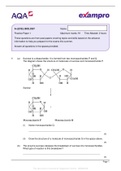
1 (a) Sucrose is a disaccharide. It is formed from two monosaccharides P and Q.
The diagram shows the structure of molecules of sucrose and monosaccharide P.
(i) Name monosaccharide Q.
__________________________________________________________
(1)
(ii) Draw the structure of a molecule of monosaccharide Q in the space above.
(1)
(b) The enzyme sucrase catalyses the breakdown of sucrose into monosaccharides.
What type of reaction is this breakdown?
______________________________________________________________
(1)
Page 1
This document is licensed to Haggerston School - MB260045
,(c) The diagram shows apparatus used in breaking down sucrose. The enzyme
sucrase is fixed to inert beads. Sucrose solution is then passed through the
column.
Describe a biochemical test to find out if the solution collected from the apparatus
contains
(i) the products;
__________________________________________________________
__________________________________________________________
__________________________________________________________
__________________________________________________________
(2)
(ii) the enzyme.
__________________________________________________________
__________________________________________________________
__________________________________________________________
__________________________________________________________
(2)
Page 2
This document is licensed to Haggerston School - MB260045
, (d) Describe how the structures of starch and cellulose molecules are related to their
functions.
_____________________________________________________________
_____________________________________________________________
_____________________________________________________________
_____________________________________________________________
_____________________________________________________________
_____________________________________________________________
_____________________________________________________________
_____________________________________________________________
(5)
[Total 12 marks]
2 The flowchart shows how chloroplasts may be obtained from leaves.
Leaves homogenised by grinding in cold buffer solution
↓
Homogenised leaves filtered. Filtrate centrifuged at low speed
↓ ↓
Supernatant centrifuged
Pellet A
at high speed
↓ ↓
Pellet B containing chloroplast Supernatant C
(a) In the first step in this procedure, the leaves were homogenised by grinding in
cold buffer solution. Explain why
(i) the leaves were homogenised,
__________________________________________________________
__________________________________________________________
(1)
(ii) a buffer solution was used.
__________________________________________________________
__________________________________________________________
__________________________________________________________
__________________________________________________________
(2)
Page 3
This document is licensed to Haggerston School - MB260045
Practice Paper 1 Maximum marks: 91 Time Allowed: 2 hours
These questions are from past papers covering topics and skills based on the advance
information to help you prepare for the exams this summer.
Answer all questions in the spaces provided.
1 (a) Sucrose is a disaccharide. It is formed from two monosaccharides P and Q.
The diagram shows the structure of molecules of sucrose and monosaccharide P.
(i) Name monosaccharide Q.
__________________________________________________________
(1)
(ii) Draw the structure of a molecule of monosaccharide Q in the space above.
(1)
(b) The enzyme sucrase catalyses the breakdown of sucrose into monosaccharides.
What type of reaction is this breakdown?
______________________________________________________________
(1)
Page 1
This document is licensed to Haggerston School - MB260045
,(c) The diagram shows apparatus used in breaking down sucrose. The enzyme
sucrase is fixed to inert beads. Sucrose solution is then passed through the
column.
Describe a biochemical test to find out if the solution collected from the apparatus
contains
(i) the products;
__________________________________________________________
__________________________________________________________
__________________________________________________________
__________________________________________________________
(2)
(ii) the enzyme.
__________________________________________________________
__________________________________________________________
__________________________________________________________
__________________________________________________________
(2)
Page 2
This document is licensed to Haggerston School - MB260045
, (d) Describe how the structures of starch and cellulose molecules are related to their
functions.
_____________________________________________________________
_____________________________________________________________
_____________________________________________________________
_____________________________________________________________
_____________________________________________________________
_____________________________________________________________
_____________________________________________________________
_____________________________________________________________
(5)
[Total 12 marks]
2 The flowchart shows how chloroplasts may be obtained from leaves.
Leaves homogenised by grinding in cold buffer solution
↓
Homogenised leaves filtered. Filtrate centrifuged at low speed
↓ ↓
Supernatant centrifuged
Pellet A
at high speed
↓ ↓
Pellet B containing chloroplast Supernatant C
(a) In the first step in this procedure, the leaves were homogenised by grinding in
cold buffer solution. Explain why
(i) the leaves were homogenised,
__________________________________________________________
__________________________________________________________
(1)
(ii) a buffer solution was used.
__________________________________________________________
__________________________________________________________
__________________________________________________________
__________________________________________________________
(2)
Page 3
This document is licensed to Haggerston School - MB260045