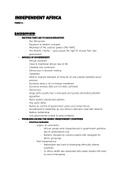
INDEPENDENT AFRICA
TOPIC 2 -
Background
- Factors that led to decolonisation
- Pan Africanism
- Exposure to western concepts
- Weakness of the colonial powers after WW2
- The Atlantic Charter – gave people the right to choose their own
government.
- Models of government
- African socialism
- Close to traditional african way of life
- Classless and communal
- Democracy in decision making
- Capitalism
- Want to improve standard of living for all and provide essential social
services
- Economy relies a lot on foreign investment
- Economy involves state but not state controlled
- Democracy
- Singe party usually had a monopoly and quickly eliminated potential
opposition
- Many leaders abandoned systems
- One party states
- Ruling on control of government, police and armed forces
- Accustomed to leadership by one african chief who ruled with advisors
- Military dictatorship
- Civil governments unable to solve problems
- Problems facing the newly independent countries
- Political problems
- Legacy of colonialism
- African people were inexperienced in government positions
due to authoritarian rule.
- Borders imposed by colonial powers with disregard for
ethnic groupings
- Post-independence
- Nationalism was hard to developing ethnically diverse
countries
- In africa wealth was associated with power, leaders felt need
to enrich themselves
, - Low literacy levels made it hard to educate people politically
(unconcerned with loss of democracy)
- Social problems
- Legacy of colonialism
- Exploited in their own countries and were used to being
workers not leaders
- Post-independence
- No improvement made to education and loss of mission
schooling meant high levels of illiteracy and unskilled
people
- Lack of basic services
- Poor health care
- Social conditions worsened during times of civil war
- Rapid urbanisation meant the development of squatter
camps
- Economic problems
- Legacy of colonialism
- African economies had been developed to suit colonial
needs. African countries exported raw materials and
imported manufactured good, but local african industries
never developed
- emphasis on cash crop farming not subsistence farming
- No secondary industries had ever been developed
- Economy therefore reliant on trade relationships with
colonial powers
- Post-independent
- The drop in demand for raw materials income from trade
- Government tended to spend money on large scale project
which did not benefit the people
- No money spent on agriculture by the government
encourages cash than subsistence farms, which leads to
starvation.
- African leaders borrowing money led to neo-colonialism
- The Congo *maps
- Background
- 1878 to 1959 ruled by King Leopold II, ruled by personal property,
belgium cruel colonial power
- Exploitation of rubber and ivory
- wealthy in palm oil cotton and coffee
- During WW2 african nationalism popular
- Winds of change speech
TOPIC 2 -
Background
- Factors that led to decolonisation
- Pan Africanism
- Exposure to western concepts
- Weakness of the colonial powers after WW2
- The Atlantic Charter – gave people the right to choose their own
government.
- Models of government
- African socialism
- Close to traditional african way of life
- Classless and communal
- Democracy in decision making
- Capitalism
- Want to improve standard of living for all and provide essential social
services
- Economy relies a lot on foreign investment
- Economy involves state but not state controlled
- Democracy
- Singe party usually had a monopoly and quickly eliminated potential
opposition
- Many leaders abandoned systems
- One party states
- Ruling on control of government, police and armed forces
- Accustomed to leadership by one african chief who ruled with advisors
- Military dictatorship
- Civil governments unable to solve problems
- Problems facing the newly independent countries
- Political problems
- Legacy of colonialism
- African people were inexperienced in government positions
due to authoritarian rule.
- Borders imposed by colonial powers with disregard for
ethnic groupings
- Post-independence
- Nationalism was hard to developing ethnically diverse
countries
- In africa wealth was associated with power, leaders felt need
to enrich themselves
, - Low literacy levels made it hard to educate people politically
(unconcerned with loss of democracy)
- Social problems
- Legacy of colonialism
- Exploited in their own countries and were used to being
workers not leaders
- Post-independence
- No improvement made to education and loss of mission
schooling meant high levels of illiteracy and unskilled
people
- Lack of basic services
- Poor health care
- Social conditions worsened during times of civil war
- Rapid urbanisation meant the development of squatter
camps
- Economic problems
- Legacy of colonialism
- African economies had been developed to suit colonial
needs. African countries exported raw materials and
imported manufactured good, but local african industries
never developed
- emphasis on cash crop farming not subsistence farming
- No secondary industries had ever been developed
- Economy therefore reliant on trade relationships with
colonial powers
- Post-independent
- The drop in demand for raw materials income from trade
- Government tended to spend money on large scale project
which did not benefit the people
- No money spent on agriculture by the government
encourages cash than subsistence farms, which leads to
starvation.
- African leaders borrowing money led to neo-colonialism
- The Congo *maps
- Background
- 1878 to 1959 ruled by King Leopold II, ruled by personal property,
belgium cruel colonial power
- Exploitation of rubber and ivory
- wealthy in palm oil cotton and coffee
- During WW2 african nationalism popular
- Winds of change speech