Chemie Ester Klasse 11
Ester (Carboxylic Ester)
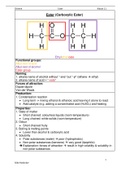
Ethylethanoate
Functional groups:
Alkyl-rest of acid
Alkyl-rest of alcohol
Ester-group
Naming:
1. alkane name of alcohol without “-ane” but “-yl” (ethane → ethyl)
2. alkane name of acid + “-oate”
Forces of attraction:
Dipole-dipole
Van der Waals
Production:
1. Condensation reaction
• Long-term → mixing ethanol & ethanoic acid leaving it alone to react
• Add catalyst (e.g. adding a consentrated acid (H2SO4) and heating
Properties:
1. State of matter
• Short chained: colourless liquids (room temperature)
• Long chained: white solids (room temperature)
2. Odour
• Short chained fruity
3. Boiling & melting points
• Lower than alcohol & carboxylic acid
4. Solubility
• Polar substances (water) → poor (hydrophobic)
• Non-polar substances (benzene) → very good (lipophilic)
➔ Explanation: forces of attraction → result in high volatility & solubility in
non-polar substances
1
Silke Redecker
Ester (Carboxylic Ester)
Ethylethanoate
Functional groups:
Alkyl-rest of acid
Alkyl-rest of alcohol
Ester-group
Naming:
1. alkane name of alcohol without “-ane” but “-yl” (ethane → ethyl)
2. alkane name of acid + “-oate”
Forces of attraction:
Dipole-dipole
Van der Waals
Production:
1. Condensation reaction
• Long-term → mixing ethanol & ethanoic acid leaving it alone to react
• Add catalyst (e.g. adding a consentrated acid (H2SO4) and heating
Properties:
1. State of matter
• Short chained: colourless liquids (room temperature)
• Long chained: white solids (room temperature)
2. Odour
• Short chained fruity
3. Boiling & melting points
• Lower than alcohol & carboxylic acid
4. Solubility
• Polar substances (water) → poor (hydrophobic)
• Non-polar substances (benzene) → very good (lipophilic)
➔ Explanation: forces of attraction → result in high volatility & solubility in
non-polar substances
1
Silke Redecker