Intermolecular Forces
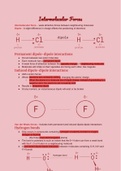
Intermolecular force - weak attractive forces between neighbouring molecules
Dipole - A slight difference in charge effects the positioning of electrons
dipole
Permanent dipole-dipole interactions
● Occurs between two polar molecules
● Each molecule has a permanent dipole
● A weak force of attraction between the opposite charges of neighbouring molecules
● Molecules will rotate so their opposites are facing each other, like magnets
Induced dipole-dipole interactions
● AKA London forces
● Where electrons are constantly shifting, changing the atoms’ charge
○ When the atoms in a molecule are of equal charge, instead of gravitating to a
negative atom the electrons will constantly shift
● Results in temporary dipole
● At any moment, an instantaneous dipole will exist or be broken
Van der Waals forces - Includes both permanent and induced dipole-dipole interactions
Hydrogen bonds
● Only occurs in compounds containing hydrogen covalently bonded to oxygen,
nitrogen or fluorine
○ (the three most electronegative atoms)
● The bond is polarised to such an extent that the δ+ H atom can form a weak bond
with the F, O or N atom in a neighbouring molecule
● A permanent dipole-dipole interaction between molecules containing O-H, N-H and
F-H bonds
Hydrogen bond
Intermolecular force - weak attractive forces between neighbouring molecules
Dipole - A slight difference in charge effects the positioning of electrons
dipole
Permanent dipole-dipole interactions
● Occurs between two polar molecules
● Each molecule has a permanent dipole
● A weak force of attraction between the opposite charges of neighbouring molecules
● Molecules will rotate so their opposites are facing each other, like magnets
Induced dipole-dipole interactions
● AKA London forces
● Where electrons are constantly shifting, changing the atoms’ charge
○ When the atoms in a molecule are of equal charge, instead of gravitating to a
negative atom the electrons will constantly shift
● Results in temporary dipole
● At any moment, an instantaneous dipole will exist or be broken
Van der Waals forces - Includes both permanent and induced dipole-dipole interactions
Hydrogen bonds
● Only occurs in compounds containing hydrogen covalently bonded to oxygen,
nitrogen or fluorine
○ (the three most electronegative atoms)
● The bond is polarised to such an extent that the δ+ H atom can form a weak bond
with the F, O or N atom in a neighbouring molecule
● A permanent dipole-dipole interaction between molecules containing O-H, N-H and
F-H bonds
Hydrogen bond