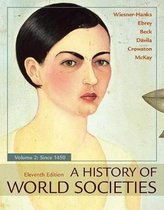
SUMMARY TEXTBOOK A HISTORY OF WORLD SOCIETIES, VOLUME 2 (11TH EDITION 2018)
BY MERRY WIESNER-HANKS ET AL.
CHAPTER 24 – 33
BACHELOR HISTORY - UTRECHT UNIVERSITY
COURSE CODE: GE1V21003
SPRING 2022
,Content
Chapter 24 Ideologies of Change in Europe 1815-1914
Chapter 25 Africa, the Ottoman Empire, and the New Imperialism
Chapter 26 Asia and the Pacific in the Era Of Imperialism
Chapter 27 The Americas in the Age of Liberalism
Chapter 28 World War and Revolution
Chapter 29 Nationalism in Asia
Chapter 30 The Great Depression and World War II
Chapter 31 Decolonization, Revolution and the Cold War
Chapter 32 Liberalization
Chapter 33 The Contemporary World in Historical Perspective
,Chapter 24 Ideologies of Change in Europe 1815-1914
How did the allies fashion a peace settlement in 1815, and what radical ideas emerged
between 1815 and 1848?
After the defeat of Napoleon by the Quadrupel Alliance (Russia, Prussia, Austria and
Great Britain), they concluded at the Congress of Vienna a peace treaty whereby
strong measures were taken against France. The Quadrupel members went there too
agree to meet regularly to keep the peace and
discuss common interests. This leaves a transformation in diplomacy in
see Europe.
Klemens von Metternich (Austria Foreign Minister) formed the in 1815
Holy Alliance jointly with Russia and Prussia. Metternich was very conservative
set. Therefore, he was against liberalism and nationalism.
Liberalism = freedom and equality. These ideas were used for the first time and
defended in 1815. They were idealized in the various revolutions, starting with the
American. The idea of freedom was also intended for the individual; freedom of press,
freedom of speech etc. Liberalism took on more radical competition in the 19th century. So
did you get the doctrine of laissez faire (policy of minimal government interference in the
economic affairs of individuals and society).
Nationalism = a radical new ideology that emerged after 1815. There was an ethnic
group with its own culture. This group had a shared history. the political
ideal was/is to create a territory with fixed, clear boundaries in a
independent nation state. The idea of liberalism (individual freedom) and a free nation
overlapped a lot.
Socialism = a second radical new ideology. This one started in France. early
French socialists shared a disappointment in the outcome of the French
revolution. Due to the rise of the radical movements, they mainly saw the egoistic
individual. They felt the urgency to help the poor, the one where the
living conditions had not improved. The government had to radically change the economy
be reorganized; prices had to be checked and land had to be
regulate. Until 1840, France was the center of socialism, but there was Karl Marx.
, He turned this idea into a modern ideology. According to Marx, one class had
always exploited the other and with the advent of modern industry, society was
divided more clearly than ever before: between the educated and the wealthy
middle class (bourgeois) and the modern working class (proletariat).
Why did revolutions triumph briefly throughout most of Europe in 1848, and why did
they fail?
In the spring of 1848, many people objected to housing and taxes. This one
conflicts were fueled by the new political ideologies, these were born from
disappointments of previous revolutions. These ideologies helped convert this
frustrations to revolutions.
In Great Britain, The Reform Bill of 1832 increased representation in the house of
commons and more people could vote. For the first time, this also allowed
the middle class vote. The New Poor law 1834 caused the poor in
workhouses were housed, clothed and fed. Children who run the workhouse
came in would get some training. In exchange for this care, all the poor
workers have to work several hours a day. There was a lot of protest against this new
measures because there was still a lot of exclusion.
The revolutions in France ended in failure. The middle and the working class
turned against each other. This allowed Napoleon Bonaparte's nephew, Louis Napoleon,
winning a major victory in the December 1848 election.
In central Europe, the conflicts had been exacerbated by the economic crisis. They became
dominated by social elites. The revolution in Austria began in Hungary in 1848, when
the Hungarian nationalists demanded full autonomy. The Coalition of Revolutionary Wax
however not stable enough and weakened and destroyed by national aspirations. In the end
the revolution was crushed by the Habsburgs.
After Austria, Prussia was the largest kingdom in the German Confederation. In 1848
middle class Prussian liberals had the idea to reclassify Prussia as a
liberal constitutional monarchy. King Frederick William IV eventually became the ruler
of the new German nation state. Austria, however, did not agree to this, supported
by Russia, everything was reversed.
BY MERRY WIESNER-HANKS ET AL.
CHAPTER 24 – 33
BACHELOR HISTORY - UTRECHT UNIVERSITY
COURSE CODE: GE1V21003
SPRING 2022
,Content
Chapter 24 Ideologies of Change in Europe 1815-1914
Chapter 25 Africa, the Ottoman Empire, and the New Imperialism
Chapter 26 Asia and the Pacific in the Era Of Imperialism
Chapter 27 The Americas in the Age of Liberalism
Chapter 28 World War and Revolution
Chapter 29 Nationalism in Asia
Chapter 30 The Great Depression and World War II
Chapter 31 Decolonization, Revolution and the Cold War
Chapter 32 Liberalization
Chapter 33 The Contemporary World in Historical Perspective
,Chapter 24 Ideologies of Change in Europe 1815-1914
How did the allies fashion a peace settlement in 1815, and what radical ideas emerged
between 1815 and 1848?
After the defeat of Napoleon by the Quadrupel Alliance (Russia, Prussia, Austria and
Great Britain), they concluded at the Congress of Vienna a peace treaty whereby
strong measures were taken against France. The Quadrupel members went there too
agree to meet regularly to keep the peace and
discuss common interests. This leaves a transformation in diplomacy in
see Europe.
Klemens von Metternich (Austria Foreign Minister) formed the in 1815
Holy Alliance jointly with Russia and Prussia. Metternich was very conservative
set. Therefore, he was against liberalism and nationalism.
Liberalism = freedom and equality. These ideas were used for the first time and
defended in 1815. They were idealized in the various revolutions, starting with the
American. The idea of freedom was also intended for the individual; freedom of press,
freedom of speech etc. Liberalism took on more radical competition in the 19th century. So
did you get the doctrine of laissez faire (policy of minimal government interference in the
economic affairs of individuals and society).
Nationalism = a radical new ideology that emerged after 1815. There was an ethnic
group with its own culture. This group had a shared history. the political
ideal was/is to create a territory with fixed, clear boundaries in a
independent nation state. The idea of liberalism (individual freedom) and a free nation
overlapped a lot.
Socialism = a second radical new ideology. This one started in France. early
French socialists shared a disappointment in the outcome of the French
revolution. Due to the rise of the radical movements, they mainly saw the egoistic
individual. They felt the urgency to help the poor, the one where the
living conditions had not improved. The government had to radically change the economy
be reorganized; prices had to be checked and land had to be
regulate. Until 1840, France was the center of socialism, but there was Karl Marx.
, He turned this idea into a modern ideology. According to Marx, one class had
always exploited the other and with the advent of modern industry, society was
divided more clearly than ever before: between the educated and the wealthy
middle class (bourgeois) and the modern working class (proletariat).
Why did revolutions triumph briefly throughout most of Europe in 1848, and why did
they fail?
In the spring of 1848, many people objected to housing and taxes. This one
conflicts were fueled by the new political ideologies, these were born from
disappointments of previous revolutions. These ideologies helped convert this
frustrations to revolutions.
In Great Britain, The Reform Bill of 1832 increased representation in the house of
commons and more people could vote. For the first time, this also allowed
the middle class vote. The New Poor law 1834 caused the poor in
workhouses were housed, clothed and fed. Children who run the workhouse
came in would get some training. In exchange for this care, all the poor
workers have to work several hours a day. There was a lot of protest against this new
measures because there was still a lot of exclusion.
The revolutions in France ended in failure. The middle and the working class
turned against each other. This allowed Napoleon Bonaparte's nephew, Louis Napoleon,
winning a major victory in the December 1848 election.
In central Europe, the conflicts had been exacerbated by the economic crisis. They became
dominated by social elites. The revolution in Austria began in Hungary in 1848, when
the Hungarian nationalists demanded full autonomy. The Coalition of Revolutionary Wax
however not stable enough and weakened and destroyed by national aspirations. In the end
the revolution was crushed by the Habsburgs.
After Austria, Prussia was the largest kingdom in the German Confederation. In 1848
middle class Prussian liberals had the idea to reclassify Prussia as a
liberal constitutional monarchy. King Frederick William IV eventually became the ruler
of the new German nation state. Austria, however, did not agree to this, supported
by Russia, everything was reversed.