Advanced Finance, Banking and Insurance
Dr. Peter Wierts & Prof. Dirk Schoenmaker
College 1: Functions of the Financial System
Learning objectives course:
- Financial manager: understand financial markets & institutions
- Learning objectives: insight in
the functions and dynamics of financial markets and institutions in the
European context
key policy areas for the financial sector
Learning objectives chapter 1:
Explain the main functions of the financial system
Differentiate between the roles of financial markets and financial
intermediaries
Explain why financial development may stimulate economic growth
Describe the advantages and disadvantages of bank-based and market-based
financial systems
Explain the various corporate governance mechanisms
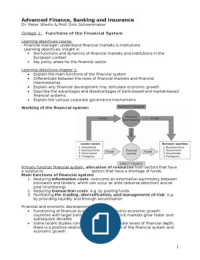
Working of the financial system:
Primary function financial system: allocation of resources from sectors that have
a surplus to sectors that have a shortage of funds.
Main functions of financial system:
1. Reducing information costs: overcome an information asymmetry between
borrowers and lenders, which can occur ex ante (adverse selection) and ex
post (monitoring)
2. Reducing transaction costs, e.g. by pooling funds
3. Facilitating the trading, diversification, and management of risk: e.g.
by providing liquidity and through securitisation
Financial and economic development:
Functioning of financial systems is vitally linked to economic growth:
countries with larger banks and more active stock markets grow faster over
subsequent decades
Some recent studies conclude that at intermediate levels of financial depth,
there is a positive relationship between the size of the financial system and
economic growth
1
, But at high levels of financial depth (private credit ≥ 100% GDP), more
finance is associated with less growth
Government intervention (regulation, policy) is needed:
to protect property rights and to enforce (=afdwingen) contracts
to encourage proper information provision (transparency)
in order to ensure soundness of financial institutions. Savers are unable
to properly evaluate the financial soundness of a financial intermediary.
Governement regulation may prevent financial intermediaries from taking too
much risk. They have incentives to do this
In order to ensure competition via competition policy. Example price fixing
(kartelvorming)
Financial liberalisation: opening up of domestic financial markets to foreign
capital and foreign financial intermediaries
- Allowing foreign capital to freely enter domestic markets:
increases the availability of funds, stimulating investment and economic
growth
enhances competition in the financial system
may lead to a constitution for institutional reforms that stimulate financial
development
Bank- versus market-based
Direct finance: sector in need of funds borrows from another sector via a
financial market
Indirect finance: a financial intermediary obtains funds from savers and
uses these savings to make loans to a sector in need of finance
In most countries, indirect finance is the main route for moving funds from
lenders to borrowers; these countries have a bank-based system, while
countries that rely more on financial markets have a market-based system
- EU is more bank-based (high % bank credit, low % corporate bonds and medium %
stock market)
& US more market based (low % bank credit, high % corporate bonds and stock
market).
- In the EU there is a wide difference between
countries see sheet 15 lecture 1
- Type of activity
Corporate governance:
= The set of mechanisms arranging the relationship between stakeholders of a firm
and the management of the firm.
- Investors can use several tools to ensure that management of a firm acts in their
interest; the most important tools are:
appointment of the board of directors
executive compensation
the market for corporate control: proxy contests (shareholder tries to
persuade other shareholders to act in concert with him), friendly mergers and
takeovers, and hostile takeovers
concentrated holdings
monitoring by financial intermediaries
2
,- Bond and equity markets behave totally different. Debt & bond holders just want
their money back.
- Corporate governance ratings in the EU are high in: Austria, Finland, Germany,
Ireland, Netherlands, Sweden & United Kingdom and low in: Spain, Belgium, Greece
& Portugal.
Rise of shadow banking
Traditional banking model, in which the issuing banks hold loans until they
are repaid, was increasingly replaced by the originate and distribute banking
model: banks pool loans (like mortgages) and then tranch and sell them via
securitisation.
Securitisation led to non-regulated shadow banking system: institutions that
support bank-style maturity transformation – funding of long-term assets with
short-term debt – outside banks and without access to central bank liquidity
backstop;
it includes hedge funds, investment banks, and other non-bank financial
firms.
- Example:
A bank can put its assets in a special purpose vehicule. This SPV contains the loans
and asset-backed securities. Of the ABS they make collateral debt obligations which
contains super senior (AAA), Mezzanine debt (medium) and Equity.
Securitisation:
Long intermediation chains
From “originate and hold” to “originate and distribute”
Leading to long intermediation chains
- Household (MMF shares) Money market fund (Short-term paper) Commercial
bank (Repo) Securities firm (CDO) SPV (MBS) Mortgage pool (Mortgage)
Housholds
Conclusions:
3
, Main task financial system is to allocate funds from surplus sectors to
sectors with a shortage; it performs two functions:
1. Reducing information and transaction costs
2. Facilitating trading, diversification and management of risk
Financial markets and intermediaries provide complementary growth-
enhancing financial services to the economy
* Markets face free-rider problem; intermediaries can better deal with this
* Large institutional investors are strong in corporate governance
Due to several recent changes (securitisation, shadow-banking), market-
based financial intermediaries have become very important
Literatuur: - Chapter 1
Two major changes in the years before the financial crisis in industrial countries
1. Traditional banking model was increasingly replaced by the ‘orginate and
distribute’ banking model, in which banks pool loans and tranch them and
sell them via securities.
2. This securitisation led to a non-regulated shadow banking system. (=
refers to institutions that support bank-style maturity transformation outside
banks and without acces to a central bank liquidity backstop.
College 2: Financial Crises
Learning objectives:
Explain the characteristics of different types of financial crises
Understand the link between sovereign and banking crises
Explain the main theoretical models of banking crises
Understand the pro-cyclicality of the financial system
Explain the main drivers and contagion mechanisms of the 2007-2009
financial crisis
Explain the euro crisis
- The financial crisis was a man-made storm.
- Underlying the housing bubble caused the financial crisis. This the most important
the macro cause. Of course there are a lot of micro causes too.
- Who should prevent a crisis: all together = bank manager (financial sector),
supervisor and central bank.
- In the US dacht de economische experts van de overheid dat na 2000 de economie
door zou gaan met groeien. Dit noemde ze the new economy, waarbij de ict
ontwikkelingen zouden zorgen voor doorgaande groei. Maar uiteindelijk bleek de
economische cyclus van groei en crisis ook dit keer weer van toepassing.
Interessant boek hierover is ‘This time is different’.
Type of crisis
- Banking crisis
(Large) part of a country’s banking system insolvent (heavy losses and/or
banking panics)
Systemic and non-systemic (systemic = country experience large number of
defaults)
- Sovereign crisis
Outright default on debt
4
Dr. Peter Wierts & Prof. Dirk Schoenmaker
College 1: Functions of the Financial System
Learning objectives course:
- Financial manager: understand financial markets & institutions
- Learning objectives: insight in
the functions and dynamics of financial markets and institutions in the
European context
key policy areas for the financial sector
Learning objectives chapter 1:
Explain the main functions of the financial system
Differentiate between the roles of financial markets and financial
intermediaries
Explain why financial development may stimulate economic growth
Describe the advantages and disadvantages of bank-based and market-based
financial systems
Explain the various corporate governance mechanisms
Working of the financial system:
Primary function financial system: allocation of resources from sectors that have
a surplus to sectors that have a shortage of funds.
Main functions of financial system:
1. Reducing information costs: overcome an information asymmetry between
borrowers and lenders, which can occur ex ante (adverse selection) and ex
post (monitoring)
2. Reducing transaction costs, e.g. by pooling funds
3. Facilitating the trading, diversification, and management of risk: e.g.
by providing liquidity and through securitisation
Financial and economic development:
Functioning of financial systems is vitally linked to economic growth:
countries with larger banks and more active stock markets grow faster over
subsequent decades
Some recent studies conclude that at intermediate levels of financial depth,
there is a positive relationship between the size of the financial system and
economic growth
1
, But at high levels of financial depth (private credit ≥ 100% GDP), more
finance is associated with less growth
Government intervention (regulation, policy) is needed:
to protect property rights and to enforce (=afdwingen) contracts
to encourage proper information provision (transparency)
in order to ensure soundness of financial institutions. Savers are unable
to properly evaluate the financial soundness of a financial intermediary.
Governement regulation may prevent financial intermediaries from taking too
much risk. They have incentives to do this
In order to ensure competition via competition policy. Example price fixing
(kartelvorming)
Financial liberalisation: opening up of domestic financial markets to foreign
capital and foreign financial intermediaries
- Allowing foreign capital to freely enter domestic markets:
increases the availability of funds, stimulating investment and economic
growth
enhances competition in the financial system
may lead to a constitution for institutional reforms that stimulate financial
development
Bank- versus market-based
Direct finance: sector in need of funds borrows from another sector via a
financial market
Indirect finance: a financial intermediary obtains funds from savers and
uses these savings to make loans to a sector in need of finance
In most countries, indirect finance is the main route for moving funds from
lenders to borrowers; these countries have a bank-based system, while
countries that rely more on financial markets have a market-based system
- EU is more bank-based (high % bank credit, low % corporate bonds and medium %
stock market)
& US more market based (low % bank credit, high % corporate bonds and stock
market).
- In the EU there is a wide difference between
countries see sheet 15 lecture 1
- Type of activity
Corporate governance:
= The set of mechanisms arranging the relationship between stakeholders of a firm
and the management of the firm.
- Investors can use several tools to ensure that management of a firm acts in their
interest; the most important tools are:
appointment of the board of directors
executive compensation
the market for corporate control: proxy contests (shareholder tries to
persuade other shareholders to act in concert with him), friendly mergers and
takeovers, and hostile takeovers
concentrated holdings
monitoring by financial intermediaries
2
,- Bond and equity markets behave totally different. Debt & bond holders just want
their money back.
- Corporate governance ratings in the EU are high in: Austria, Finland, Germany,
Ireland, Netherlands, Sweden & United Kingdom and low in: Spain, Belgium, Greece
& Portugal.
Rise of shadow banking
Traditional banking model, in which the issuing banks hold loans until they
are repaid, was increasingly replaced by the originate and distribute banking
model: banks pool loans (like mortgages) and then tranch and sell them via
securitisation.
Securitisation led to non-regulated shadow banking system: institutions that
support bank-style maturity transformation – funding of long-term assets with
short-term debt – outside banks and without access to central bank liquidity
backstop;
it includes hedge funds, investment banks, and other non-bank financial
firms.
- Example:
A bank can put its assets in a special purpose vehicule. This SPV contains the loans
and asset-backed securities. Of the ABS they make collateral debt obligations which
contains super senior (AAA), Mezzanine debt (medium) and Equity.
Securitisation:
Long intermediation chains
From “originate and hold” to “originate and distribute”
Leading to long intermediation chains
- Household (MMF shares) Money market fund (Short-term paper) Commercial
bank (Repo) Securities firm (CDO) SPV (MBS) Mortgage pool (Mortgage)
Housholds
Conclusions:
3
, Main task financial system is to allocate funds from surplus sectors to
sectors with a shortage; it performs two functions:
1. Reducing information and transaction costs
2. Facilitating trading, diversification and management of risk
Financial markets and intermediaries provide complementary growth-
enhancing financial services to the economy
* Markets face free-rider problem; intermediaries can better deal with this
* Large institutional investors are strong in corporate governance
Due to several recent changes (securitisation, shadow-banking), market-
based financial intermediaries have become very important
Literatuur: - Chapter 1
Two major changes in the years before the financial crisis in industrial countries
1. Traditional banking model was increasingly replaced by the ‘orginate and
distribute’ banking model, in which banks pool loans and tranch them and
sell them via securities.
2. This securitisation led to a non-regulated shadow banking system. (=
refers to institutions that support bank-style maturity transformation outside
banks and without acces to a central bank liquidity backstop.
College 2: Financial Crises
Learning objectives:
Explain the characteristics of different types of financial crises
Understand the link between sovereign and banking crises
Explain the main theoretical models of banking crises
Understand the pro-cyclicality of the financial system
Explain the main drivers and contagion mechanisms of the 2007-2009
financial crisis
Explain the euro crisis
- The financial crisis was a man-made storm.
- Underlying the housing bubble caused the financial crisis. This the most important
the macro cause. Of course there are a lot of micro causes too.
- Who should prevent a crisis: all together = bank manager (financial sector),
supervisor and central bank.
- In the US dacht de economische experts van de overheid dat na 2000 de economie
door zou gaan met groeien. Dit noemde ze the new economy, waarbij de ict
ontwikkelingen zouden zorgen voor doorgaande groei. Maar uiteindelijk bleek de
economische cyclus van groei en crisis ook dit keer weer van toepassing.
Interessant boek hierover is ‘This time is different’.
Type of crisis
- Banking crisis
(Large) part of a country’s banking system insolvent (heavy losses and/or
banking panics)
Systemic and non-systemic (systemic = country experience large number of
defaults)
- Sovereign crisis
Outright default on debt
4