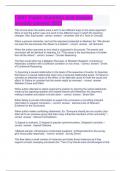
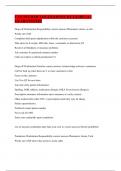
CFA TEST QUESTIONS AND ANSWERS
Standard-setting bodies ANS: professional organizations of accountants and auditors that establish
financial reporting standards
Regulatory Authorities ANS: Government agencies that have the legal authority to enforce compliance
with financial reporting standards
International Organization of Securities Commissions ANS: (1) protect investors (2) ensure the fairness,
efficiency, and transparency of markets (3) reduce systemic risk.
Because of globalization increasing in securities markets: uniform goal of financial regulations across
countries
Form S-1 (Registration Statement) ANS: Registration statement filed prior to the sale of new securities
to the public. The registration statement includes audited financial statements, risk assessment,
underwriter identification, and the estimated amount and use of the offering proceeds.
Form 10-K (Annual Report) ANS: Required annual filing that includes information about the business
and its management, audited financial statements and disclosures, and disclosures about legal matters
involving the firm. Information required in 10-K is similar to that which a firm typically provides in its
annual report to shareholders. However, a firm's annual report is not a substitute for the required 10-K
filing.
Equivalent SEC forms for foreign issuers in the U.S. markets are Form 40-F for Canadian companies and
Form 20-F for other foreign issuers.
Form 10-Q (Quarterly Report) ANS: U.S. firms are required to file this form quarterly, with updated
financial statements (unlike Form 10-K, these statements do not have to be audited) and disclosures
about certain events such as significant legal proceedings or changes in accounting policy. Non-U.S.
companies are typically required to file the equivalent Form 6-K semiannually.
Form DEF-14A ANS: When a company prepares a proxy statement for its shareholders prior to the
annual meeting or other shareholder vote, it also files the statement with the SEC as Form DEF-14A
Form 8-K ANS: Companies must file this form to disclose material events including significant asset
acquisitions and disposals, changes in management or corporate governance, or matters related to its
accountants, its financial statements, or the markets in which its securities trade
Form 144 ANS: A company can issue securities to certain qualified buyers without registering the
securities with the SEC but must notify the SEC that it intends to do so.
Forms 3,4 and 5 ANS: Involve the beneficial ownership of securities by a company's officers and
directors. Analyst can use these filings to learn about purchases and sales of company securities by
corporate insiders.
2 Fundamental Characteristics that make financial information useful ANS: Relevance and Faithful
representation
,4 Characteristics that Enhance Relevance and Faithful Representation ANS: Comparability, Verifiability,
Timeliness, Understandability
Assets ANS: Resources controlled as a result of past transactions that are expected to provide future
economic benefits.
Liabilities ANS: Obligations as a result of past events that are expected to require an outflow of
economic resources.
Equity ANS: The owner's residual interest in the assets after deducting the liabilities
Income ANS: An increase in economic benefits, either increasing assets or decreasing liabilities in a way
that increases owners' equity (but not including contributions by owners). Includes: revenues and gains
Expenses ANS: Decreases in economic benefits, either decreasing assets or increasing liabilities in a way
that decreases owners' equity(but not including distributions to owners). Includes: losses
Measurement Base ANS: includes: historical cost, amortized cost, current cost, net realizable value,
present value, and fair value - help determine which items are reported in the financial statement
General features of financial statements according to IAS No. 1 are: ANS: Fair presentation
Going Concern
Accrual accounting
Consistency
Materiality
Aggregation
No offsetting
Reporting Frequency
Comparative information
Remaining differences of IASB and FASB ANS: - IASB lists income and expenses as performance
elements, while the FASB lists revenues, expenses, gains, losses , and comprehensive income
- Minor differences in the definition of assets (FASB uses the word probable when defining Assets &
Liabilities).
- FASB does not allow the upward revaluation of most assets
For firms that list their shares in the United States but do not use U.S. GAAP or IFRS, they are required
to: ANS: Reconcile their financial statements with U.S. GAAP. Reconciliation is no longer required for
IFRS firms who list their shares in the the U.S.
A Coherent financial reporting framework should exhibit: ANS: Transparency, Comprehensiveness, and
Consistency
Barriers to creating a coherent framework: ANS: issues of valuation, standard setting, and measurement
Which of the following organizations is least likely involved with enforcing compliance with financial
reporting standards?
,A. Financial Conduct Authority
B. Securities and Exchange Commission
C. International Accounting Standards Board ANS: C. The IASB is a standard-setting body.
SEC (U.S.) and the Financial Conduct Authority (United Kingdom) are regulatory authorities
Which of the following most accurately lists a required reporting element that is used to measure a
company's financial position and one that is used to measure a company's performance? ANS: Position:
Assets, Liabilities, Owner's Equity
Performance: Income and Expenses
IAS No. 1 states that financial statements must be presented at least: (how often) ANS: annually
The FASB framework lists: ANS: Revenue, expenses, gains, losses, and comprehensive income related to
financial performance
The IASB framework lists only: ANS: Income and expenses
The income statement is sometimes referred to as: ANS: "Statement of operations"
"Statement of earnings"
or ""Profit and loss statement"
Income Statement Equation (short) ANS: Net Income = Revenues - Expenses
Under IFRS, the income statement can be combined with __________________ and presented as a
single statement of _____________ ____________. ANS: "other comprehensive income"
"comprehensive income"
alternatively can be presented separately
Investors examine a firm's income statement for valuation purposes, while lenders examine the income
statement for : ANS: Information about the firm's ability to make the promised interest and principal
payments on its debt
The amounts reported from the sale of goods and services in the normal course of business ANS:
Revenues
Revenues Less Adjustments for estimated returns and allowances is known as: ANS: Net Revenue
Amounts incurred to generate revenue and include costs of goods sold, operating expenses, interest,
and taxes ANS: Expenses
Grouping expenses by function is sometimes referred to as : ANS: The cost of sales method
Income Statement Equation ANS: Net Income = Revenues - ordinary expenses + other income - other
expenses + gains - losses
If a firm has a controlling interest in a subsidiary, the pro rata share of the the subsidiary's income not
owned by the parent is reported in the parent
, s income statement as the: ANS: Non-controlling interest
Gross Profit ANS: the amount that remains after the direct costs of producing a product or service are
subtracted from revenue
Operating Profit/Income ANS: Subtotal resulting from subtracting Operating Expenses (such as selling,
general, and administrative expenses) from Gross Profit
Under the accrual method of accounting, revenue is recognized when _______ and expenses are
recognized when _________. ANS: earned, incurred
According to IASB, revenue is recognized from the sale of goods when: ANS: 1. risk & reward of
ownership is transferred
2. no continuing control or mgmt over the goods sold
3. revenue can be reliably measured
4. probable flow of economic benefits
5. cost can reliably measured
According to IASB, revenue is recognized from services rendered: ANS: 1. The amount of revenue can be
reliably measured
2. probable flow of economic benefits
3. Stage of completion can be measured
4. Cost incurred and cost of completion can be reliably measured
According to FASB, revenue is recognized in the income statement when: ANS: Realized/realizable and
Earned
The Securities and Exchange Commision (SEC) provides additional guidance by listing 4 criteria to
determine whether revenue should be recognized: ANS: 1. There is evidence of an arrangement
between the buyer and seller
2. The product has been delivered or the service has been rendered
3. The price is determined or determinable
4. The seller is reasonably sure of collecting money
If a firm receives cash before revenue recognition is complete, the firm reports it as : ANS: Unearned
Revenue
Unearned revenue is reported on the balance sheet as a ________________. ANS: Liability
Installment sale ANS: occurs when a firm finances a sale and payments are expected to be received over
an extended period.
If collectibility cannot be reasonably estimated, the installment method is used, if highly uncertain, the
cost recovery method is used, otherwise revenue is recognized at the time of sale using the normal
revenue recognition criteria
Under the installment method, profit is recognized as: ANS: Cash is collected.
Standard-setting bodies ANS: professional organizations of accountants and auditors that establish
financial reporting standards
Regulatory Authorities ANS: Government agencies that have the legal authority to enforce compliance
with financial reporting standards
International Organization of Securities Commissions ANS: (1) protect investors (2) ensure the fairness,
efficiency, and transparency of markets (3) reduce systemic risk.
Because of globalization increasing in securities markets: uniform goal of financial regulations across
countries
Form S-1 (Registration Statement) ANS: Registration statement filed prior to the sale of new securities
to the public. The registration statement includes audited financial statements, risk assessment,
underwriter identification, and the estimated amount and use of the offering proceeds.
Form 10-K (Annual Report) ANS: Required annual filing that includes information about the business
and its management, audited financial statements and disclosures, and disclosures about legal matters
involving the firm. Information required in 10-K is similar to that which a firm typically provides in its
annual report to shareholders. However, a firm's annual report is not a substitute for the required 10-K
filing.
Equivalent SEC forms for foreign issuers in the U.S. markets are Form 40-F for Canadian companies and
Form 20-F for other foreign issuers.
Form 10-Q (Quarterly Report) ANS: U.S. firms are required to file this form quarterly, with updated
financial statements (unlike Form 10-K, these statements do not have to be audited) and disclosures
about certain events such as significant legal proceedings or changes in accounting policy. Non-U.S.
companies are typically required to file the equivalent Form 6-K semiannually.
Form DEF-14A ANS: When a company prepares a proxy statement for its shareholders prior to the
annual meeting or other shareholder vote, it also files the statement with the SEC as Form DEF-14A
Form 8-K ANS: Companies must file this form to disclose material events including significant asset
acquisitions and disposals, changes in management or corporate governance, or matters related to its
accountants, its financial statements, or the markets in which its securities trade
Form 144 ANS: A company can issue securities to certain qualified buyers without registering the
securities with the SEC but must notify the SEC that it intends to do so.
Forms 3,4 and 5 ANS: Involve the beneficial ownership of securities by a company's officers and
directors. Analyst can use these filings to learn about purchases and sales of company securities by
corporate insiders.
2 Fundamental Characteristics that make financial information useful ANS: Relevance and Faithful
representation
,4 Characteristics that Enhance Relevance and Faithful Representation ANS: Comparability, Verifiability,
Timeliness, Understandability
Assets ANS: Resources controlled as a result of past transactions that are expected to provide future
economic benefits.
Liabilities ANS: Obligations as a result of past events that are expected to require an outflow of
economic resources.
Equity ANS: The owner's residual interest in the assets after deducting the liabilities
Income ANS: An increase in economic benefits, either increasing assets or decreasing liabilities in a way
that increases owners' equity (but not including contributions by owners). Includes: revenues and gains
Expenses ANS: Decreases in economic benefits, either decreasing assets or increasing liabilities in a way
that decreases owners' equity(but not including distributions to owners). Includes: losses
Measurement Base ANS: includes: historical cost, amortized cost, current cost, net realizable value,
present value, and fair value - help determine which items are reported in the financial statement
General features of financial statements according to IAS No. 1 are: ANS: Fair presentation
Going Concern
Accrual accounting
Consistency
Materiality
Aggregation
No offsetting
Reporting Frequency
Comparative information
Remaining differences of IASB and FASB ANS: - IASB lists income and expenses as performance
elements, while the FASB lists revenues, expenses, gains, losses , and comprehensive income
- Minor differences in the definition of assets (FASB uses the word probable when defining Assets &
Liabilities).
- FASB does not allow the upward revaluation of most assets
For firms that list their shares in the United States but do not use U.S. GAAP or IFRS, they are required
to: ANS: Reconcile their financial statements with U.S. GAAP. Reconciliation is no longer required for
IFRS firms who list their shares in the the U.S.
A Coherent financial reporting framework should exhibit: ANS: Transparency, Comprehensiveness, and
Consistency
Barriers to creating a coherent framework: ANS: issues of valuation, standard setting, and measurement
Which of the following organizations is least likely involved with enforcing compliance with financial
reporting standards?
,A. Financial Conduct Authority
B. Securities and Exchange Commission
C. International Accounting Standards Board ANS: C. The IASB is a standard-setting body.
SEC (U.S.) and the Financial Conduct Authority (United Kingdom) are regulatory authorities
Which of the following most accurately lists a required reporting element that is used to measure a
company's financial position and one that is used to measure a company's performance? ANS: Position:
Assets, Liabilities, Owner's Equity
Performance: Income and Expenses
IAS No. 1 states that financial statements must be presented at least: (how often) ANS: annually
The FASB framework lists: ANS: Revenue, expenses, gains, losses, and comprehensive income related to
financial performance
The IASB framework lists only: ANS: Income and expenses
The income statement is sometimes referred to as: ANS: "Statement of operations"
"Statement of earnings"
or ""Profit and loss statement"
Income Statement Equation (short) ANS: Net Income = Revenues - Expenses
Under IFRS, the income statement can be combined with __________________ and presented as a
single statement of _____________ ____________. ANS: "other comprehensive income"
"comprehensive income"
alternatively can be presented separately
Investors examine a firm's income statement for valuation purposes, while lenders examine the income
statement for : ANS: Information about the firm's ability to make the promised interest and principal
payments on its debt
The amounts reported from the sale of goods and services in the normal course of business ANS:
Revenues
Revenues Less Adjustments for estimated returns and allowances is known as: ANS: Net Revenue
Amounts incurred to generate revenue and include costs of goods sold, operating expenses, interest,
and taxes ANS: Expenses
Grouping expenses by function is sometimes referred to as : ANS: The cost of sales method
Income Statement Equation ANS: Net Income = Revenues - ordinary expenses + other income - other
expenses + gains - losses
If a firm has a controlling interest in a subsidiary, the pro rata share of the the subsidiary's income not
owned by the parent is reported in the parent
, s income statement as the: ANS: Non-controlling interest
Gross Profit ANS: the amount that remains after the direct costs of producing a product or service are
subtracted from revenue
Operating Profit/Income ANS: Subtotal resulting from subtracting Operating Expenses (such as selling,
general, and administrative expenses) from Gross Profit
Under the accrual method of accounting, revenue is recognized when _______ and expenses are
recognized when _________. ANS: earned, incurred
According to IASB, revenue is recognized from the sale of goods when: ANS: 1. risk & reward of
ownership is transferred
2. no continuing control or mgmt over the goods sold
3. revenue can be reliably measured
4. probable flow of economic benefits
5. cost can reliably measured
According to IASB, revenue is recognized from services rendered: ANS: 1. The amount of revenue can be
reliably measured
2. probable flow of economic benefits
3. Stage of completion can be measured
4. Cost incurred and cost of completion can be reliably measured
According to FASB, revenue is recognized in the income statement when: ANS: Realized/realizable and
Earned
The Securities and Exchange Commision (SEC) provides additional guidance by listing 4 criteria to
determine whether revenue should be recognized: ANS: 1. There is evidence of an arrangement
between the buyer and seller
2. The product has been delivered or the service has been rendered
3. The price is determined or determinable
4. The seller is reasonably sure of collecting money
If a firm receives cash before revenue recognition is complete, the firm reports it as : ANS: Unearned
Revenue
Unearned revenue is reported on the balance sheet as a ________________. ANS: Liability
Installment sale ANS: occurs when a firm finances a sale and payments are expected to be received over
an extended period.
If collectibility cannot be reasonably estimated, the installment method is used, if highly uncertain, the
cost recovery method is used, otherwise revenue is recognized at the time of sale using the normal
revenue recognition criteria
Under the installment method, profit is recognized as: ANS: Cash is collected.