Lecture 1 Migration, acculturation and multiculturalism
Migration
- Know your history. E.g. the Dutch Republic was nicknamed the ‘arc of refugees’- profited
greatly from its openness and tolerance: migration meant new ideas, new ways of
production, increase of wealth.
- Not all migration is international, a lot is internal, ant the distinction between the two is
relative.
- Borders shift over time; due to conquest, war, empire building, collapse. Think of the former
Soviet Union etc.
- Passports are a new invention – only after WWI introduced. Before that there was free
movement of people.
Words are not innocent! The significance of name giving
- John Oliver in the Today Show on ‘Migrant and Refugees’
- Labels that are used in different national contexts to denote
migrants are not coincidental or inconsequential.
- Names mirror ‘us – them’ boundaries and indicate differential levels
of willingness to accommodate international migration.
Diversity and inclusion
- Both concepts are linked to the ideal of social justice as essential pillar of a free and
democratic society. But how do they differ?
- Diversity = focus on differences
- Inclusion = focus on participatory ‘voice’ (not only okay that you are here but we appreciate
that you are here, changing yourself and also you)
Challenge: how do ethnic minorities become integrated?, what kind of policies can facilitate
integration? What does it mean to be ‘integrated’? What is the economic position of ethnic
minorities? How can de economic position of ethnic minorities be improved?
Why do people move? Theorizing
- Economic theories of migration
Push-pull theories (Ravenstein) – 1890s
Neo-classical economics (individualistic & ahistorical, human capital. RAT, dual labor
market, overly simplistic, no role of state) – 1960s
- The historical structural approach – 1970s
World system theory (Marxist theory roots; flaws ‘too much for capital, too little for
‘agency’) – 1970s/1980s
- Migration systems theory and the trend to a new interdisciplinary approach
Prior links between sending & receiving countries, based on colonization, politics, trade,
investments or cultural ties; interaction of macro/micro structures, family (not
individuals & ciommunity are crucial in migration, no single cause) – 1990s
- Transnational theory
Modern technologies, transport and communication make it easier to remain close links
with area of origins circulatory and repeated migration; agency based) – 1990s
Theories of internation migration, ongoing
Challenges:
- The immobility paradox = many do not move! Class and inequality as a factor leading to
access of migration. Existential and emotional aspects of migration
, - Biographies of migrants, life-course stories. Structure & agency factors (structuration model)
Integration = immigrant integration is the process of economic mobility and social inclusion for
newcomers and their children (MPI).
- ‘Integration is the process by which immigrants become accepted into society, both as
individuals and as groups’ (MPI)
- ‘Integration is a process wherein immigrants and the communities in which they settle – both
the individuals and institutions – mutually adapt to one another.’ (MPI)
Assimiliation (integration) as a final outcome:
- Melting pot (assimilation) = you truly become the other.
- Salad bowl (pluralism) = realities coexist, you see all different colors.
- Tex-mex turkey burger (creolization) = you see that its about mixing. Not saying that we
become like the other and live happily together, more of a new mix that is created.
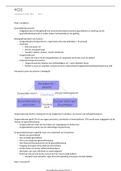
Different levels of integration (Saggar & Somerville, 2012)
- Micro-level: integration outcomes for migrants
(individual)
- Meso-level: successful communities
- Macro-level: national identity
Enculturation = the process by which people learn the
requirements of their surrounding culture and acquire values
and behaviors approriate or necessary in that culture (Grusec &
Hastings, 2007)
Acculturation = the process of cultural and psychological change
that results following meeting between cultures (Sam & Berry, 2010)
Should immigrants assimilate or integrate?
- Research shows that minority cultural identity is an important resource for minority group
members, positively associated with well-being, school success, etc. >>> integration most
adaptive strategy / preferred by immigrants
- In many European countries, the native majority tends to favor assimilation over integration,
requiring immigrants to abandon the origin culture.
National identity
- Acculturation strategy of ‘integration’ implies that national identity can accommodate
cultural diversity
Migration
- Know your history. E.g. the Dutch Republic was nicknamed the ‘arc of refugees’- profited
greatly from its openness and tolerance: migration meant new ideas, new ways of
production, increase of wealth.
- Not all migration is international, a lot is internal, ant the distinction between the two is
relative.
- Borders shift over time; due to conquest, war, empire building, collapse. Think of the former
Soviet Union etc.
- Passports are a new invention – only after WWI introduced. Before that there was free
movement of people.
Words are not innocent! The significance of name giving
- John Oliver in the Today Show on ‘Migrant and Refugees’
- Labels that are used in different national contexts to denote
migrants are not coincidental or inconsequential.
- Names mirror ‘us – them’ boundaries and indicate differential levels
of willingness to accommodate international migration.
Diversity and inclusion
- Both concepts are linked to the ideal of social justice as essential pillar of a free and
democratic society. But how do they differ?
- Diversity = focus on differences
- Inclusion = focus on participatory ‘voice’ (not only okay that you are here but we appreciate
that you are here, changing yourself and also you)
Challenge: how do ethnic minorities become integrated?, what kind of policies can facilitate
integration? What does it mean to be ‘integrated’? What is the economic position of ethnic
minorities? How can de economic position of ethnic minorities be improved?
Why do people move? Theorizing
- Economic theories of migration
Push-pull theories (Ravenstein) – 1890s
Neo-classical economics (individualistic & ahistorical, human capital. RAT, dual labor
market, overly simplistic, no role of state) – 1960s
- The historical structural approach – 1970s
World system theory (Marxist theory roots; flaws ‘too much for capital, too little for
‘agency’) – 1970s/1980s
- Migration systems theory and the trend to a new interdisciplinary approach
Prior links between sending & receiving countries, based on colonization, politics, trade,
investments or cultural ties; interaction of macro/micro structures, family (not
individuals & ciommunity are crucial in migration, no single cause) – 1990s
- Transnational theory
Modern technologies, transport and communication make it easier to remain close links
with area of origins circulatory and repeated migration; agency based) – 1990s
Theories of internation migration, ongoing
Challenges:
- The immobility paradox = many do not move! Class and inequality as a factor leading to
access of migration. Existential and emotional aspects of migration
, - Biographies of migrants, life-course stories. Structure & agency factors (structuration model)
Integration = immigrant integration is the process of economic mobility and social inclusion for
newcomers and their children (MPI).
- ‘Integration is the process by which immigrants become accepted into society, both as
individuals and as groups’ (MPI)
- ‘Integration is a process wherein immigrants and the communities in which they settle – both
the individuals and institutions – mutually adapt to one another.’ (MPI)
Assimiliation (integration) as a final outcome:
- Melting pot (assimilation) = you truly become the other.
- Salad bowl (pluralism) = realities coexist, you see all different colors.
- Tex-mex turkey burger (creolization) = you see that its about mixing. Not saying that we
become like the other and live happily together, more of a new mix that is created.
Different levels of integration (Saggar & Somerville, 2012)
- Micro-level: integration outcomes for migrants
(individual)
- Meso-level: successful communities
- Macro-level: national identity
Enculturation = the process by which people learn the
requirements of their surrounding culture and acquire values
and behaviors approriate or necessary in that culture (Grusec &
Hastings, 2007)
Acculturation = the process of cultural and psychological change
that results following meeting between cultures (Sam & Berry, 2010)
Should immigrants assimilate or integrate?
- Research shows that minority cultural identity is an important resource for minority group
members, positively associated with well-being, school success, etc. >>> integration most
adaptive strategy / preferred by immigrants
- In many European countries, the native majority tends to favor assimilation over integration,
requiring immigrants to abandon the origin culture.
National identity
- Acculturation strategy of ‘integration’ implies that national identity can accommodate
cultural diversity