
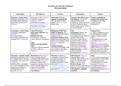
A-Level Law- Unit Two: Defences
Summary Notes
Intoxication Self-Defence Insanity Automatism Duress
Voluntary + basic intent- Protection of self- (Palmer) Used when D is not Common law offence and D feels compelled to
Voluntary intoxication (Allen) Protection of another- capable of forming MR full defence- If it can be perform the criminal act.
For basic intent, voluntary (Buckley v DPP) Can’t be used for strict argued if actions are Available for all crimes
intoxication will fail (DPP v Protection of property- s.5 liability- (DPP v H (1997)) involuntary. Comes about as except murder
Majewski) Criminal Damage Act 1971 Rarely used a result of external cause Full defence
Prevention of a crime- s.3 which causes loss of control
Criminal Law Act 1967 or consciousness
Involuntary + basic intent- Court Procedure- M'Naghten (1843) Test- Test- Graham Test-
Involuntary intoxication Who raises defence- The Defect of Reason- D’s Involuntary- Mind is not 1- Was D impelled to act as
(Hardie) defendant power of reasoning must be controlling limbs in a he did because he faced
For a basic intent, Burden of Proof- impaired (Clarke) purposeful manner. Must be death or serious physical
involuntary intoxication will Prosecution -> prove D Caused by disease of the a loss of self-control. injury?
succeed (DPP v Majewski) wasn’t acting in self-defence mind- Must cause defect of Done by muscle without Psychological harm does
reason can be either mental control of mind or done by not suffice (Baker and
Test- (Burgess) or physical person not conscious of Wilkins)
Need to use reasonable (Kemp) what he is doing (Bratty) Other form of threat will be
force- D does not know: Total lack of awareness disregarded but a mitigating
Using an objective standard The nature and quality of his (A.G. Ref (no.2 of 1992)) factor (Valderrama-Vega)
so down to the jury act or what he was doing External cause- i.e blow to Must be connection with the
(Buckley) was wrong (Windle) head/ sneezing/ threats made to accused
sleepwalking(Hill v Baxter) and offence committed(Cole)
Voluntary + specific intent- Must look at- Not part of Outcome- If defence is Self-induced- Bailey- If Cont-
Voluntary intoxication (Allen) test but should also be successful- D will be found external factor is self- 2- If so, did he respond as a
For specific intent, voluntary considered:Should/Could D not guilty by reason of induced, defence cannot be sober person of reasonable
intoxication may work (DPP have retreated- (McInnes) insanity and receive a used. For specific intent firmness sharing the
v Majewski) (D takes himself to the hospital order with no time defence can be used characteristics of D would
Defence will be successful dangerous situation(Malnik)) limit under Criminal Drink or drugs- If D have done? (Bowen)
so crime is dropped to basic Did D honestly believe his Procedure (Insanity and doesn’t know it would lead to Immediacy of threat and
intent and conviction on actions were justified unfitness to plead) Act 1991 automa can be used(Hardie) possible escape (Gill)
recklessness can be (Gladstone Williams) amended by s.5 Criminal Full defence- complete Self-induced duress (Sharp)
secured (Lipman) Full defence Procedure (Insanity)Act1994 acquittal Full Defence
Summary Notes
Intoxication Self-Defence Insanity Automatism Duress
Voluntary + basic intent- Protection of self- (Palmer) Used when D is not Common law offence and D feels compelled to
Voluntary intoxication (Allen) Protection of another- capable of forming MR full defence- If it can be perform the criminal act.
For basic intent, voluntary (Buckley v DPP) Can’t be used for strict argued if actions are Available for all crimes
intoxication will fail (DPP v Protection of property- s.5 liability- (DPP v H (1997)) involuntary. Comes about as except murder
Majewski) Criminal Damage Act 1971 Rarely used a result of external cause Full defence
Prevention of a crime- s.3 which causes loss of control
Criminal Law Act 1967 or consciousness
Involuntary + basic intent- Court Procedure- M'Naghten (1843) Test- Test- Graham Test-
Involuntary intoxication Who raises defence- The Defect of Reason- D’s Involuntary- Mind is not 1- Was D impelled to act as
(Hardie) defendant power of reasoning must be controlling limbs in a he did because he faced
For a basic intent, Burden of Proof- impaired (Clarke) purposeful manner. Must be death or serious physical
involuntary intoxication will Prosecution -> prove D Caused by disease of the a loss of self-control. injury?
succeed (DPP v Majewski) wasn’t acting in self-defence mind- Must cause defect of Done by muscle without Psychological harm does
reason can be either mental control of mind or done by not suffice (Baker and
Test- (Burgess) or physical person not conscious of Wilkins)
Need to use reasonable (Kemp) what he is doing (Bratty) Other form of threat will be
force- D does not know: Total lack of awareness disregarded but a mitigating
Using an objective standard The nature and quality of his (A.G. Ref (no.2 of 1992)) factor (Valderrama-Vega)
so down to the jury act or what he was doing External cause- i.e blow to Must be connection with the
(Buckley) was wrong (Windle) head/ sneezing/ threats made to accused
sleepwalking(Hill v Baxter) and offence committed(Cole)
Voluntary + specific intent- Must look at- Not part of Outcome- If defence is Self-induced- Bailey- If Cont-
Voluntary intoxication (Allen) test but should also be successful- D will be found external factor is self- 2- If so, did he respond as a
For specific intent, voluntary considered:Should/Could D not guilty by reason of induced, defence cannot be sober person of reasonable
intoxication may work (DPP have retreated- (McInnes) insanity and receive a used. For specific intent firmness sharing the
v Majewski) (D takes himself to the hospital order with no time defence can be used characteristics of D would
Defence will be successful dangerous situation(Malnik)) limit under Criminal Drink or drugs- If D have done? (Bowen)
so crime is dropped to basic Did D honestly believe his Procedure (Insanity and doesn’t know it would lead to Immediacy of threat and
intent and conviction on actions were justified unfitness to plead) Act 1991 automa can be used(Hardie) possible escape (Gill)
recklessness can be (Gladstone Williams) amended by s.5 Criminal Full defence- complete Self-induced duress (Sharp)
secured (Lipman) Full defence Procedure (Insanity)Act1994 acquittal Full Defence


