VCE Lesson 11 -
Emphysema and Pneumonia
NRSG 2570 Multisystem
Disorders
,Question 1
Not yet graded / 1 pts
Exercise 1 - Writing Activity
This exercise will take approximately 20 minutes to complete.
Exercise 1 - Question 1
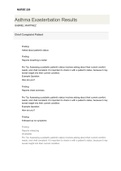
To which categories of lung disease does emphysema belong?
Your Answer:
It is in the chronic obstructive pulmonary disease category.
Chronic airflow limitation (CAL)
Chronic obstructive pulmonary disease (COPD)
Question 2
Not yet graded / 1 pts
Exercise 1 - Question 2
Briefly describe the pathophysiology of emphysema.
Your Answer:
Emphysema is pathologically defined as an abnormal permanent enlargement of air spaces
distal to the terminal bronchioles, accompanied by the destruction of alveolar walls and
without obvious fibrosis. This process leads to reduced gas exchange, changes in airway
dynamics that impair expiratory airflow, and progressive air trapping.
Protease enzymes, normally present to destroy and eliminate particles and organisms inhaled
during breathing, are present in higher-than-normal levels. They damage the alveoli and small
airways by breaking down elastin. The alveolar sacs lose their elasticity and the small airways
collapse or narrow. Some alveoli are destroyed and others become large and flabby with
decreased area for effective gas exchange. An increased amount of air becomes trapped in the
lungs, caused by loss of elastic recoil in the alveolar walls, overstretching and enlargement of
, the alveoli into air-filled spaces called bullae, and collapse of small airways (bronchioles). These
changes greatly increase the work of breathing. The hyperinflated lung flattens the diaphragm,
weakening the effect of the muscle. Hence the patient must use accessory muscles (neck, chest
wall, and abdomen) to breath. The increased effort increases oxygen demand, making the
patient work harder and resulting in an "air hunger" sensation. Gas exchange is also affected by
the increased work of breathing and loss of alveolar tissue.
Question 3
Not yet graded / 1 pts
Exercise 1 - Question 3
Briefly describe the pathophysiology of pneumonia.
Your Answer:
Pneumonia can be transmitted when airborne microbes from an infected indi-vidual are inhaled
by someone else. However, most instances of pneumonia are attributable to self-infection with
one or more types of microbes that originate in the nose and mouth. In healthy people, typical
upper airway bacterial residents such as Streptococcus pneumoniae (commonly referred to as
“pneumococcus”) and Hemophilus influenzae are the most common bacteria causing
community-acquired pneumonia. Hospital-acquired pneumonia is usually caused by more
resistant bacteria, such as Staphylococcus aureus, Klebsiella pneumoniae, Pseudomonas
aeruginosa, and Escherichia coli. Individuals with a serious impairment of their immune system
become susceptible to pneumonia caused by so-called “opportunistic” microbes, such as
certain fungi, viruses, and bacte-ria related to tuberculosis (mycobacteria), that would not
ordinarily cause disease in normal individuals.
Pneumonia is an excess of fluid in the lungs resulting from an inflammatory process. The
inflammation occurs in the interstitial spaces, the alveoli, and often the bronchioles. The
process of pneumonia begins when organisms penetrate the airway mucosa and multiply in the
alveolar spaces. White blood cells migrate to the area of infection, causing local capillary leak,
edema, and exudate. These fluids collect in and around the alveoli and the alveolar walls
thicken. RBCs and fibrin move into the alveoli. The capillary leak spreads the infection to other
areas of the lung. The fibrin and edema of inflammation stiffen the lung, causing decreased lung
compliance and a decline in the vital capacity. Alveolar collapse (atelectasis) further reduces the
ability of the lungs to oxygenate the blood moving through it. As a result, arterial oxygen level
fall, causing hypoxemia.
Question 4
0. pts
Emphysema and Pneumonia
NRSG 2570 Multisystem
Disorders
,Question 1
Not yet graded / 1 pts
Exercise 1 - Writing Activity
This exercise will take approximately 20 minutes to complete.
Exercise 1 - Question 1
To which categories of lung disease does emphysema belong?
Your Answer:
It is in the chronic obstructive pulmonary disease category.
Chronic airflow limitation (CAL)
Chronic obstructive pulmonary disease (COPD)
Question 2
Not yet graded / 1 pts
Exercise 1 - Question 2
Briefly describe the pathophysiology of emphysema.
Your Answer:
Emphysema is pathologically defined as an abnormal permanent enlargement of air spaces
distal to the terminal bronchioles, accompanied by the destruction of alveolar walls and
without obvious fibrosis. This process leads to reduced gas exchange, changes in airway
dynamics that impair expiratory airflow, and progressive air trapping.
Protease enzymes, normally present to destroy and eliminate particles and organisms inhaled
during breathing, are present in higher-than-normal levels. They damage the alveoli and small
airways by breaking down elastin. The alveolar sacs lose their elasticity and the small airways
collapse or narrow. Some alveoli are destroyed and others become large and flabby with
decreased area for effective gas exchange. An increased amount of air becomes trapped in the
lungs, caused by loss of elastic recoil in the alveolar walls, overstretching and enlargement of
, the alveoli into air-filled spaces called bullae, and collapse of small airways (bronchioles). These
changes greatly increase the work of breathing. The hyperinflated lung flattens the diaphragm,
weakening the effect of the muscle. Hence the patient must use accessory muscles (neck, chest
wall, and abdomen) to breath. The increased effort increases oxygen demand, making the
patient work harder and resulting in an "air hunger" sensation. Gas exchange is also affected by
the increased work of breathing and loss of alveolar tissue.
Question 3
Not yet graded / 1 pts
Exercise 1 - Question 3
Briefly describe the pathophysiology of pneumonia.
Your Answer:
Pneumonia can be transmitted when airborne microbes from an infected indi-vidual are inhaled
by someone else. However, most instances of pneumonia are attributable to self-infection with
one or more types of microbes that originate in the nose and mouth. In healthy people, typical
upper airway bacterial residents such as Streptococcus pneumoniae (commonly referred to as
“pneumococcus”) and Hemophilus influenzae are the most common bacteria causing
community-acquired pneumonia. Hospital-acquired pneumonia is usually caused by more
resistant bacteria, such as Staphylococcus aureus, Klebsiella pneumoniae, Pseudomonas
aeruginosa, and Escherichia coli. Individuals with a serious impairment of their immune system
become susceptible to pneumonia caused by so-called “opportunistic” microbes, such as
certain fungi, viruses, and bacte-ria related to tuberculosis (mycobacteria), that would not
ordinarily cause disease in normal individuals.
Pneumonia is an excess of fluid in the lungs resulting from an inflammatory process. The
inflammation occurs in the interstitial spaces, the alveoli, and often the bronchioles. The
process of pneumonia begins when organisms penetrate the airway mucosa and multiply in the
alveolar spaces. White blood cells migrate to the area of infection, causing local capillary leak,
edema, and exudate. These fluids collect in and around the alveoli and the alveolar walls
thicken. RBCs and fibrin move into the alveoli. The capillary leak spreads the infection to other
areas of the lung. The fibrin and edema of inflammation stiffen the lung, causing decreased lung
compliance and a decline in the vital capacity. Alveolar collapse (atelectasis) further reduces the
ability of the lungs to oxygenate the blood moving through it. As a result, arterial oxygen level
fall, causing hypoxemia.
Question 4
0. pts