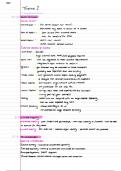
Experimental method
Experime - Manipulation of an IV to measure the effect on the DV
ntal
method
Lab - Highly controlled environment
experime - Manipulate IV and record effect on DV
nt - Strict control over extraneous variables = high internal validity by
ensuring the change in DV is the result of the IV
- High control = easier to replicate
- Lacks generalisability due to artificial tasks = low ecological and
external validity and mundane realism
- Demand characteristics
Field - Highly controlled environment
experime - Manipulate IV and record effect on DV
nt - Strict control over extraneous variables = high internal validity by
ensuring the change in DV is the result of the IV
- High control = easier to replicate
- Lacks generalisability due to artificial tasks = low ecological and
external validity and mundane realism
- Demand characteristics
Natural - Pre-existing IV which could change without the researcher who just
experime measures the effect on the DV
nt - Opportunity for unethical research
- High external and ecological validity
- Rare, limiting generalisability
- Conditions can’t be randomly allocated reducing the clarity of effect
on the IV and DV and makes research socially sensitive
Quasi - IV based on pre-existing differences between people – simply exists
experime and no manipulation is needed e.g. age, gender, anxiety
nt - Controlled conditions = high internal validity
- Cofounding variables can arise from lack of random allocation
Observational techniques
Naturalis - Setting behaviour would normally occur
tic - High external validity as findings generalise to everyday life
- Issues with replication because lack of control
- Control over extraneous variables is difficult
Controlle - Structured environment where some variables can be managed
d - Manipulates variables
- E.g. Strange Situation
- Control over extraneous variables = high internal validity
- Easier replication
- Low internal validity, restricting generalisability to real life
Covert - Without participant knowledge or consent
- Removes participant reactivity = natural behaviours and less risk of
demand characteristics
- Ethical issues = privacy and lack of informed consent
Overt - With participant knowledge or consent
- Ethical
- May produce unnatural behaviours, increased risk of demand
characteristics
Participa - Researcher becomes member of observed group
, nt - Increased insight into behaviour which may increase validity
- Loses objectivity if they identify too strongly with who they’re
studying
Non- - Researcher remains outside of observed group
participa - Maintains objective psychological distance as they don’t get too
nt involved or influence the findings
- May lose valuable insights
Self-report methods
Self-report - Involve participants explaining/stating feelings, opinions,
methods behaviours related to a topic
- Insight into reasons behind behaviour
Questionna - Pre-determined questions used to assess thoughts or experiences
ires - Can assess the DV
- Large sample = cost-effective
- Researcher doesn’t need to be present
- Closed questions easy to analyse
- Open questions provide depth
- Social desirability bias
- Demand characteristics
- Acquiescence bias may skew data
Interviews - Interviewer asks set of questions to assess interviewees thoughts
or experiences
Structured
- Pre-determined, fixed order, no deviation from questions
- Easy replication
- Standardised
- Lack of deviation is frustrating if more detail is needed
Unstructured
- No set questions
- Discuss general topic, participants allowed to elaborate their
answers
- Flexibility increases insight
- Difficult to analyse as there may be irrelevant information
- Social desirability bias – establish rapport to remove
Correlations
Correlation - Investigates association between two co-variables
s - Shows strength and direction of association between the variables
- Experiments manipulate the IV to measure the effect on the DV =
change on one variable
- Unlike experiments, correlations do not involve manipulation =
cannot establish cause and effect
- Useful tool allowing researchers to investigate ideas and make
suggestions for future research
- Quick and economical – no need for controlled environment, often
uses secondary data
- Can’t establish cause and affect
- Third variable may cause the correlation
- Often misinterpreted
, Content analysis
Content - Enables indirect study of behaviour by examining communications
analysis - Coding involves analysing communication by identifying the
occurrences of the categories e.g. counting the number of times a
word appears in a communication
- Use of secondary data avoids ethical issues = high external
validity
- Quantitative data = easy to analyse and collect
- Indirect study = may be analysed out of context
- Researcher bias – may only tally up words that support their
research, ignoring those that contradict
Case studies
Case - In-depth investigation into one group, institution or event
studies - Qualitative data
- Often longitudinal
- In-depth – increases understanding
- Gathers range of data
- Opportunity to conduct research
- Idiographic – used to generate future hypotheses
- Lacks generalisability – unique (low external validity), individual
differences, often representative samples
- Longitudinal can be time consuming
- Qualitative data hard to analyse
- Poor reliability due to lack of replication – can ensure inter-rater
reliability
Aims and hypotheses
Aim - General statement of what the researcher intends to investigate
- Purpose of the study
- Narrow the focus of the research to produce an aim, often
developed through theories
Hypothese - Clear, precise, testable statement that states the relationship
s between the variables to be investigated
- A hypothesis is a proposed explanation of something that has to
be verified and tested before it can be widely accepted as fact
while aim is the goal or the purpose of the process
- Ensure the IV and DV are clear and measurable
- State the relationship between the IV and the DV
- Select the appropriate hypothesis (directional/non-directional)
- E.g. of directional/one-tailed hypothesis – children who score over
50 on the confidence scale obey more instructions than children
who score under 50
- E.g. of a non-directional/two-tailed hypothesis – children who score
over 50 on the confidence scale differ from those who score below
50 in terms of how much they obeyed the teacher
Sampling
Experime - Manipulation of an IV to measure the effect on the DV
ntal
method
Lab - Highly controlled environment
experime - Manipulate IV and record effect on DV
nt - Strict control over extraneous variables = high internal validity by
ensuring the change in DV is the result of the IV
- High control = easier to replicate
- Lacks generalisability due to artificial tasks = low ecological and
external validity and mundane realism
- Demand characteristics
Field - Highly controlled environment
experime - Manipulate IV and record effect on DV
nt - Strict control over extraneous variables = high internal validity by
ensuring the change in DV is the result of the IV
- High control = easier to replicate
- Lacks generalisability due to artificial tasks = low ecological and
external validity and mundane realism
- Demand characteristics
Natural - Pre-existing IV which could change without the researcher who just
experime measures the effect on the DV
nt - Opportunity for unethical research
- High external and ecological validity
- Rare, limiting generalisability
- Conditions can’t be randomly allocated reducing the clarity of effect
on the IV and DV and makes research socially sensitive
Quasi - IV based on pre-existing differences between people – simply exists
experime and no manipulation is needed e.g. age, gender, anxiety
nt - Controlled conditions = high internal validity
- Cofounding variables can arise from lack of random allocation
Observational techniques
Naturalis - Setting behaviour would normally occur
tic - High external validity as findings generalise to everyday life
- Issues with replication because lack of control
- Control over extraneous variables is difficult
Controlle - Structured environment where some variables can be managed
d - Manipulates variables
- E.g. Strange Situation
- Control over extraneous variables = high internal validity
- Easier replication
- Low internal validity, restricting generalisability to real life
Covert - Without participant knowledge or consent
- Removes participant reactivity = natural behaviours and less risk of
demand characteristics
- Ethical issues = privacy and lack of informed consent
Overt - With participant knowledge or consent
- Ethical
- May produce unnatural behaviours, increased risk of demand
characteristics
Participa - Researcher becomes member of observed group
, nt - Increased insight into behaviour which may increase validity
- Loses objectivity if they identify too strongly with who they’re
studying
Non- - Researcher remains outside of observed group
participa - Maintains objective psychological distance as they don’t get too
nt involved or influence the findings
- May lose valuable insights
Self-report methods
Self-report - Involve participants explaining/stating feelings, opinions,
methods behaviours related to a topic
- Insight into reasons behind behaviour
Questionna - Pre-determined questions used to assess thoughts or experiences
ires - Can assess the DV
- Large sample = cost-effective
- Researcher doesn’t need to be present
- Closed questions easy to analyse
- Open questions provide depth
- Social desirability bias
- Demand characteristics
- Acquiescence bias may skew data
Interviews - Interviewer asks set of questions to assess interviewees thoughts
or experiences
Structured
- Pre-determined, fixed order, no deviation from questions
- Easy replication
- Standardised
- Lack of deviation is frustrating if more detail is needed
Unstructured
- No set questions
- Discuss general topic, participants allowed to elaborate their
answers
- Flexibility increases insight
- Difficult to analyse as there may be irrelevant information
- Social desirability bias – establish rapport to remove
Correlations
Correlation - Investigates association between two co-variables
s - Shows strength and direction of association between the variables
- Experiments manipulate the IV to measure the effect on the DV =
change on one variable
- Unlike experiments, correlations do not involve manipulation =
cannot establish cause and effect
- Useful tool allowing researchers to investigate ideas and make
suggestions for future research
- Quick and economical – no need for controlled environment, often
uses secondary data
- Can’t establish cause and affect
- Third variable may cause the correlation
- Often misinterpreted
, Content analysis
Content - Enables indirect study of behaviour by examining communications
analysis - Coding involves analysing communication by identifying the
occurrences of the categories e.g. counting the number of times a
word appears in a communication
- Use of secondary data avoids ethical issues = high external
validity
- Quantitative data = easy to analyse and collect
- Indirect study = may be analysed out of context
- Researcher bias – may only tally up words that support their
research, ignoring those that contradict
Case studies
Case - In-depth investigation into one group, institution or event
studies - Qualitative data
- Often longitudinal
- In-depth – increases understanding
- Gathers range of data
- Opportunity to conduct research
- Idiographic – used to generate future hypotheses
- Lacks generalisability – unique (low external validity), individual
differences, often representative samples
- Longitudinal can be time consuming
- Qualitative data hard to analyse
- Poor reliability due to lack of replication – can ensure inter-rater
reliability
Aims and hypotheses
Aim - General statement of what the researcher intends to investigate
- Purpose of the study
- Narrow the focus of the research to produce an aim, often
developed through theories
Hypothese - Clear, precise, testable statement that states the relationship
s between the variables to be investigated
- A hypothesis is a proposed explanation of something that has to
be verified and tested before it can be widely accepted as fact
while aim is the goal or the purpose of the process
- Ensure the IV and DV are clear and measurable
- State the relationship between the IV and the DV
- Select the appropriate hypothesis (directional/non-directional)
- E.g. of directional/one-tailed hypothesis – children who score over
50 on the confidence scale obey more instructions than children
who score under 50
- E.g. of a non-directional/two-tailed hypothesis – children who score
over 50 on the confidence scale differ from those who score below
50 in terms of how much they obeyed the teacher
Sampling