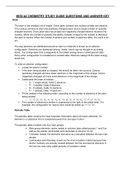
HESI A2 CHEMISTRY STUDY GUIDE QUESTIONS AND ANSWER KEY
HESI A2 CHEMISTRY STUDY GUIDE QUESTIONS AND ANSWER KEY Atom The atom is the smallest unit of matter. Every atom contains one nucleus at least one electron. The nucleus contains at least one positively charged proton and an equal number of neutrally charged neutrons. Every atom also has at least one negatively charged electron bound to the nucleus. When the number of protons (the atomic number) is equal to the number of electrons, the atom is neutral. When the number of protons and number of electrons differ, the result is an ion. The way electrons are distributed around an atom or molecule is known as an electron configuration. Electrons are distributed among “shells” which may be thought of as energy levels. The configuration that corresponds to the lowest energy level is called ground state. Every other configuration is considered an excited state. Electrons always fill the lower energy levels first. To write an electron configuration: Locate the atomic number If the atom being studied is charged, this should be taken into account. Cations (positively charged) will have fewer electrons in the magnitude of the charge. Anions (negatively charged) will have extra electrons in the magnitude of the charge. Understand the order of orbitals: o S – 1 single orbital, holds 2 electrons o P – 3 orbitals, holds 6 electrons o D – 5 orbitals, holds 10 electrons o F – 7 orbitals, holds 14 electrons Fill the orbitals in the following order, according to the number of electrons of the atom being studied. o 1s, 2s, 2p, 3s, 3p, 4s, 3d, 4p, 5s, 4d, 5p, 6s, 4f, 5d, 6p, 7s, 5f, 6d, 7p, 8s. The number of electrons is written in superscript to the right of the orbital letter. For example, the configuration for neutral neon would be written as 1s2 2s2 2p6. Periodic Table The periodic table contains the most important information about all known elements. An element is a substance that is composed purely from one type of atom. The periodic table is broken into four main groups. Main group elements: active metals in columns (also called groups) 1 and 2 as well as the metals, semimetals and nonmetals in columns 13-18. Transition metals: the elements that serve as a transition between the two main groups Lanthanides and Actinides: known as the inner transition metals because their atomic numbers are actually located between the first and second elements in the last two rows (also called periods) of transition metals. 3 | P a g e Electronegativity is an important concept in chemistry and can be charted predictably across the periodic table. Electronegativity is an atom’s measure of attraction for electrons. Electronegativity increases from bottom to top within groups Electronegativity increases from left to right across periods Additional important information about each element can be gathered from the periodic table: The number of protons in an atom will always determine what element it is from. The number of protons will always be the same for all atoms from the same element. The number of protons is called the atomic number. The number of electrons, in a neutral atom, is equal to the number of protons. If the atom is an ion, the number of electrons will vary. The number of neutrons in an atom can also vary. If an atom has a different number of neutrons, it is called an isotope. The mass number is equal to the number of protons plus the number of neutrons. In order to calculate the number of neutrons, subtract the atomic mass minus the atomic number. The relative atomic mass, also called the atomic weight, is an average of the atomic masses of all the different isotopes in a sample. Example: Hydrogen’s chemical symbol is H. Its atomic number is 1 and atomic weight is 1.00794. This shows that there are some isotopes of hydrogen. A neutral hydrogen atom would have a mass of 1. Atomic Number Each element has its own atomic number, which is based on the number of protons in an atom. The number of protons will always remain the same for an element. In a neutral atom, the number of protons is equal to the number of electrons. The number of electrons can change based on
Escuela, estudio y materia
- Institución
- Hesi A2
- Grado
- Hesi A2
Información del documento
- Subido en
- 30 de mayo de 2022
- Número de páginas
- 54
- Escrito en
- 2021/2022
- Tipo
- OTRO
- Personaje
- Desconocido
Temas
-
hesi a2 chemistry study guide questions and answer key atom the atom is the smallest unit of matter every atom contains one nucleus at least one electron the nucleus contains at least one positively

Documento también disponible en un lote